Strength Training for Children and Teenagers: What the Evidence Says

Strength training is one of the most misunderstood subjects in youth sport. Ask a club manager, a school sports coordinator or a parent whether an eleven-year-old should be allowed near a loaded barbell and you will still hear the same objections: it stunts growth, it damages joints, it is for adults only. The scientific literature says something very different. Used properly, resistance training is one of the safest and most productive forms of activity available to children and adolescents, and it belongs in school programmes, clubs and municipal facilities alike.
This guide sets out what the evidence supports, where the real risks lie, how to programme training by age group, and what that means for the equipment a facility actually needs.
Why physical activity matters for young people
A higher dose of exercise builds physical fitness, helps young people keep body weight at an appropriate level, is associated with better learning outcomes and raises self-esteem. The World Health Organization recommends that people aged 5 to 18 accumulate 60 minutes of moderate-intensity physical activity every day.
Where strength work is concerned, it is still common to hear that this kind of activity produces more frequent injuries and disrupts normal development, for instance by inhibiting growth. Those beliefs are simply wrong. The evidence points the other way: structured strength programmes for children have been implemented regularly in recent years precisely because of their health benefits (A. D. Faigenbaum et al. 2009; A. D. Faigenbaum, G. D. Myer 2010; R. S. Lloyd et al. 2014; G. Pena et al. 2016). General guidelines do have to be respected, however, and they revolve around three things: supervision, planning, and control of correct exercise technique.
Benefits of strength training for children and adolescents
The claim that correctly selected training improves anyone physical condition is not new, which is exactly why it is worth introducing some form of exercise as early as possible. The earlier the training journey begins, the faster the progress, and the safer and easier the later development in whichever sporting discipline the young person eventually chooses.
Resistance training, whether performed with external load or with body weight alone, has a positive effect on the musculoskeletal system. Performing strength exercises from an early age contributes not only to an increase in strength but also to an increase in bone mineral density, which can minimise injury risk (J. Pochettia et al. 2018; P. R. Stricker et al. 2020).
It is worth noting that resistance training also has a positive effect on the lipid profile and can lead to improved body composition, which supports the treatment of children living with obesity (J. Pochettia et al. 2018). A substantial body of work shows that this style of work supports cardiovascular function (J. Aucouturier, D. Thivel, epub). It can also increase spontaneous activity during the day (U. Meinhardt et al. 2013; U. Eiholzer et al. 2010).
One finding deserves particular attention from anyone running a facility. Strength training is likely to be a more attractive form of exercise for people who are deconditioned, living with obesity or overweight, or who have reduced tolerance for aerobic exercise (M. R. McGuigan et al. 2009; M. S. Sothern et al. 2000; M. Sgro et al. 2009; U. Meinhardt et al. 2013). The reason may be the intermittent nature of the work, which comes from frequent rest periods between sets. For less active young people, strength work can therefore be the gateway to every other form of exercise.
What the real risks are
Is strength training characterised by a higher injury risk than other types of activity? It is not. Strength work contributes far more to injury prevention than to injury creation. What does cause injuries is a long, intense and badly planned programme combined with neglected recovery between sessions.
The factors that lead to injury are well identified:
- lack of safety provision;
- inadequate supervision during exercise;
- incorrect use of the equipment;
- a poorly constructed training plan that ignores the user level of experience.
One study showed that among adolescents, injuries resulting from lack of supervision, poor load progression and intensity that is too high relative to strength and adaptive capacity are far more frequent (M. E. Eisenberg, M. Wall, D. Neumark-Sztainer 2012). In the early stages of introducing strength training it is therefore worth using the services of a coach or instructor who will guide the whole training process and pass on the basic knowledge involved (J. Pochettia et al. 2018).
Read that list again from a facility manager point of view. Every one of those four factors is an operational decision, not a physiological one. Supervision ratios, equipment specification, induction procedure and programme design are all within the control of the organisation that owns the room.
Recommendations for training young people
Strength training carried out in the early school years or in adolescence should take place in the presence of a qualified coach who has the knowledge and experience to plan that kind of training. This matters above all for technique control and for the education that goes with strength work. The coach needs knowledge in both training and teaching. That combination allows information to be communicated intelligibly to different age groups, because talking to an eight-year-old is a completely different exercise from talking to a teenager.
Programming matters too, particularly for beginners. The plan must take account of the degree of development and of adaptive capacity relative to maturity and hormonal development (M. Rippetoe, A. Baker 2013). A complete training plan built on the full range of periodisation models is therefore recommended only after stage 4 on the Tanner scale has been reached. This applies to girls and boys alike.
The points above matter enormously for the safety and health of children and young people. But whatever the form of the work, the activity has to be enjoyable first. That is the key aspect. If training becomes boring and is done out of obligation, sooner or later it will stop for lack of motivation. In the initial development stage, whatever the type of training, elements of fun that vary the training process should therefore be built in (M. Rippetoe, A. Baker 2013).
Development stages of the young athlete
The literature divides youth development into three broad stages, each with its own tools, session lengths and priorities.
| Stage | Age | Tools | Session | Priorities |
|---|---|---|---|---|
| Foundation | 6 to 10 years, up to 12 | Body weight, medicine balls, relatively light loads | Limited to 30 minutes | 20 to 30 per cent of the work as play; running, jumping, throwing, dribbling, kicking |
| Athlete formation | 10 to 14 years, up to 16 | Free weights: dumbbells, barbells, lifts | Increasing progressively to 45 minutes | General strength development, isometric elements, full range multi-joint movements |
| Specialisation | 14 to 18 years | Multi-joint and single-joint work plus Olympic exercises | Progressive increase in volume and intensity | Largest gains in muscle mass and strength; simple periodisation |
Children aged 6 to 10, and up to 12, should train with their own body weight, possibly with medicine balls or a relatively light load. It is recommended that 20 to 30 per cent of the work at this age takes the form of play oriented towards harmonious, all-round development. Session time should be limited to 30 minutes and its intensity chosen individually and with the greatest care, so that the activity fits the capacities of that particular person. The exercises in a child plan should include all kinds of running, jumping, throwing, dribbling and kicking.
The 10 to 14 age range, extending to 16, belongs to the athlete formation stage. Training in this bracket should be based on general strength development with the introduction of isometric elements aimed at strengthening joints, bones and ligaments among other structures. Work with free weights can be introduced here: dumbbells, barbells, lifts. Particular care should go into performing exercises through full ranges using multi-joint or compound movements such as the squat, the deadlift, the flat bench press and the military press. Session time should increase progressively to 45 minutes, while the work volume should be 10 to 12 exercises in the range of 5 to 15 repetitions.
The final stage covers the 14 to 18 age range and is oriented towards specialisation. This is the period in which the largest increase in muscle mass and strength occurs. Strength training should include multi-joint and single-joint movements as well as Olympic exercises such as the snatch and the clean. Intensity and volume should be increased progressively, and at the start of preparatory periods it is worth implementing isometric training elements in order to strengthen connective tissue. Simple periodisation models can be introduced at this stage, for example linear periodisation (A. Pacek, M. Babiarz 2020).
What this means for the equipment in the room
A youth strength programme built on the principles above places specific demands on a facility, and they are not the demands of an adult performance gym.
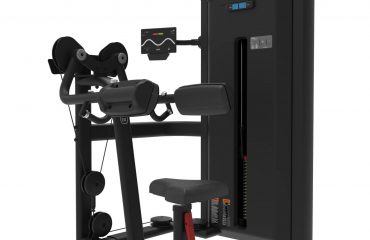
The first is load granularity. Adolescents in the formation stage need to progress in small increments across 10 to 12 exercises at 5 to 15 repetitions. Selectorised machines with fine weight increments make that progression controllable and repeatable in a way that free weights alone do not, which is why most school and club installations combine both. Our range of professional strength training machines is built for that pattern of use.
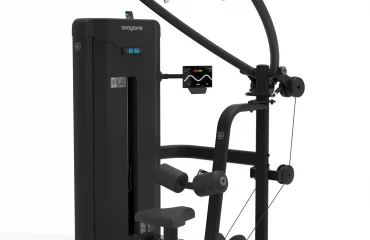
The second is assisted body-weight work. The 6 to 12 age group trains almost entirely with body weight, and the 10 to 16 group still relies heavily on it, but a pull-up or a dip is an all-or-nothing exercise for a young trainee. Counterweight assistance turns it into a scalable one; a station such as the Forza Bodytone FB13 weight assisted chin-dip lets the same movement be prescribed across a whole age range.
The third is the play requirement. If 20 to 30 per cent of the work for the youngest group is meant to be play, part of the answer sits outside the weights room. Purpose-built outdoor fitness equipment for children supports the running, jumping and climbing side of the same programme, and it does so on equipment designed for that user group rather than on adult stations scaled down.
The fourth is compliance. Indoor professional equipment for supervised commercial and institutional use is covered by EN ISO 20957-1 class S. Outdoor adult fitness equipment falls under EN 16630. Children playground equipment is covered by EN 1176-1, with impact-attenuating surfacing under EN 1177; these are separate standards and equipment for children is never certified under EN 16630. Any facility mixing youth training with public access needs to know which of those applies to which piece of kit before it is specified, not after.
Frequently asked questions
Does strength training stunt growth in children?
No. That belief is not supported by the evidence. Structured strength programmes for children have been implemented regularly in recent years because of their health benefits, including increased bone mineral density, which can minimise injury risk.
At what age can a young person start using free weights?
Work with free weights such as dumbbells, barbells and lifts belongs to the athlete formation stage, which covers the 10 to 14 age range and extends to 16. Before that, from 6 to 10 and up to 12, training should use body weight, possibly with medicine balls or a relatively light load.
When can a full periodised programme be introduced?
A complete training plan based on the full range of periodisation models is recommended only after stage 4 on the Tanner scale has been reached, for girls and boys alike. Simple models such as linear periodisation can be introduced in the 14 to 18 specialisation stage.
How long should a youth training session last?
Session time should be limited to 30 minutes for the 6 to 10 age group and increase progressively to 45 minutes in the 10 to 14 group.
Is supervision really necessary?
Yes. Injuries among adolescents result far more often from lack of supervision, poor load progression and excessive intensity than from the act of lifting itself. A qualified coach with both training and teaching competence is the single most effective safety measure a facility can put in place.
Specifying a youth strength area
Strength training should be part of physical education lessons and should feature in programmes for children and adolescents. The purpose of introducing that activity is above all to improve general physical condition, weaving in elements that strengthen the whole locomotor system, adapted to the age and maturity level of the child. It is very important that the exercises include varied forms of enjoyment, so that young people at early school age come to like moving. And at this stage, training must be delivered under the supervision of coaches and specialists who know how to work with children and young people, so that the plan can be adjusted to the needs, goals and capacities of the participants.
If you are equipping a school, a club, a municipal facility or a rehabilitation centre for this kind of programme, the specification follows from the programme, not the other way round. Tell us the age groups, the supervision model and the room, and we will build the equipment list around them. Request a quote and you will receive a costed proposal.