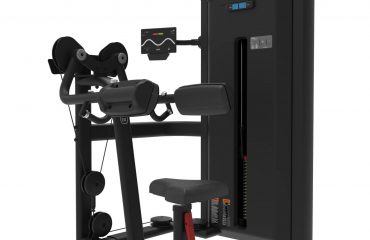
Chest Training: Pec Deck and Chest Press Machines for Gyms
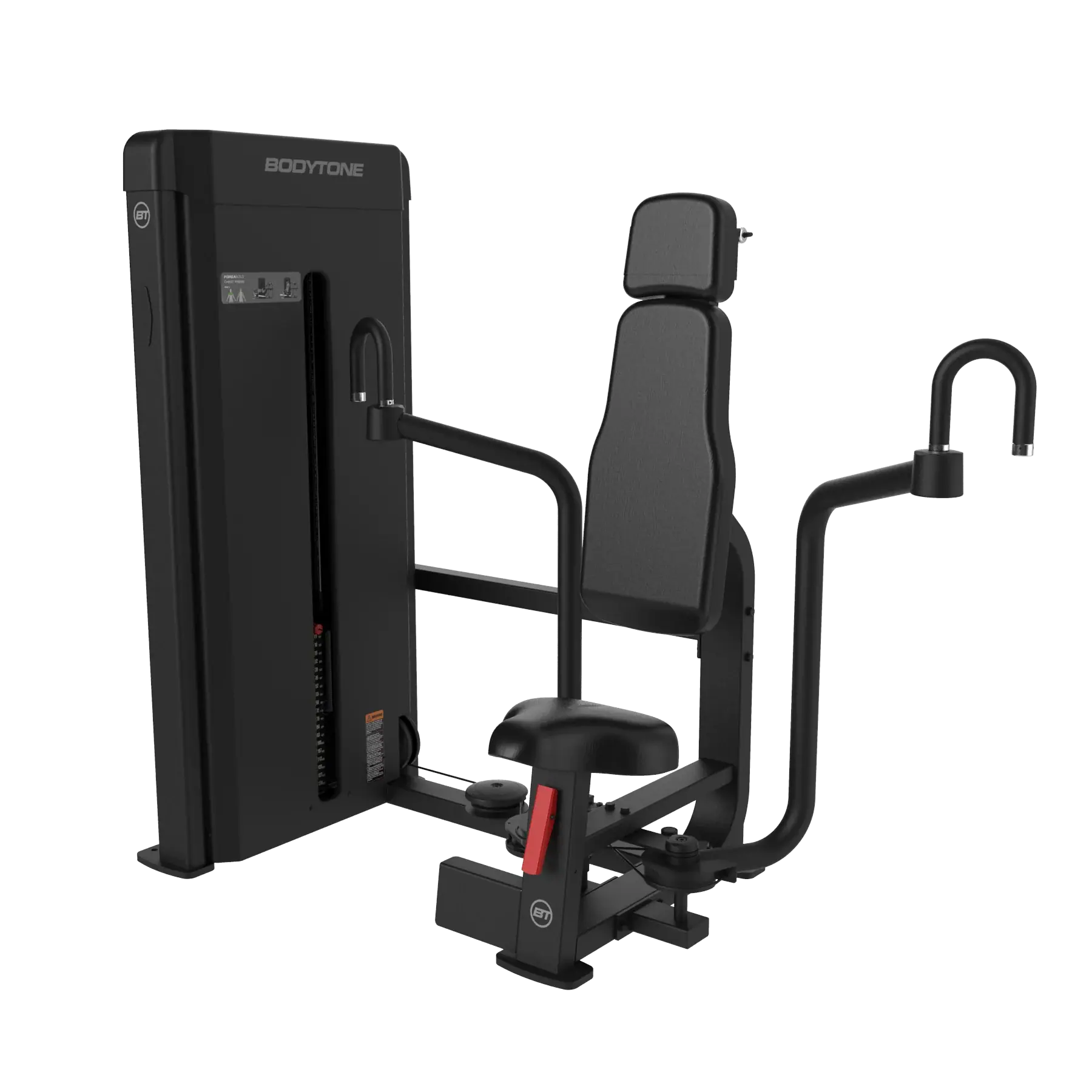
Few muscle groups shape the upper body as visibly as the pectorals, and few zones of a gym floor see as much traffic as the chest area. For a club manager, a hotel fitness room, a cross-training box or a municipal sports hall, the question is rarely whether to install chest equipment, but which combination of pec deck, chest press and bench work covers the widest range of members without wasting floor space.
Why the chest area deserves careful planning
The pectoralis major drives every horizontal push, from a bench press to closing a heavy door. Trained together with the upper back, it also supports posture: a balanced push and pull programme helps counter the rounded-shoulder position that most members bring in from a working day at a desk. That is why a chest station is never a cosmetic choice on a gym floor. It is one of the movement patterns your programming has to cover, alongside vertical push, horizontal pull, hinge and squat.
For an operator, the practical consequence is simple: the chest area has to work for a first-time member and for an experienced lifter on the same afternoon. That usually means combining a guided machine, which requires no spotter and no technical coaching, with a free-weight bench for members who already train with a barbell.
Pec deck or chest press: two movements, two machines
The two machines are often confused because they sit side by side, but they do different jobs.
- The pec deck, or butterfly machine, is a single-joint movement. The elbows stay fixed and the arms close in front of the chest. It isolates the pectorals with very little involvement from the triceps, which makes it a good finisher and an easy movement to teach.
- The chest press is a compound push. The elbows extend, the triceps and front deltoids contribute, and the member can handle a heavier load. It is the machine equivalent of a bench press and the safest way to let an unsupervised member train the chest heavy.
A gym that installs only one of the two loses something. Only a pec deck and your strong members have nowhere to push heavy. Only a chest press and beginners struggle to feel the target muscle at all. Our range of professional chest press machines is built for continuous commercial use, and the Forza selectorised line covers both movements with a consistent look across the floor.
The free-weight side: benches and barbell work
Flat, incline and decline bench press remain the reference for members who train for strength. The incline angle shifts the emphasis towards the upper chest and the front deltoid, the decline towards the lower fibres. A well-equipped chest area therefore rarely relies on a single fixed bench.
The point most operators underestimate is safety around the free-weight zone. A barbell bench needs adjustable safety catches or a rack with spotter arms, clear circulation space on both sides, and flooring able to absorb a dropped bar. Our professional weight benches are designed to sit inside a rack or as standalone stations, with the frame and upholstery specified for club use rather than occasional training.
What to check before you order
- Certification. Indoor equipment installed in a supervised commercial facility must comply with EN ISO 20957-1 class S. This is the professional class, and it is the only one that belongs in a gym open to the public.
- Frame and welds. Look at the steel section, the quality of the welds and the paint or powder coating. These are what decide whether a machine still feels solid after several years of daily use.
- Upholstery and grips. Pads and handles are the parts that wear first. Check that they can be replaced individually rather than requiring a new machine.
- Adjustment range. Seat height and starting position must accommodate a wide range of body sizes, ideally with a scale marked on the machine so a member can return to the same setting.
- Footprint and circulation. Measure the machine in use, not in its catalogue dimensions: a pec deck needs clearance for the arms to open, and a bench needs space to load and unload plates.
Frequently asked questions
How many chest stations does a gym need?
There is no universal ratio. The right number depends on your peak attendance, the width of your member profile and how much of your programming is machine-based. The usual approach is to size the chest area against the other push and pull stations so that no single machine becomes a bottleneck at the busiest hour, then review it after a few months of real use.
Is a pec deck or a cable crossover the better choice?
They are complementary rather than interchangeable. The pec deck guides the movement on a fixed path, which suits beginners and high-traffic floors. A cable crossover offers more freedom of angle and is favoured by experienced members, but it needs more floor space and more coaching.
Can a hotel or residential gym use the same machines as a commercial club?
Yes, and it should. Any facility open to guests, residents or employees is a professional environment, whatever its size. Equipment rated for home use has no place there: it is not built for the number of users, and it is not certified for the setting.
What flooring should go under a chest area?
Guided machines need a stable, hard-wearing surface that protects the slab and limits noise transmission. Free-weight benches and barbell work need a thicker impact-absorbing floor. In practice most chest areas combine both, with the heavier specification under the bench and rack zone.
Planning your chest area with Light In Fitness
Light In Fitness has supplied professional strength equipment to gyms, clubs, hotels, local authorities and sports facilities since 2013. If you are equipping a new floor or replacing an ageing chest station, send us your plan, your expected attendance and your member profile, and we will propose a configuration that fits the space rather than a list of machines. Request a quote and our team will come back to you with a costed layout.