The Smith Machine: A Complete Guide for Gym Operators
La Smith machine permet de travailler en charge sans pareur grâce à des crans de sécurité présents sur toute la course de la barre. Elle convient au squat, au développé, aux fentes et aux tirages, avec une trajectoire imposée. Elle décharge en contrepartie les stabilisateurs, ce qui limite son transfert vers la barre libre.
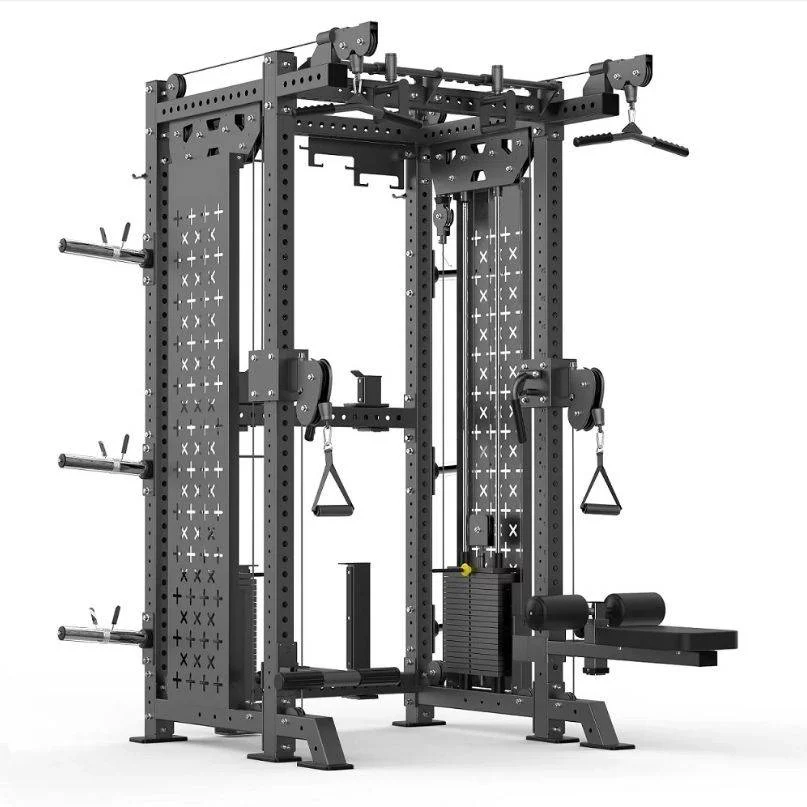
Few pieces of equipment divide a gym floor like the Smith machine. Some coaches see a guided bar as a shortcut; others see the only way a member can load a heavy squat or press at seven in the morning with nobody around to spot. Both are partly right. For an operator, the question is never whether the Smith machine is good or bad in the abstract, but what it does for a specific room, a specific membership and a specific staffing model.
A Smith machine is a barbell captured on vertical rails. The bar travels in a straight line, up and down, and adjustable catches let the user park it at any point along that travel. That single design choice explains everything that follows: every strength and every limitation of the machine comes from the fact that the bar cannot leave its path.
The exercises a guided bar supports
The catalogue is wider than most buyers expect, and it covers the movements that fill a commercial floor at peak hours.
- Squats. The bar is set at the right height and stays stable through the whole movement, which suits members who have not yet built the coordination for a free barbell squat. The coaching cue is simple: brace the trunk, and resist the temptation to lean too far forward or back.
- Bench press. A safe and efficient way to press without a spotter. The bar height can be set to avoid loading the shoulders at the bottom, and the stability of the frame lets the user concentrate on form and on contracting the pectorals.
- Incline press. Working on an incline shifts the emphasis to the upper chest. Again, the fixed path lets the user hold a clean position instead of fighting the bar.
- Deadlifts. Not the first movement people associate with a guided bar, but it works: either as a teaching tool for the pattern, or to add controlled resistance to it.
- Shoulder press. One of the strongest arguments for the machine in a lightly staffed room. The bar starts at the right height and the catches remove the need for a partner.
- Bent-over rows. The height of the bar can be set so the back and shoulders are not strained at the start of the pull.
Used properly, the guided bar earns its footprint. These six movements are only a starting point; most operators end up programming far more around it.
What the Smith machine does well
The machine has a poor reputation in parts of the industry, and it is largely undeserved. Its advantages are real, and they matter most to exactly the members a commercial club needs to retain.
First, it gives control and safety during the set. For anyone whose technique is still forming, a bar that cannot drift sideways removes the main source of risk, and the catches turn a failed rep into a non-event.
Second, the bar is easy to reset at different heights, so the same station serves a wide range of body sizes and experience levels without a queue forming around a single setup.
Third, it isolates well. When a programme calls for a specific muscle group rather than a whole-body pattern, taking stabilisation out of the equation is a feature, not a defect.
None of this makes the machine right for every room. It does make it a serious option for hotels, corporate suites, residential schemes, rehabilitation centres and any club running long unstaffed hours.
Where the Smith machine falls short
The honest counter-argument starts with the same fixed path. The bar follows one trajectory, which means the body has to adapt to the machine rather than the other way round. Over time that can feed imbalances, and in the wrong hands it can cause injury.
There is also a dependency risk. The guided bar is useful while a member is learning a pattern, but more advanced lifters will not get the same return from it as they would from free weights. Exercises can feel easier on the machine than they really are, which means the working muscles are not always loaded hard enough to keep driving progress.
Finally, it is simply not the right tool at the top end of training. Members chasing maximal strength will find the machine short on variety and on the kind of loading they need, and there is a satisfaction in lifting heavy from the floor unassisted that no guided station reproduces.
The practical conclusion for an operator is that the Smith machine belongs alongside free weights, not instead of them. A floor built around a guided bar and nothing else will lose its strongest members.
Common mistakes your members will make
Every operator has watched the same handful of errors play out on the guided bar. They are worth putting on an induction sheet.
- The wrong load. The stability of the frame tempts people into weights they cannot control, which ruins form and invites injury. Technique matters more than the number on the bar.
- The wrong bar height. Setting the start position badly costs range of movement and adds risk. Each exercise has its own height.
- Leaning too far forward or back. Swinging the body to move the bar creates strain rather than progress.
- A slack trunk. Without an engaged core the position drifts and the set is wasted. Bracing the abdominals is what holds the whole movement together.
Programming on the guided bar
A guided bar rewards a written plan more than most stations, because it is easy to drift into comfortable sets on it.
Start with the goal and the experience level. A member building muscle for the first time and an experienced lifter adding strength and endurance need different work, and the plan has to say which one it is for.
Then choose exercises that target specific muscle groups. The machine covers everything from squats to bench press, so the constraint is not the equipment but the selection: quality over quantity.
Set the volume next. Beginners should aim for 2 to 3 sets of 8 to 12 repetitions; more experienced lifters can work at 4 to 5 sets with lower repetitions. Rest between sets stays short, in the region of 30 to 60 seconds.
Finally, track it. Sets, repetitions and loads written down make adjustment possible and give members visible progress, which is the single most reliable driver of retention.
Specifying a Smith machine for a commercial floor
Buying for a club is a different exercise from buying for a private room. A station on a commercial floor will be used by dozens of people a day, most of them without supervision, for years.
Look first at the catches: they should be adjustable and effective along the full travel of the bar, not only near the bottom. That is what allows a member to work heavy without a spotter, which is the whole point of the machine.
Check the footprint and the loading zone before anything else. A guided station needs clear space in front and behind for entry, exit and plate handling, and it is usually placed against a wall or at the end of a run of squat racks and power racks so it does not break the circulation of the room.
Consider what sits next to it. A guided bar is most useful when it is paired with adjustable weight benches so the same station covers flat, incline and decline pressing without a second frame.
Then look at the frame itself, the finish, the quality of the linear bearings and the availability of spare parts. Our range of professional Smith machines is selected for commercial use in clubs, hotels and public facilities.
Frequently asked questions
Is a Smith machine a replacement for a power rack?
No. They answer different needs. The rack supports free barbell work with all the stabilisation that implies; the guided bar removes stabilisation on purpose. Most commercial floors need both, in different proportions depending on the membership.
Who benefits most from it?
Members who are still learning a movement pattern, members training alone, and anyone working on isolation rather than whole-body patterns. It is also a strong fit for facilities that run unstaffed hours.
Does it make members weaker on free weights?
Not by itself, but it does not build stabilisation either. That is why it works best as one station among free-weight equipment rather than as the centre of a strength area.
How much space should be allowed around it?
Enough for clear entry and exit and for handling plates on both sides. The exact figure depends on the model chosen and on the layout of the room, so it is worth settling at the plan stage rather than on delivery day.
In short
Love it or hate it, the Smith machine is here to stay. It is a versatile station that covers a whole range of exercises, and it makes a genuine addition to a training programme. Some argue that it restricts natural movement; others value the safety it gives. On a commercial floor, both views can be accommodated at once, provided the guided bar is one option among several rather than the only one.
If you are planning a strength area and want the guided station specified alongside the rest of the room, our team can work from your floor plan and your membership profile. Request a quote and we will come back with a costed proposal.