
Aller au contenu
Light In Fitness
  • Strength training
    • Selectorised
      • Strength training
      • Selectorised
      • Smith machines
      • Bodytone Forza
      • Forza FH
      • Gold Line
      • Lexco
      • Bodytone SRX
      • Power Line
      • Authentique range
      • Strong Line
    • Plate loaded
      • Plate loaded
      • Gold Line
      • Etenon Olympic
      • Etenon R8
      • Lexco plate loaded
      • Solid Rock
      • O Live Pro
      • Etenon PC series
      • TITAN range
      • Shock range
      • Lexco LSP series
      • Chest press machines
    • Benches
      • Benches
      • Racks and cages
      • Squat and power racks
      • Barbells
      • Coloured barbells
      • Booty Area
      • Power sleds
      • Multi station gyms
      • Multi station gyms
      • Vertical leg press
      • Cable stations
    • Accessories
      • Accessories
      • Kettlebells
      • Gym storage
      • Special offers
      • Double power racks
      • EVOM4 multi station
      • MT6 indoor cycling
  • Cardio equipment
    • Treadmills
      • Cardio equipment
      • Treadmills
      • Professional treadmills
      • Bodytone treadmills
      • Etenon treadmills
      • Lexco treadmills
      • Outdoor treadmills
    • Exercise bikes
      • Exercise bikes
      • Upright bikes
      • Bodytone bikes
      • Recumbent bikes
      • Lexco seated bikes
      • Cycling bikes
    • Cardio machines
      • Cardio machines
      • Lexco cardio
      • Cross trainers
      • Lexco cross trainers
      • Rowers
      • Ski ergometers
      • Stair climbers
      • Xebex
  • Wellness
    • Cold plunge baths
      • Wellness
      • Cold plunge baths
      • Portable baths
      • Fixed baths
      • Chillers
      • Cold plunge bath accessories
    • Sauna, steam and spa
      • Sauna, steam and spa
      • Sauna and steam room
      • Outdoor saunas
    • Acrylic and rigid spas
      • Acrylic and rigid spas
      • Zodiac pools
      • Pool surfacing
      • Aquatic and wellness
    • Pilates
      • Pilates
      • Inflatable air tracks
  • CrossFit and Hyrox
    • CrossFit rigs
      • CrossFit and Hyrox
      • CrossFit rigs
      • Freestanding rigs
      • Wall mounted rigs
      • Functional rigs
      • Cross training cages
      • Cross training stations
      • Portable structures
    • Ziva
      • Ziva
      • Container gym
      • Parkour and CrossFit parks
    • Floor level MMA cages
      • Floor level MMA cages
      • Podium MMA cages
      • Punch bag rails
      • Tatami mats
      • Roll out mats
    • Standards
      • Standards
      • Prices
  • Street workout
    • Stainless steel Functional Rig worldwide
    • iGreenMill outdoor treadmill worldwide
    • Calisthenics cages
      • Street workout
      • Calisthenics cages
      • Street workout parks
      • Custom configurator
      • Uruk parks
      • Parkour and CrossFit parks
      • Hexagon range
      • Mini outdoor cages
      • Calisthenics cages
      • Stainless workout cages
      • Stainless equipment
      • Outdoor wall bars
    • Stainless steel outdoor
      • Stainless steel outdoor
      • Stainless machines
      • Outdoor gym
      • Steel4Fit
      • TRAINER OutdoorStart
      • TRAINER OutdoorFit
      • TRAINER sets
      • Outdoor strength machines
      • Compact 3 in 1 stations
    • Fitness trail
      • Fitness trail
      • OUTDOOR FITNESS I
      • Adapted and rehabilitation
      • Accessible outdoor
      • TRAINER accessible
      • Galvanised range B
      • Wooden trail
      • Fitness trail stations
      • Obstacle courses
    • Ninja Warrior
      • Ninja Warrior
      • Toroz Ninja and OCR
      • Outdoor Ninja structures
      • Warped walls
      • Parkour
      • Obstacle trail modules
      • Pump tracks
  • Playground
    • Rope play modules
      • Playground
      • Rope play modules
      • Rope play sets
      • Combined rope structures
      • Complex play systems
      • Rope climbing pyramids
      • Rope climbing nets
      • Rope structure parts
    • Diamond Collection
      • Diamond Collection
      • Tubular play structures
      • Play towers
      • Elevated playhouses
      • Bespoke playgrounds
    • Swing sets
      • Swing sets
      • Spring riders
      • Playground roundabouts
      • Playground furniture
      • Children sports parks
      • Kids outdoor fitness
      • Kids cardio machines
      • Mobility wheels
      • Kids balance stations
    • Playground surfacing
      • Playground surfacing
      • Wood chips
      • Operator duties
      • Inspections
  • Rubber flooring
    • Rubber flooring
      • Rubber flooring
      • Weightlifting tiles
      • Fire rated tiles
      • Coloured tiles
      • Wood effect tiles
      • COV A tiles
    • Interlocking tiles
      • Interlocking tiles
      • 7 mm interlocking tiles
      • 6 mm patterned sports flooring
      • Pool surfacing
      • Rubber rolls
      • Sports court rolls
      • Floor underlay
    • Fitness, gym and Pilates mats
      • Fitness, gym and Pilates mats
      • Smooth surface mats
      • Moulded surface mats
      • Roll out mats
      • Tatami mats
    • Outdoor flooring
      • Outdoor flooring
      • Turf sled tracks
      • Turf sled tracks
      • Artificial turf tiles
      • Stable matting
    • Multi-sport courts
      • Multi-sport courts
      • Basketball court tiles
      • Pickleball surfacing
      • Mini modular multisport court
      • Standard modular multisport court
      • Max modular multisport court
      • Modular 3×3 basketball court
      • Multisport and 3×3 complex
    • Sports flooring tiles, deliveries
  • By facility type
    • By facility type
      • By facility type
      • Public sector
    • Buying sports equipment through public tender
      • Buying sports equipment through public tender
      • Supplier file
      • Specification template
      • Specification clauses
      • Funding
    • Case studies
      • Case studies
      • References
    • Standards
      • Standards
      • Warranties
      • After sales
      • Glossary
      • Blog
  • FRENESDE
  • No products in cart.
  • Home
  • Expert guides on professional fitness equipment
  • Stations et Cages
  • Racks de musculation
  • Professional Squat Rack: Specifying Strength Training for a Commercial Floor

Professional Squat Rack: Specifying Strength Training for a Commercial Floor
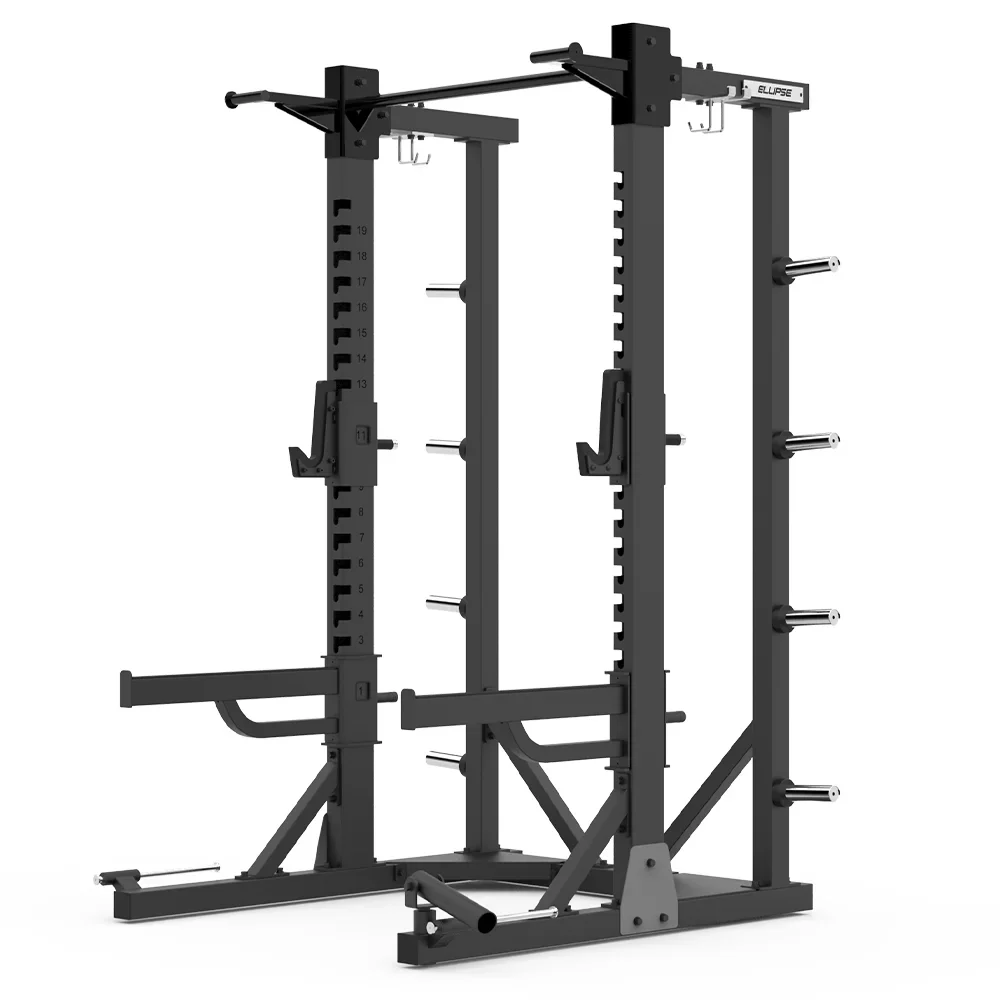
by Michaël Galy / Tuesday, 04 July 2023 / Published in Racks de musculation, Smith machines et racks
Rack et Cage à Squat God Line - rack squat - cage a squat

A professional squat rack is the single densest piece of equipment on a strength floor: one footprint, a full range of barbell movements, and adjustable safety arms that let members train heavy without a spotter. For a commercial facility the specification questions are always the same: certification to EN ISO 20957-1 class S, steel section and wall thickness, anchoring, upright hole spacing and the accessories the uprights will accept later.

This guide is written for the person specifying the equipment, not for the person using it: gym operators, box owners, hotels, clubs, universities, local authorities and rehabilitation centres. It covers what the rack does for the floor, how to choose between the rack families, what has to appear on the quotation, and how the movement should be set up and coached.

On this page

  • What a professional squat rack brings to a training floor
  • Squat rack, power rack or half rack: choosing the family
  • What has to appear on the specification
  • Setting up the rack and coaching the movement
  • Accessories that earn their place
  • Cleaning and maintenance
  • Frequently asked questions
  • Specifying your strength area
  • À lire aussi sur le même thème

What a professional squat rack brings to a training floor

One footprint, many movements

A rack is not a squat machine. Back squat, front squat, overhead press, bench press with a bench brought in, rack pulls, pin presses and, on a rig-mounted version, pull-ups all happen inside the same frame. That density is what makes the rack the anchor point around which the rest of the strength area is laid out.

Training safely without a spotter

Adjustable safety arms or spotter pins are the reason a supervised commercial floor can let members work close to maximal loads. Set at the right height they catch a failed repetition before it reaches the lifter. For an operator this is a risk management feature as much as a training one, and it is the first thing to check on any rack offered as professional.

Progressive loading and technique

Adjustable J-cups and closely spaced upright holes let each user set the bar at their own height, which matters far more than it sounds. A bar racked too high or too low forces a compensation at the start and end of every set. Close hole spacing in the pressing zone is a genuine quality marker.

Posture and balanced development

Barbell work under a coach builds the posterior chain, the trunk and the shoulder girdle together. That is what a machine-only floor tends to miss, and it is why even a facility built around selectorised equipment usually needs at least one rack.

Squat rack, power rack or half rack: choosing the family

Family Description Best suited to Points to watch
Squat stand or two-post rack Two uprights, J-cups, optional safety arms Small strength corners, secondary stations, mobile setups Needs floor anchoring or a heavy base; limited accessory mounting
Half rack Two uprights with a rear frame and extended safety arms Studios and clubs wanting barbell work in a compact area Check the depth of the safety arms and the anchoring specification
Power rack or full cage Four uprights, internal safety bars, pull-up bar on top Commercial gyms, boxes, university and forces facilities Largest footprint; verify clearance behind and in front
Rig-integrated rack Rack stations built into a multi-station rig Group training, functional and competition formats Station spacing determines how many people can train at once
Wall-mounted or folding rack Uprights fixed to a load-bearing wall, folded when not in use Multi-purpose rooms and constrained floor areas Wall load-bearing capacity has to be verified before ordering

Our squat racks and power racks cover all of these families, and the choice is normally settled by the floor plan rather than by preference.

What has to appear on the specification

  • EN ISO 20957-1 class S. Class S is the professional class for indoor equipment. It is what an insurer and an inspection body will look for in a facility open to members. Ask for the certificate rather than the wording.
  • Steel section and wall thickness. These decide how the frame behaves under load and under a dropped bar. Both belong on the quotation, not in a sales conversation.
  • Anchoring. Most professional racks are designed to be anchored to the slab. Confirm the fixing pattern, the number of anchors and what the slab has to provide. A rack sold as freestanding is a different product, built heavier.
  • Upright hole spacing. Standard spacing through the frame with closer spacing in the pressing zone is the arrangement that suits the widest range of users.
  • Safety arms. Check the type, the adjustment range and the rated capacity, and check that they can be set low enough for a full-depth squat.
  • Finish. Powder coating for indoor use. For a rack that will live outdoors or in a humid environment such as a poolside or a coastal site, stainless steel is the durable answer.
  • Accessory compatibility. Dip bars, landmine attachments, plate storage, band pegs and safety straps should mount on the uprights you are buying now.

Setting up the rack and coaching the movement

Most of the injury risk around a rack comes from setup rather than from loading. Four points cover the majority of it.

Bar height. The J-cups should sit slightly below shoulder height so the lifter unracks by extending the legs, not by rising onto the toes. Too high is the more common error and the more dangerous one.

Safety arm height. Set just below the lowest point the bar reaches in a correctly executed repetition. Anything higher blocks the movement, anything lower defeats the purpose.

Bar placement. The bar rests on the upper back, across the trapezius and the rear deltoids. It must never sit on the neck or on the cervical spine. Hand position sits slightly wider than the shoulders, wide enough to create a stable shelf without forcing the shoulder into external rotation.

Execution. Feet around shoulder width, trunk braced, controlled descent, drive back up through the whole foot. Depth and knee travel depend on the individual and on the discipline trained; they are a coaching decision, not a universal rule.

Accessories that earn their place

  • An adjustable bench for pressing work inside the rack, from the weight benches range
  • Calibrated or bumper plates matched to the discipline, and Olympic barbells rated for the loads used
  • Plate storage on the uprights, which keeps the floor clear and reduces handling
  • Rubber flooring or a lifting platform under the rack to protect the slab and control noise
  • Landmine, dip bars and band pegs to widen the exercise range without adding a footprint

Cleaning and maintenance

Wipe contact surfaces with a mild soapy solution or a disinfectant wipe as part of the daily routine, and avoid abrasive products on the coating. Include the rack in the periodic inspection round: anchor bolts, J-cup and safety arm wear, pull-up bar fixings and coating condition. Recording those checks is part of the operator duty in a facility open to the public.

Frequently asked questions

Is a squat rack safe to use without a spotter?

With safety arms correctly set for the user and the movement, yes. That is what they are for. Setting them is part of the induction, and on a supervised floor it should be checked rather than assumed.

What is the difference between a front squat and a back squat?

In the front squat the bar rests on the front deltoids, in front of the body. In the back squat it rests on the upper back. The front squat places more demand on the quadriceps and the trunk and requires a more upright torso; the back squat allows heavier loading and involves the glutes and hamstrings more.

How much floor area does a rack need?

The frame itself is compact. What determines the area is the clearance around it: room to load and unload plates, room to walk the bar out, and a receiving zone if bumper plates are dropped. That clearance is set at the layout stage.

What load can a professional rack take?

Rated capacity varies by model and is stated on each product sheet, together with the steel section it derives from. Ask for the figure for the specific reference you are quoted rather than working from a range.

Specifying your strength area

Send us the dimensions of the room, the ceiling height, the number of simultaneous users and the disciplines trained. You get back a layout, a specification and a costed proposal. Request a quote to open the file.

À lire aussi sur le même thème

  • Squat Racks by Light In Fitness: The Professional Range
  • Power Rack: Tout ce que vous devez savoir sur cet équipement de musculation essentiel
  • How to choose a power rack with cable pulleys
  • Lexco LS-203 Power Rack: The Versatile Squat Cage for Your Gym
  • Smith Machine Exercises: The Essential Guide for Gym Operators

Tous les articles « Racks de musculation »

Tagged under: musculation

About Michaël Galy

Michaël Galy est fondateur et directeur de Light In Fitness, expert en équipements de fitness et musculation professionnels depuis 2013. Fort de plus de 15 ans d'expérience dans l'équipement sportif professionnel, il accompagne les salles de sport, box CrossFit, hôtels, collectivités et établissements de santé dans leurs projets d'aménagement fitness de A à Z. Consultant reconnu en France et en Europe, Michaël Galy a équipé plus de 500 établissements professionnels. Il partage régulièrement son expertise sur les tendances fitness, les normes de sécurité et les meilleures pratiques d'aménagement des espaces sportifs professionnels.

What you can read next

Cage à Squat, Rack, Smith Machine - Musculation et Crossfit Fitness
Squat Cage, Power Rack or Smith Machine: How to Choose
Comment choisir son power rack à poulie
How to choose a power rack with cable pulleys
Power Rack-Tout ce que vous devez savoir sur cet équipement de musculation essentiel
Power Rack: Tout ce que vous devez savoir sur cet équipement de musculation essentiel
TOP
This website uses cookies to improve your experience. We assume you are happy with this, but you can opt out if you wish. Cookie settingsAccept
Privacy policy

Privacy policy

This website uses cookies to improve your browsing experience. Cookies classified as necessary are stored in your browser because they are essential to the basic operation of the site. We also use third party cookies that help us analyse and understand how you use this site. These cookies are stored in your browser only with your consent. You can also disable these cookies. Disabling some of them may affect your browsing experience.
Necessary
Always Enabled
Necessary cookies are essential for the website to work properly. This category only covers cookies that provide the basic functionality and security features of the site. These cookies do not store any personal information.
Non-necessary
Cookies that are not strictly necessary for the site to work et qui sont utilisés spécifiquement pour collecter des données personnelles via des analyses, des publicités ou d\'autres contenus intégrés sont qualifiés de cookies non nécessaires. Il est obligatoire d\'obtenir le consentement de l\'utilisateur avant d\'exécuter ces cookies sur votre site web.
SAVE & ACCEPT
My quotation request 0