Professional Biceps Curl Machines for Commercial Gyms
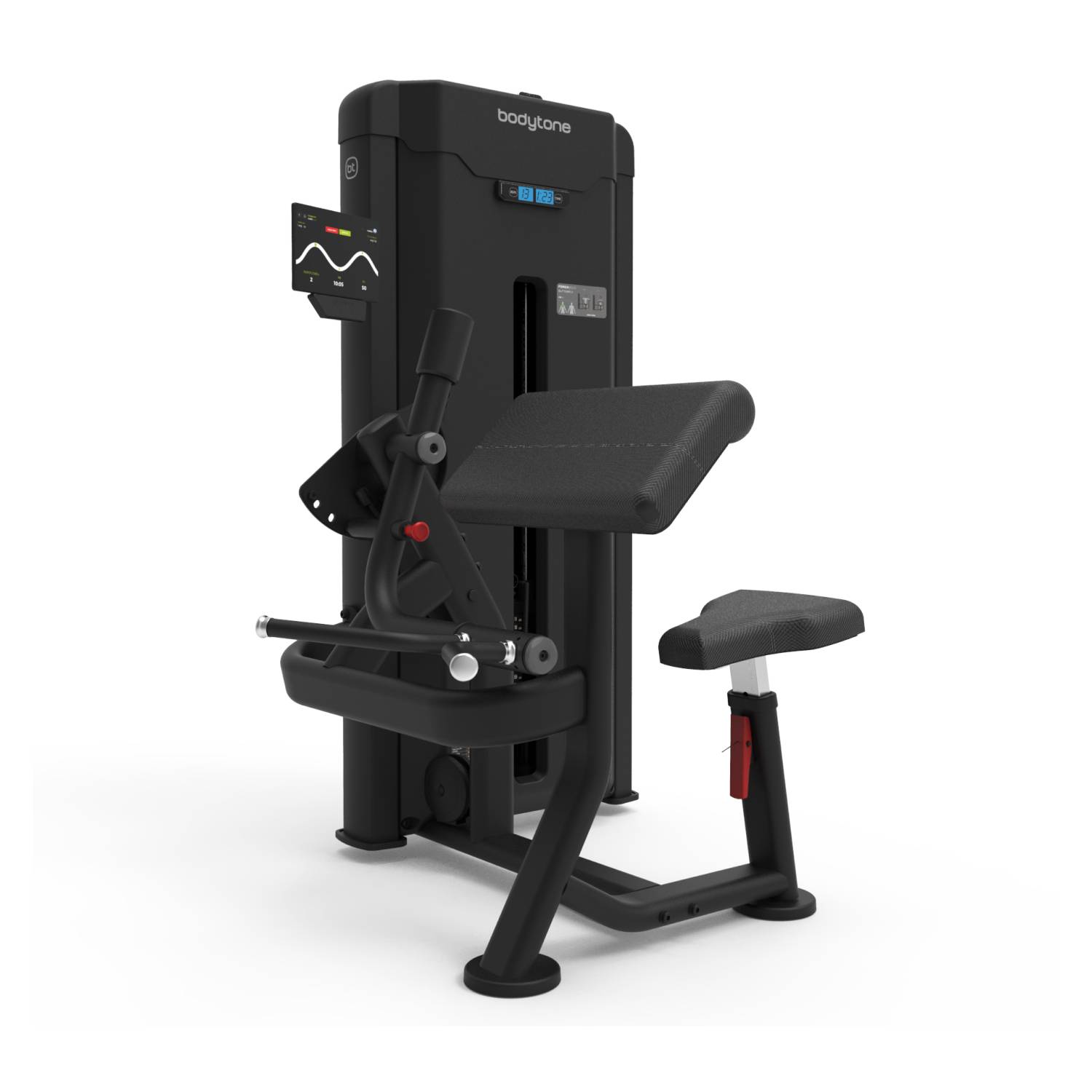
A guided biceps curl machine is one of the least glamorous purchases an operator makes and one of the most heavily used. It sits in the arm zone, it is picked up by beginners and experienced members alike, and because the movement is short and the load is changed constantly, it accumulates more repetitions per square metre than almost anything else on the floor. Specifying it properly is worth more thought than its price suggests.
This guide covers what to look for in a professional arm curl machine, how the guided version compares with the alternatives, and how it fits into the strength zone of a commercial facility.
Why a guided machine rather than free weights
The argument for a guided biceps machine on a shared floor has nothing to do with which builds more muscle. It has to do with who is using the room.
A guided path fixes the elbow position and removes the swing that a standing curl invites. That means a member with no coaching gets a usable movement on the first attempt, which matters enormously in a facility where most people train unsupervised. It also means the load stays on the target muscle rather than migrating into the lower back, which is where the complaints and the injuries come from.
The pad and the seat do the rest of the work. A well-designed preacher pad supports the upper arm at a fixed angle so the shoulder cannot compensate, and an adjustable seat lets the same machine work for a wide range of body sizes. On a commercial floor, adjustability is not a comfort feature: it is what decides how many of your members can actually use the machine.
What separates a professional machine
Four things, in roughly this order.
The frame. Section thickness, weld quality and the footprint decide whether the machine stays square after years of being loaded, leaned on and dragged across the floor during cleaning. A machine that rocks under load will be avoided by members long before it fails.
The load system. On a selectorised machine the cable, the pulleys and the guide rods are the wear parts, and their quality decides how smooth the movement feels and how often you touch the machine. On a plate-loaded machine there is no cable to service, which is why plate-loaded arm stations often suit sites with limited maintenance capacity.
The pads and upholstery. This is the part members touch, the part that shows wear first, and the part most often impossible to source three years later. Ask whether pads are replaceable and whether the covering is specified for commercial cleaning products, because in shared access they are cleaned several times a day.
The adjustment range. Seat height, pad angle and, on better machines, handle position. The wider the range, the more of your membership the machine actually serves.
Selectorised or plate-loaded
Both are professional solutions and the choice depends on the site rather than on the equipment.
Selectorised machines change load with a pin. They suit mixed-ability rooms, circuit layouts and any site where members move quickly between stations. They need periodic cable inspection, which is a scheduled task rather than a problem. The Bodytone Forza FB30 biceps machine and the Power Line biceps curl are both built for this kind of continuous shared use.
Plate-loaded machines change load with discs. They suit stronger memberships, they cost less to maintain, and they give a movement feel that experienced lifters prefer. They also need disc storage planned into the layout, which is the detail most often forgotten at the drawing stage.
Many commercial floors carry both, and there is nothing wrong with that. What causes trouble is mixing manufacturers arbitrarily across the arm zone, because it fragments spare parts and service and it makes the room look assembled rather than designed. Browse the full selectorised strength machine range to see how a consistent line is built up.
Standards and compliance
Indoor strength equipment installed in a supervised commercial or public facility falls under EN ISO 20957-1 class S, the class written for professional use with unrestricted access. Class I is a professional class intended for inclusive access, not an intensity step above class S: the two answer different questions and are not a ladder.
Ask for the declaration of conformity in writing before the order is placed, not after delivery. On a machine that will be used unsupervised by members you have never met, this is the document your insurer will want to see.
Placing it in the strength zone
An arm station is a short-dwell machine: users occupy it for a few minutes and move on. That argues for placing it where circulation is easy rather than in a corner, and against putting it next to another short-dwell station that will queue at the same time.
Leave working space in front of the machine for the member and beside it for anyone waiting. Underneath, dense rubber flooring protects the slab, keeps the frame from moving and, on plate-loaded stations, absorbs the discs that will eventually be set down badly.
Buying from a professional supplier
The difference between suppliers shows up after the invoice, not before it. Three questions separate them quickly.
Can they tell you what the wear parts are on the machine you are looking at? Can they still supply pads and cables for a range they sold several years ago? And will they put the conformity documentation in writing before you order rather than after?
Light In Fitness sources directly from manufacturers and has equipped professional sites since 2013, across clubs, hotels, municipal facilities, schools, clubs and rehabilitation centres. That matters less as a credential than as a practical point: a supplier who services what they sell can answer those three questions without checking.
Frequently asked questions
Is a guided biceps machine worth the floor space?
In a supervised gym with strong coaching, perhaps not. In shared, largely unsupervised access it earns its place because it gives an untrained member a safe, usable movement without instruction.
Selectorised or plate-loaded for a commercial floor?
Selectorised suits mixed-ability rooms and fast station changes. Plate-loaded suits stronger memberships and sites with limited maintenance capacity. Many floors carry both.
Which standard applies?
EN ISO 20957-1 class S for indoor equipment in professional use with unrestricted access. Ask for the declaration of conformity in writing before ordering.
What fails first on an arm curl machine?
Upholstery, then cables and pulleys on selectorised models. Ask whether both are individually replaceable before you buy, because that is what decides the machine’s real service life.
Specifying your arm zone
If you are building or refitting a strength area, start from the membership and the room rather than from a model list. Tell us the surface area, the expected traffic and the profile of your users, and we will put a specification and a costed proposal in front of you: request a quote.
À lire aussi sur le même thème
- Matériel de musculation professionnel pour collège et lycée avec Light in fitness
- Matériel de musculation pour associations et collectivités avec Light In Fitness
- Matériel de musculation professionnel pour l’armée de terre, les régiments et la marine avec Light In Fitness
- Quels sont les muscles sollicités avec le développé couché ?