Maximising Athletic Performance with Professional Strength Equipment

Athletic performance is not built by enthusiasm alone. For a club, a performance centre, a rehabilitation unit, an armed-forces facility or a hotel gym that wants members to progress rather than churn, it is built by the equipment specified on the floor plan and by the programming that equipment makes possible. This article sets out what athletic performance actually measures, why a properly specified strength floor moves those numbers, which categories of professional equipment do what, and the mistakes that are far cheaper to design out than to correct later.
What athletic performance actually measures
Athletic performance is the ability to carry out a sport or an activity at a high level of skill. It combines physical, mental and technical qualities, and it is assessed rather than felt. Speed, strength, agility and endurance are the usual measures. Physical testing and biomechanical analysis are the two common assessment routes: testing establishes general condition, including speed, endurance, flexibility and strength, while biomechanical analysis evaluates movement quality so that technique can be optimised.
Several factors influence the result: genetics, training, nutrition, age and sex. They affect both the level an athlete can reach and how quickly they recover from a session or an injury. For an operator, the practical consequence is that a strength floor has to serve a spread of populations at once, not a single ideal user.
Why the strength floor drives the numbers
Strength training improves power, stability and mobility, and those transfer to the field and to the gym floor. Professional equipment matters because it makes correct execution the default: the movement path is defined, the load is controlled, and the athlete can work close to their limit without improvising the technique. That is what turns a training plan into a result.
Strength work also underpins injury prevention and rehabilitation, which is why performance centres and rehab units specify it as carefully as clubs do. Bodyweight exercises have their place, but they cap out at a resistance that stops being a stimulus. Professional machines target defined muscle groups with adjustable resistance, so load can be raised or lowered against a stated objective rather than guessed.
The downstream effects are worth stating to a board as well as to a coach: greater overall strength and endurance, improved body composition, and a positive effect on bone density that matters for populations at risk of stress fractures.
The equipment categories and what each one is for
Free weights
Dumbbells, barbells and kettlebells remain the base layer. They build general strength, allow specific muscles to be targeted, and load balance and stabilisation in a way no guided machine reproduces. They also need the most floor discipline: drop zones, dense flooring, and storage that keeps the racks tidy between classes.
Selectorised machines
The smooth, consistent, easy-to-supervise end of the floor. Selectorised machines isolate a muscle group in a controlled environment, which suits rehabilitation, beginners and any session that has to run safely without one-to-one coaching. See our Gold Line selectorised machines for a professional-grade example.
Plate-loaded machines
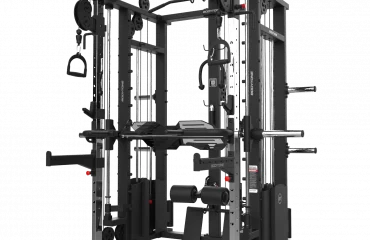
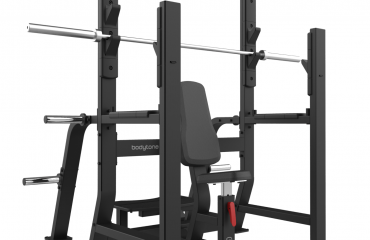
Plate-loaded units combine a defined movement path with free-weight loading, and converging designs follow the natural arc of the movement. They are the usual answer for a strength floor that has to serve athletes and general members from the same footprint. Our Gold Line converging machines sit in this category.
Resistance bands
Compact, portable and capable of loading almost every muscle group. Adjustable resistance makes them a sensible entry point for novices and a useful tool for warm-ups, activation and travelling squads.
Kettlebells
Kettlebells build functional strength and cardiovascular endurance in the same movement. They suit full-body work and explosive power development, and they occupy very little floor area for the programming they unlock.
Plyometric boxes
Plyo boxes support explosive work that develops strength, speed and agility: box jumps, split jumps and squat jumps. Stackable designs let one set of boxes cover several heights and difficulty levels, which is what makes them practical for group classes.
Commercial grade is a standard, not a claim
Indoor equipment used in a facility open to third parties must meet EN ISO 20957-1 class S, the class for continuous use in supervised commercial environments. Class I is a professional class for inclusive access, not a step above class S. Ask for the declaration that names the standard and the class before the order, not after the first inspection.
Building strength work into the programme
Start with stated objectives. Muscle development, endurance and general strength lead to different equipment choices: free weights and kettlebells for building muscle and raising strength, resistance bands for toning and endurance work, plyometric boxes for explosive power. A floor plan that has not been asked what it is for will serve every objective mediocrely.
Then design the session structure. A programme should work the whole body, be demanding without being unmanageable, and leave real rest between sets. Progression is gradual: intensity and frequency rise over time, and consistency does more than any single heroic session. Zone the room so that this is physically possible, with enough stations that a typical class does not queue.
Finally, measure. Record sessions, loads, sets and repetitions, whether on a training log or a tracking system. That record is what tells a coach when to raise intensity, when to deload and when to change the plan, and it is what tells an operator whether the equipment investment is doing its job.
Mistakes worth designing out
Skipping warm-up and cool-down. They are the least glamorous part of a session and the most reliable predictor of whether members get injured. Build the space and the time for them into the schedule.
Loading too much, too soon. Members should start with a weight they can control and a technique they can hold. Equipment with fine load increments makes this easier to enforce than equipment that jumps in coarse steps.
Neglecting technique. Correct form is what makes an exercise target the intended muscles and what minimises injury risk. Repetitions performed only to be counted are wasted at best.
Treating the strength floor as the whole gym. Strength work is essential, but cardio, flexibility and balance belong in the same building. A facility that specifies only one of the four will see progress stall and retention follow it down.
Frequently asked questions
Do I need machines if my members already use free weights?
Usually yes. Free weights and machines answer different problems: one loads stabilisation and coordination, the other allows a defined path under supervision-light conditions. A commercial floor that serves several populations wants both.
Can strength equipment be used in a rehabilitation setting?
Selectorised and converging machines are widely specified for rehabilitation because the movement path is controlled and load can be set precisely. The programming must be defined by the clinical staff, and the equipment specification should follow the protocols they intend to run.
How much floor area does a strength zone need?
That follows from the number of simultaneous users, the mix of machines and free weights, and the circulation between them, not from a rule of thumb. Bring the room dimensions and the class sizes and the layout can be drawn against them.
Specifying your strength floor
Equipment choice is a consequence of objectives, populations and floor plan, in that order. Review our professional strength training machines and the CrossFit rigs that anchor a functional zone, then request a quote so the whole room can be specified and priced as one project rather than assembled item by item.