Power Rack vs Half Rack vs Smith Machine: Which Should Your Gym Buy?
Le power rack apporte la sécurité maximale grâce à ses barres de sécurité intégrales, le half rack économise la surface au sol, la Smith machine guide la barre pour un public débutant. Le choix engage la sécurité des utilisateurs sans pareur, l'emprise au sol et le budget. Une salle accueillant du travail lourd sans encadrement privilégie le power rack.
In any free-weights zone, the power rack (or half rack) is the priority investment and the Smith machine is a complement, never a substitute: the two serve fundamentally different purposes. Which combination you need — and in what order — depends on your facility type, your members’ experience level and your available floor space. This guide gives you the decision logic, the full comparison and recommended configurations with budgets for every gym typology.
The three rack types: definition and mechanics
| Type | Description | Bar guidance | Built-in safety |
|---|---|---|---|
| Power rack (full cage) | Four uprights forming a closed cage with height-adjustable safety bars or pins; the lifter works inside the cage with a free bar | None — the bar is fully free | Maximum (safeties, J-hooks) |
| Half rack | Two front uprights, optionally with spotter arms; the lifter works in front of the uprights — more open, more accessible | None — free bar | Partial (optional spotter arms) |
| Smith machine | Bar fixed on vertical (or 7° angled) rails with a constrained path and safety hooks every 5–10 cm | Fully guided rails | Maximum (hooks, rotation lock-off) |
Detailed comparison
| Criterion | Power rack | Half rack | Smith machine |
|---|---|---|---|
| Floor footprint | 6–10 m2 (with exit zone) | 4–6 m2 | 5–8 m2 |
| Height required | 240–270 cm | 220–260 cm | 230–280 cm |
| Exercises | Squat, bench, overhead press, rack pulls, pull-ups, plus dips or cable attachments | As power rack, plus walk-out lunges and clean & press | Guided squat, bench and press variants, shrugs, calf raises, guided hip thrust |
| Freedom of movement | Total (three axes) | Total (three axes) | One vertical axis only |
| Muscle recruitment | Maximum — stabilisers active | Maximum — stabilisers active | Reduced — guidance switches off stabilisers |
| Safety training alone | Excellent (safety bars) | Good, if spotter arms are fitted | Excellent (safety hooks) |
| For beginners | Good — no dangerous failure with safeties set | Caution — requires knowing your limits | Ideal — guided path, maximum security |
| For advanced lifters | Essential for heavy squat and bench | Excellent for dynamic work | Complementary only — isolation and finishing |
| Max rated load | 300–500 kg (professional) | 250–400 kg | 200–350 kg |
| Maintenance | Practically none — grease J-hooks annually | Practically none | Rail lubrication 2–4×/year, guide-bush replacement every 24–36 months |
| Indicative price (professional) | 1,500–4,000 EUR excl. VAT | 1,200–3,000 EUR excl. VAT | 2,500–6,000 EUR excl. VAT |
Does a Smith machine replace a power rack? No — and here is why
- The Smith machine guides the bar along a fixed vertical axis. That guidance eliminates the work of the stabilising muscles — core, obliques, shoulder rotators, spinal erectors. EMG studies show stabiliser activation reduced by 25–40% in a Smith squat versus a free squat.
- The power rack allows fully free movement. The body must stabilise the load in all three planes, and that controlled instability is what builds functional strength, protects against injury and drives the best hypertrophy outcomes.
- The Smith machine is a complement. It excels at isolation work — calf raises, hip thrusts, heavy shrugs — and offers unbeatable security for beginners learning squat mechanics. But it should never be the only squat or bench option on the floor.
The decision tree: which configuration for which facility
| Facility type | Recommended configuration | Rack budget (excl. VAT) |
|---|---|---|
| Home / garage gym (under 20 m2) | 1 compact power rack + Olympic bar | 1,500–2,500 EUR |
| Corporate gym (30–80 m2) | 1 half rack (space saving) + 1 Smith machine (beginner safety) | 3,700–7,000 EUR |
| Commercial gym 100–200 m2 | 1 power rack + 1 Smith machine + 1 half rack | 5,200–13,000 EUR |
| Commercial gym 200–400 m2 | 2 power racks + 1 Smith machine + 1 half rack | 6,700–17,000 EUR |
| Large club, over 400 m2 | 3+ power racks + 2 Smith machines + 1–2 half racks | 12,200–30,000 EUR |
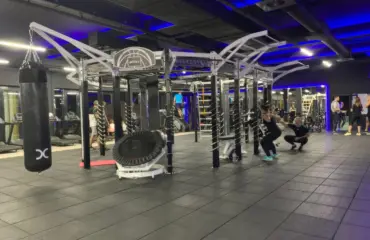
| CrossFit / HYROX box | Wall-mounted rig or cross-training cage instead of conventional racks | 1,850–8,000 EUR |
| Personal training studio | 1 half rack + 1 combined crossover/Smith unit (80+ exercises in 12 m2) | 6,150–10,500 EUR |
All budgets are project estimates excluding VAT.
How to specify a professional power rack
- Upright section: minimum 60 × 60 × 3 mm steel for commercial use. Light-duty racks in 50 × 50 × 2 mm rarely hold more than 200 kg in real conditions and vibrate under load.
- Hole spacing: 5 cm (Westside) spacing through the bench zone for precise J-hook and safety placement; 10 cm spacing limits precision.
- Safeties: prefer safety straps to solid steel pins — they absorb the shock of a failed rep and protect the knurling and whip of your Olympic bars.
- Floor anchoring: mandatory in commercial facilities for racks loaded beyond 200 kg — at least four M12 concrete anchors.
- Accessory compatibility: multigrip pull-up bars, dip bars, landmines, band pegs and cable attachments extend the rack’s life and revenue — check the ecosystem before you buy.
- Floor protection: fit 40–60 mm rubber tiles under and around the rack to protect the slab, absorb drops and cut vibration to floors below.
Full dimensional and steel specifications are covered in our gym rack and cage specification guide; for the guided option in depth, see the Smith machine buying guide, and browse the squat racks and power racks range.
The space-saving option: combined crossover + Smith
For facilities short on floor area, a combined unit brings together on one frame: a Smith machine on linear rails, a dual adjustable cable crossover, an integrated multigrip pull-up bar and a low pulley. The result is 80+ exercises in 10–12 m2 instead of the 20–25 m2 three separate machines would occupy — ideal for corporate gyms, personal training studios and any small facility that has to maximise every square metre.
Frequently asked questions
If I can only afford one, which should I buy first?
A power rack. With safeties set correctly it serves beginners and advanced lifters, covers the most exercises per euro, and needs almost no maintenance. Add the Smith machine at the second investment stage.
Is a half rack safe for unsupervised members?
Only with spotter arms fitted and positioned correctly — and unlike a full cage, they must be readjusted for every exercise and user height. For open commercial floors with mixed levels, a full power rack is the safer default.
Why do Smith machines cost more than power racks?
The guided carriage — rails, linear bearings or bushes, counterweight system and lock-out hooks — is precision hardware that a welded cage does not need. It is also why the Smith machine carries a real maintenance schedule while a rack needs almost none.
What flooring goes under a rack?
40–60 mm high-density rubber tiles under and around the lifting area. Thinner general-purpose tiles handle foot traffic but not repeated bar drops at the rack’s sides.
Get a rack configuration quote
Power rack, half rack, Smith machine or combined crossover/Smith — Light In Fitness supplies every configuration in professional steel of 3 mm and above, with a free layout plan. Request a personalised quote.
Réalisations documentées
- Dalles et sols sportifs : livraisons documentées – plusieurs chantiers
- Sol sportif extérieur, square Georges-Vallerey – Taverny (95)
À lire aussi sur le même thème
- Smith Machine or Multi-Station? Saving Floor Space Without Losing Training Value
- Smith Machine for Commercial Gyms: The Complete Buyer Guide
- Smith Machine vs Power Rack: A Guide for Gym Operators
- Rubber vs Urethane vs Chrome Dumbbells: Which Coating Should You Choose?
- Guided Machines or Free Weights: the Right Ratio for Each Audience