Diverging Seated Row Machines for Professional Gyms
Le tirage horizontal divergent fait travailler chaque bras sur une trajectoire indépendante qui s'écarte de l'axe médian. Cette géométrie reproduit le trajet naturel de la scapula et évite la compensation du côté dominant. Il cible le grand dorsal, les rhomboïdes et le trapèze moyen.
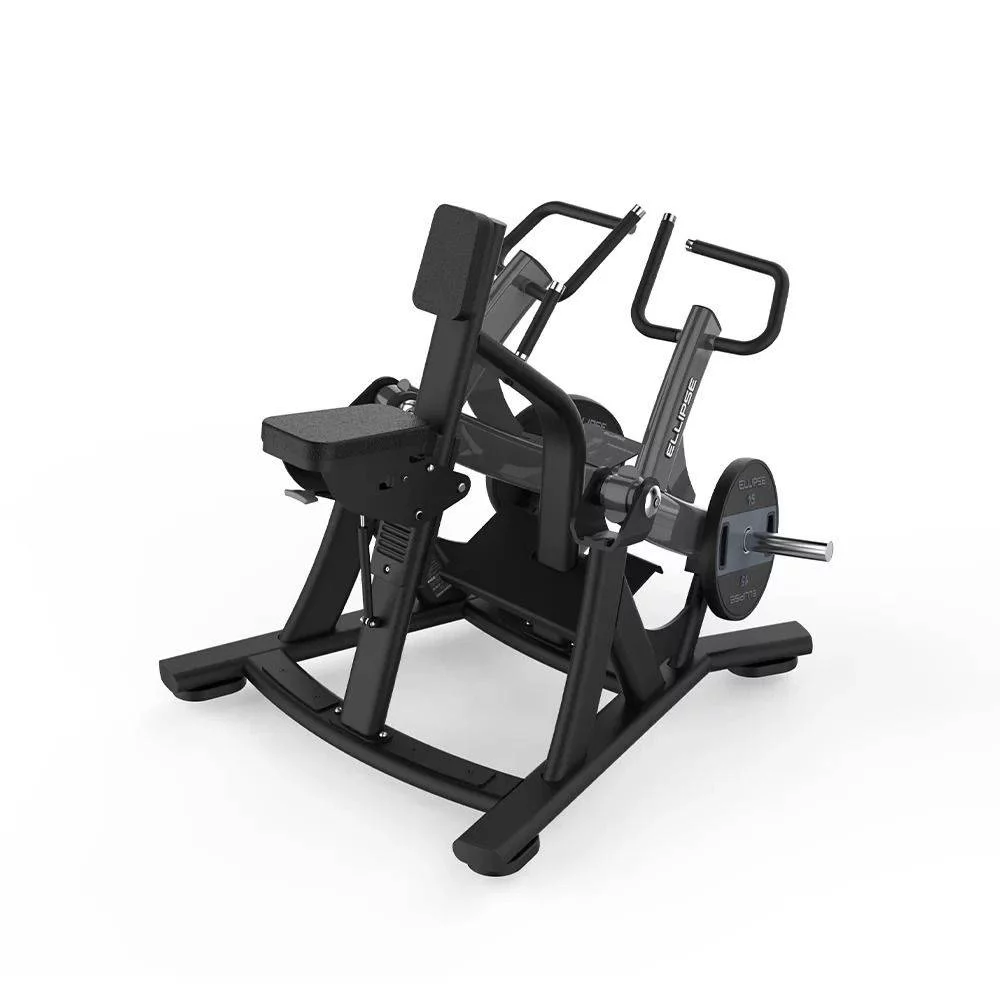
A diverging seated row is one of the most requested back exercises on a commercial gym floor, and the machine that delivers it properly is not a fixed-handle rowing station. On a diverging unit each arm travels on its own path, opening outward as the user pulls, so the movement follows the natural travel of the shoulder blade instead of forcing both arms along one locked line.
What the movement actually is
It is a horizontal pull. The user sits with the arms extended forward, grips the handles positioned either side of the body, and draws the elbows back while keeping them bent. The work is taken mainly by the latissimus dorsi, the rhomboids and the middle trapezius, with the rear deltoids and the arm flexors as secondary movers. Unlike a vertical pulldown, the line of pull stays roughly parallel to the floor, which is what makes it so effective for posture work.
Why the diverging handle path changes the result
What separates this machine from a conventional row is the handle geometry. Because each handle moves outward during the pull, the two sides are mechanically independent. A member with a dominant side cannot let the stronger arm quietly compensate for the weaker one, and the scapula is free to retract along its own arc rather than being held on an artificial track. On the floor this shows up as cleaner technique, more even left-to-right development and less shoulder discomfort for members with restricted mobility.
Where it belongs in a professional line-up
Horizontal pulling is the counterweight to every pressing station you install. A floor built around chest presses and shoulder presses without an equivalent rowing volume produces exactly the rounded-shoulder profile members come to you to fix. A diverging row also transfers directly to sports with a heavy pulling demand such as rowing, climbing and swimming, which makes it a natural fit for clubs, hotel gyms, municipal facilities and rehabilitation centres alike.
Plate-loaded or selectorised?
Both formats deliver the diverging path, and the choice is an operating decision rather than a technical one. A plate-loaded unit such as the Gold Line plate-loaded seated row suits strength-led facilities where members are comfortable handling discs and where you want the loading feel of free weight. A selectorised unit such as the Power Line seated row keeps circuits moving, removes disc handling from the floor and is usually the better answer for hotels, municipal gyms and mixed-ability memberships. The full Gold Line converging and diverging range lets you keep one visual language across the whole area.
Coaching and programming notes
Start members at a light resistance and build progressively. The diverging path is unforgiving of a rushed eccentric: the load should be controlled all the way back to full extension, with the chest kept tall and the elbows tracking close to the torso. Where a member cannot complete the range without the torso swinging, reduce the load rather than shorten the movement.
Frequently asked questions
Which muscles does a diverging seated row train?
Principally the latissimus dorsi, the rhomboids and the middle trapezius, with the rear deltoids, the biceps and the forearm flexors assisting.
How is it different from a lat pulldown?
A pulldown is a vertical pull that emphasises lat width. A seated row is a horizontal pull that emphasises mid-back thickness and scapular retraction. Most facilities install both.
Is the diverging path useful for beginners?
Yes. Because each arm is loaded independently, a beginner cannot mask a weak side, so imbalances are corrected early rather than reinforced.
How much floor space does the machine need?
Footprint varies by model and by the access clearance you plan around it. We confirm the exact dimensions and the recommended circulation space for the model you select before you commit to a layout.
Specifying the right unit for your facility
A diverging seated row is a long-life asset that will be used every day by members of very different sizes and abilities, so the specification is worth getting right first time. Tell us the profile of your site and the equipment already in place, and we will put together a costed proposal for the rowing station and the surrounding strength area. Request a quote and our team will come back to you with dimensions, loading options and delivery arrangements for your market.