Which strength machines are suitable for wheelchair users?
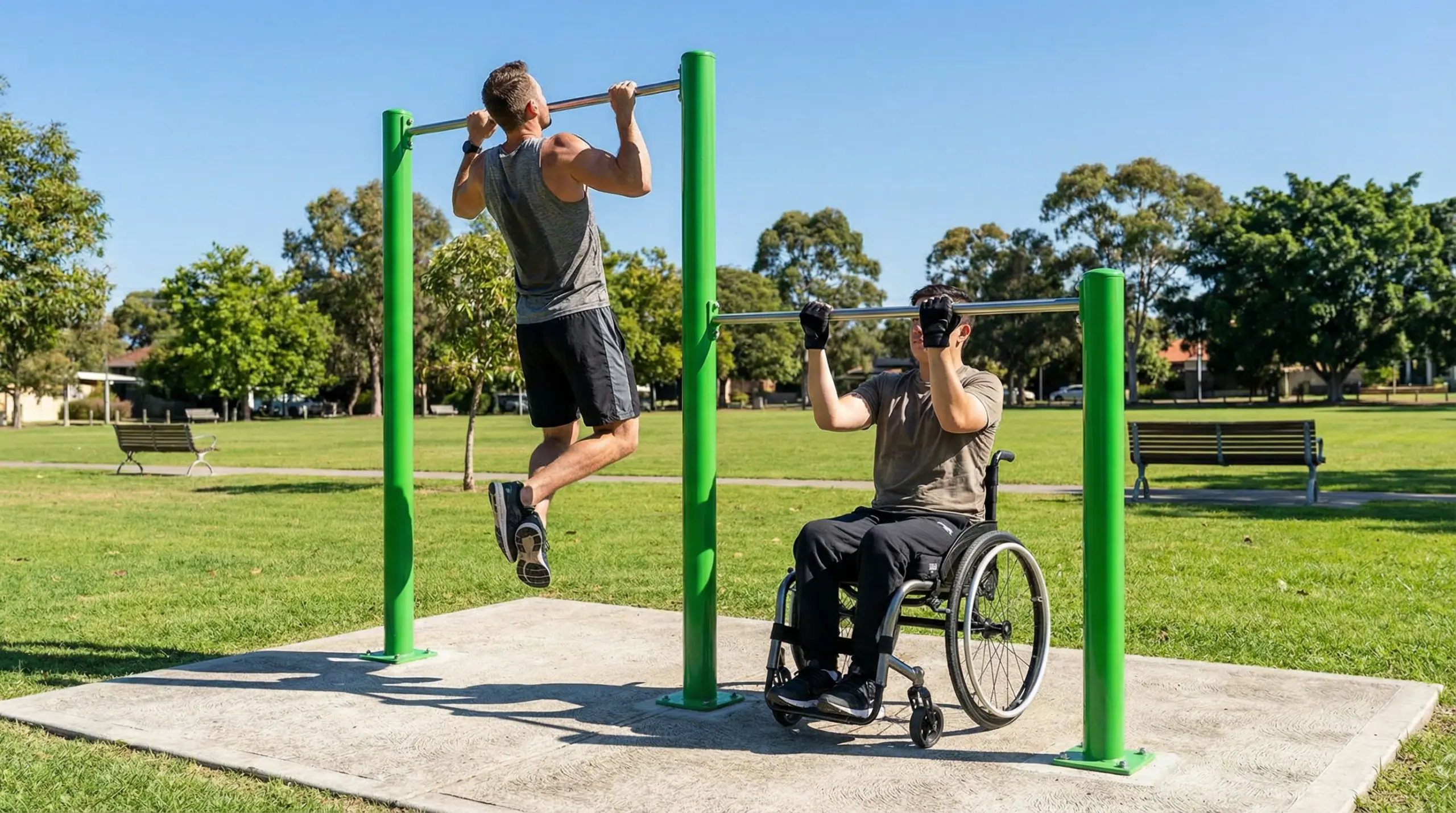
The strength machines best suited to wheelchair users are height-adjustable cable columns, arm presses (chest press and shoulder press) with removable seats or open frames, horizontal and vertical pulling machines, and accessible multi-station units — all allowing a complete upper-body workout with no transfer out of the chair. The two non-negotiables are direct roll-up access and controls reachable from a seated position. Here is the full selection guide, for gym operators building an inclusive floor and for individuals equipping a home space.
The best wheelchair-accessible machine types
Adjustable cable columns
The most versatile option. The pulley positions at any height, enabling more than 30 exercises — rows, biceps curls, triceps extensions, lateral raises, shoulder rotations — and the absence of a fixed seat means the wheelchair rolls straight into position.
Arm presses (chest press and shoulder press)
Guided upper-body presses are accessible when the seat is removable or the frame leaves clear space for the chair. Specialist manufacturers build models with an open bay in place of the seat so the wheelchair positions directly facing the mechanism.
Accessible multi-station units
These group several exercise stations — pulling, pressing, high and low pulleys — on one frame. They are ideal for inclusive gyms because they optimise floor space while covering a full training programme.
Arm ergometers (hand bikes)
Essential cardiovascular work, accessed directly from the chair. The WHO recommends at least 150 minutes of moderate aerobic activity per week for adults with motor disabilities; the hand bike is the most practical tool for reaching it.
Five criteria to check before buying
- Approach space: at least 80 cm of width and around 130 cm of depth clear in front of the machine.
- Working height: handles and mechanisms reachable between roughly 40 and 130 cm from the floor, compatible with a seated position of 45-50 cm.
- Removable seat or open frame: the chair must position directly facing the machine.
- Fine resistance increments: steps of 1 to 2.5 kg allow adapted progression.
- Chair stabilisation: floor locks, wheel chocks or non-slip stops secure the chair during effort.
A sample three-day upper-body programme
| Day | Muscle groups | Exercises | Sets x reps |
|---|---|---|---|
| Monday | Chest / triceps | Chest press + cable triceps extension | 3 x 10-12 |
| Wednesday | Back / biceps | Horizontal row + cable biceps curl | 3 x 10-12 |
| Friday | Shoulders / trunk | Shoulder press + cable rotations + adapted core work | 3 x 10-12 |
Each session should start with 5-10 minutes of hand-bike warm-up and finish with upper-body stretching.
Why strength training matters for wheelchair users
- Shoulder injury prevention. Wheelchair propulsion loads the shoulders heavily every day; targeted strengthening of the rotator cuff and posterior deltoid is associated in physical-medicine research with a markedly lower risk of tendinopathy.
- Autonomy. Stronger arms and trunk make transfers, propulsion and daily tasks easier.
- Cardiovascular health. Strength work combined with aerobic exercise reduces cardiovascular risk, elevated in sedentary wheelchair users.
- Mental wellbeing. Regular training is associated with reduced symptoms of depression and anxiety and improved confidence.
- Bone density. Resistance training helps limit bone loss, an increased risk with reduced mobility.
Where to find accessible equipment
- Specialist indoor manufacturers offer certified accessible ranges with open-frame designs.
- Accessible outdoor stations: our wheelchair-accessible outdoor range brings training into parks and facility gardens — including dedicated units such as the wheelchair-accessible arm trainer.
- Adapting existing machines: many standard machines become accessible by removing the seat, adding approach ramps and fitting chair-locking systems.
Accessibility obligations for gym operators
Across Europe, premises open to the public carry accessibility obligations. For gyms, good practice — and in several countries a regulatory requirement — means:
- Circulation aisles of at least 1.40 m between machines.
- At least two wheelchair-accessible machines per major muscle group.
- Smooth, non-slip, wheel-friendly flooring (smooth-finish rubber tiles).
- Usage instructions displayed at accessible height (90-130 cm).
Investing in accessible equipment is not only a compliance matter: it opens the facility to a wider membership and positions inclusion as a visible part of the offer. The wider clinical context — rehabilitation centres, care homes, hospitals — is covered in our healthcare fitness equipment guide.
Designing the inclusive strength zone: a layout walkthrough
For an operator adding accessibility to an existing floor, the practical sequence looks like this:
- Map the accessible route from the entrance to the zone: door widths, thresholds, lift access, and a firm, smooth floor surface throughout — deep-pile or heavily studded surfaces resist wheels.
- Cluster the accessible machines rather than scattering them: a compact inclusive zone with a cable column, an open-frame press and a hand bike is more usable (and more visible) than isolated machines across the floor.
- Free the approach zones. The 80 x 130 cm approach rectangle in front of each machine must stay permanently clear — not used for dumbbell parking or plate storage.
- Lower the periphery. Hooks for bags and crutches, water and wipes within seated reach, mirrors angled for a seated eyeline.
- Train the team. Staff should know how to remove seats, fit chair chocks and spot seated pressing safely; ten minutes of onboarding per employee changes the member experience completely.
Budget-wise, converting an existing floor is often cheaper than expected: a dual adjustable cable column plus chair-locking accessories and signage typically costs less than one additional selectorised machine, and immediately serves every member — standing users train on the same column.
Common design errors to avoid
- Buying an “accessible” machine but installing it against a wall that blocks the wheelchair’s turning circle (allow 150 cm of turning diameter nearby).
- Choosing machines whose weight-stack pins sit outside seated reach — test the full adjustment sequence from a chair before purchase.
- Relying on staff transfers instead of roll-up access: transfer-dependent equipment excludes independent training and creates manual-handling risk.
- Forgetting emergency egress: the inclusive zone must sit on the accessible evacuation route, not behind a step.
Frequently asked questions
Which single machine offers the most exercises from a wheelchair?
An adjustable dual cable column: over 30 upper-body exercises with direct roll-up access and fine load increments — the best value per square metre for an inclusive floor.
How much clear space does an accessible machine need?
Plan an approach zone of at least 80 cm wide and 130 cm deep in front of the machine, within circulation aisles of 1.40 m.
Can wheelchair users train legs on machines?
It depends on the individual’s condition. Where active or assisted lower-limb work is medically appropriate, active-passive pedal trainers and adapted leg equipment are used under professional guidance — always coordinate with the treating clinician.
Are there wheelchair-accessible outdoor fitness machines?
Yes — EN 16630-compliant outdoor stations exist in wheelchair-accessible versions (arm trainers, push-pull stations, hand-wheel units), in galvanised or stainless steel for minimal maintenance.
Build an inclusive training floor
Light In Fitness supplies accessible indoor and outdoor equipment, smooth-rolling sports flooring and layout plans that meet accessibility rules — with delivery and installation across Europe. Request a free quotation within 24 working hours.
Réalisations documentées
- Cage street workout ultime, Carcassonne – armée française
- Cage street workout ultime, Tahiti – armée française, Polynésie
- Cage SP Max, centre EPIDE de Combrée – établissement public d’insertion
- Cage SP Max, lycée Saint-Bénigne de Dijon – établissement scolaire