The seven resistance systems in professional strength equipment
Behind the word resistance sit seven distinct technologies with radically different load curves, maintenance costs and use profiles. A buyer who only knows weight stacks is missing forty years of biomechanical development. The resistance system determines four things that no specification sheet headline captures: the load curve across the joint angle, the stability of the resistance over years of service, the maintenance the machine will demand, and the minimum load, which decides whether the equipment is usable with vulnerable populations at all.
Why the resistance system is the critical variable
A biceps curl demands peak force around 90 degrees of elbow flexion; a leg press demands the opposite, with peak force at extension. If the system does not follow the physiological force curve, the machine is poorly matched to the exercise regardless of the maximum load printed on it.
Resistance stability matters over the fleet’s life: magnetic systems drift very little, free plates do not drift at all, elastic bands drift a great deal. Maintenance differs just as sharply: a cam and cable system needs cyclical part replacement, a magnetic system has almost no wear part. And the minimum load, 1 kg against 10 kg, is what determines whether a health centre or a physiotherapy practice can use the machine with its actual patients.
The seven systems
1. Free plates. Bar plus plates under gravity, in use for more than a century. Resistance is mass multiplied by gravitational acceleration: simple, robust, infinitely modular in 1.25 kg steps. Constant load curve, minimum 20 kg with an Olympic bar, service life 30 to 50 years, almost no maintenance. It demands technical coaching, carries injury risk without correct technique, gives no physiological load variation, and requires 30 to 40 mm flooring under the drop zone.
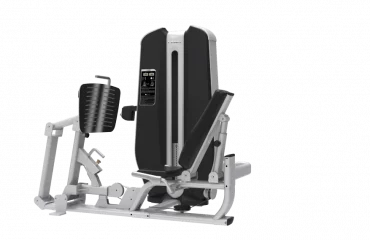
2. Weight stack with a simple pulley. The undisputed standard of fitness floors since the 1970s. A stack of plates, usually 5 kg each, lifted through a cable over a fixed pulley, selected with a pin. Constant or near-constant curve, 5 kg minimum (sometimes 2.5 kg), 80 to 150 kg maximum, 15 to 20 year service life with cables replaced every 3 to 5 years. Fast selection and guided safety, at the cost of a load curve that does not follow physiology.
3. Weight stack with a variable-profile cam. The major innovation of the 1970s. A non-circular cam alters the effective torque according to joint angle, reproducing the muscle’s physiological force curve: more resistance where the muscle is strong, less where it is weak. Variable curve, 2.5 to 5 kg minimum, 100 to 180 kg maximum, 15 to 25 year service life. Purchase cost runs 30 to 60% above a simple pulley machine, and the cam is a precision component that must be correctly calibrated.
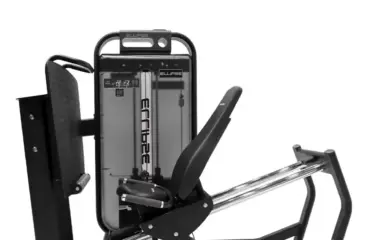
4. Plate-loaded with articulated levers. Gravity from Olympic plates combined with a mechanically guided path. The lever arm can incorporate a cam to modulate torque by angle. Variable curve by geometry, 10 kg minimum (one plate), over 300 kg maximum, 20 to 30 year service life and low maintenance because there is no cable. It needs plate storage close by and loading takes longer than moving a pin.
5. Pneumatic. Resistance from air compressed in a cylinder controlled by an electronic valve, adjustable mid-movement. Fully programmable curve, 0.5 kg minimum with increments as fine as 100 g, 150 to 200 kg maximum, 15 to 25 year service life. There is no inertia, which removes the mass effect on acceleration. Purchase cost runs two to three times a weight stack, a compressor is needed (noise and consumption), and the technology is proprietary, which narrows the parts supply.
6. Magnetic (eddy current). Permanent magnets acting on a conductive disc or flywheel. Mainly cardio today, emerging in strength. Resistance proportional to speed, effectively zero minimum, 400 to 1,000 W in cardio applications, near-unlimited service life and no maintenance because nothing touches. Silent and precisely measurable in watts. The limitation is intrinsic: at rest, resistance is zero, which is an advantage in cardio and a constraint in pure strength work.
7. Active electromagnetic (smart resistance). A brushless motor regulates resistance in real time under software control, sampling position, speed and applied force at high frequency. It enables modes mechanical systems cannot produce: isokinetic, augmented eccentric, descending chains. Fully programmable curve, 0.1 kg minimum, 100 to 200 kg maximum. Service life is limited by the electronics at 8 to 12 years, purchase cost runs three to five times a weight stack, it needs a permanent power supply, and firmware obsolescence is a genuine risk.
The seven systems side by side
| System | Load curve | Minimum load | Relative cost | Service life | Best fit |
|---|---|---|---|---|---|
| 1. Free plates | Constant | 20 kg | Low | 30 to 50 years | Strength, CrossFit, weightlifting |
| 2. Stack, simple pulley | Near-constant | 5 kg | Moderate | 15 to 20 years | Mid-market club |
| 3. Stack with cam | Physiological | 2.5 kg | High | 15 to 25 years | Premium club, targeted rehabilitation |
| 4. Plate-loaded lever | Variable by geometry | 10 kg | High | 20 to 30 years | Performance, boxes |
| 5. Pneumatic | Programmable | 0.5 kg | Very high | 15 to 25 years | Physiotherapy, adapted activity, rehabilitation |
| 6. Magnetic | Speed-dependent | Around 0 W | High | Near-unlimited | Cardio, quiet hotel spaces |
| 7. Active electromagnetic | Fully programmable | 0.1 kg | Highest | 8 to 12 years | Premium club, boutique studio |
Which combination for which project
| Project | Recommended combination |
|---|---|
| Mid-market club, 300 to 600 members | Systems 1 + 2 + 4. Free plates on the strength zone, weight stacks on the guided zone, plate-loaded for the visual high end. Add system 3 on three or four signature machines if budget allows. |
| Four or five star hotel, quiet wellness space | Systems 2 + 6 only. Silence, invisible maintenance, no noisy free weights. |
| Physiotherapy practice, health centre, care home | Systems 3 + 5 + 6. Cams for the physiological curve, pneumatic for very low loads in adapted activity, magnetic for safe cardio. |
| CrossFit box, athletic preparation | Systems 1 + 4. Free plates as the base, plate-loaded for accessory work. Systems 2, 3 and 5 are rare in a pure box. |
| Boutique studio, premium personal training | Systems 5 + 7. Precise tracking and individualised protocols, justified by the pricing position. |
For reference on real pricing across systems: the Etenon R8503 dual leg extension and seated leg curl, selectorised with a counterbalanced arm, is 4,590 EUR excluding VAT; the Bodytone FH53 seated leg curl is 4,980.10 EUR excluding VAT; the Bodytone Solid Rock hack squat, plate-loaded, is 5,480 EUR excluding VAT. Our article on selectorised versus plate-loaded machines covers the arbitration in more depth.
Five questions to put to any supplier
Which system exactly: stack with simple pulley, stack with cam, plate-loaded, pneumatic, magnetic or electromagnetic? The answer is precise, or the supplier deflects. What is the minimum load: 5 kg is fine for a mid-market club, 2.5 kg for targeted rehabilitation, 0.5 kg for severely deconditioned users. What is the real load curve: constant, physiologically variable, or programmable? Marketing often says adapted curve without saying how. What maintenance over ten years: cables to replace, pneumatic servicing, software calibration? And which specific wear parts: pulleys, cables, pneumatic seals, sensors. Each system has its consumables, and they need to be stocked by your supplier, not imported on demand. See after-sales and spare parts.
Frequently asked questions
Is a cam machine worth 30 to 60% more than a simple pulley?
On signature machines, often yes: chest press, lat pulldown, leg press. Across a whole floor, rarely. Mid-market members do not discriminate between load curves on every station, but they do notice the feel of the three or four machines they use every session. Buy the cam where the traffic is.
Which system suits low-load adapted physical activity?
Pneumatic, which starts at 0.5 kg with 100 g increments, or active electromagnetic at 0.1 kg. Conventional weight stacks start at 5 kg, sometimes 2.5 kg, which excludes a meaningful share of rehabilitation and older users from upper-body work entirely.
Why do electromagnetic machines have the shortest service life?
Because the limiting component is electronic, not structural. The frame will outlast the control board and the software support window. Budget for an 8 to 12 year cycle and confirm the firmware support commitment in writing before ordering.
Do free plates really need special flooring?
Yes. Thirty to forty millimetres of rubber under the drop zone is the working minimum, and on an upper floor an acoustic underlay goes below it. See our tile density guide.
Get the systems matched to your audience
Light In Fitness has been a manufacturer and B2B distributor of professional fitness equipment since 2013, based in Tours, France, with more than 2,500 customers equipped. We audit the biomechanical needs of your target users, select the resistance technologies that fit, and quote transparently system by system, from a physiotherapy practice to a premium boutique studio. Browse the strength training machines and plate-loaded machines ranges, then request a quote. We reply within 24 working hours.
Sources et références
- Code du sport, articles R322-4 à R322-43 – garanties d’hygiène et de sécurité applicables aux établissements d’activités physiques et sportives (Légifrance)
À lire aussi sur le même thème
- Selectorised vs Plate-Loaded: the 8-Criterion Procurement Framework by Facility Type
- Professional gym accessories: dumbbells, kettlebells, bands and plyo equipment specified for commercial use
- Smith Machine or Multi-Station? Saving Floor Space Without Losing Training Value
- How to equip a 50 square metre strength zone: clearances, building checks and budgets