Which Gym Machine to Choose: A Guide by Training Goal
Le choix d'un appareil part du groupe musculaire visé et du niveau d'encadrement disponible. Les machines guidées conviennent à une pratique autonome, les charges libres à une pratique encadrée ou expérimentée. La surface disponible détermine ensuite le nombre de postes envisageables.
Every equipment list starts with the same question, asked in a hundred different ways: which machine should we buy? The honest answer is that no single station is best in the abstract. What decides it is the muscle group you need to cover, the level of supervision available on your floor, and how much square metreage you can give the station. This guide works through the questions operators actually ask when they build a strength and cardio floor.
Before the individual stations, one principle: guided machines suit largely autonomous use, free weights suit supervised or experienced use, and the available floor area then sets how many positions you can realistically install.
Which machine covers the most muscle groups at once?
The rowing machine. It loads the arms, the legs, the back and the trunk in a single movement while delivering a genuine aerobic stimulus. For a facility with limited space and a broad membership, a bank of professional rowing machines gives more coverage per square metre than almost anything else on the floor.
Which cardio machine is the most complete?
The cross trainer. It works the whole body, engaging arms, legs, glutes and trunk, and it does so with low joint impact. That combination makes it the default recommendation for mixed-ability memberships, for older users and for any facility where a proportion of members have joint limitations. Cross trainers are also among the easiest machines to use unsupervised, which matters in hotels and municipal sites.
Which machine suits a compact facility?
The upright exercise bike. It trains the legs and glutes and delivers cardiovascular work in a small footprint, and most professional models carry a range of built-in training programmes that keep users engaged without a coach standing over them. For hotel fitness rooms, campsite gyms and small corporate facilities, bikes are usually the first cardio purchase.
Which is the most used strength station on a commercial floor?
The leg press. It builds the quadriceps, hamstrings and glutes in an isolated, controlled path, which makes it approachable for beginners and productive for experienced lifters. The vertical leg press variant is worth considering where floor area is tight, since it uses a much smaller footprint than a 45-degree unit.
Which station for trunk and abdominal work?
The adjustable incline bench. It supports a wide catalogue of trunk exercises, from crunches to torso raises to oblique work, and it provides lumbar support that reduces the risk of the user rounding under load. One bench serves many exercises, which is exactly what you want when floor area is the constraint.
Which station for the lower back?
The back extension bench. It strengthens the lower back musculature in a controlled position and adjusts to the user, which makes it usable across a wide range of fitness levels including supervised reconditioning work.
Which station for the back and pulling strength?
The pull-up bar, and by extension the pull-up station on a rack or rig. It loads the back, shoulders and arms as a whole rather than in isolation, it costs very little floor space, and it scales from assisted variations to advanced work. Every serious strength area should have one.
Which station for posture work?
The rowing machine again, for a different reason. Alongside strengthening the back musculature, the rowing pattern reinforces a pulling action that most desk-bound users under-train, which supports postural balance between the front and back of the trunk.
Which station for the glutes?
A dedicated glute station. Hip thrust, glute kickback and abductor machines isolate the gluteal musculature and load it in a controlled path, which is why they have become standard on commercial floors rather than a niche addition. Our professional strength training range covers the full set.
A note on training goals
Members will ask which machine reduces fat in a specific area. It is worth being clear with your team: exercising one part of the body does not preferentially remove fat from that part. Body composition change comes from overall energy balance and total training volume, not from targeting a region with a particular machine. Choose stations for the muscle groups you want to train and the sessions you want to programme, and let the composition question be answered by the programme as a whole.
Specification: what to insist on
Whatever the station, indoor equipment installed in a supervised multi-user facility should be specified to EN ISO 20957-1 class S. Beyond that, check the adjustment range against the body sizes you actually serve, check that spare parts for that specific model are available, and check the footprint against your installed clearances rather than against the catalogue drawing.
Frequently asked questions
Should a small facility buy cardio or strength first?
It depends on the offer you sell. A hotel or campsite generally starts with cardio because it needs no supervision. A club selling coached strength sessions starts with racks, benches and selectorised stations.
How many stations does a floor need?
Work from peak concurrent users, not from total membership. The number of positions has to absorb your busiest hour, and the circulation space between them is part of the calculation, not an afterthought.
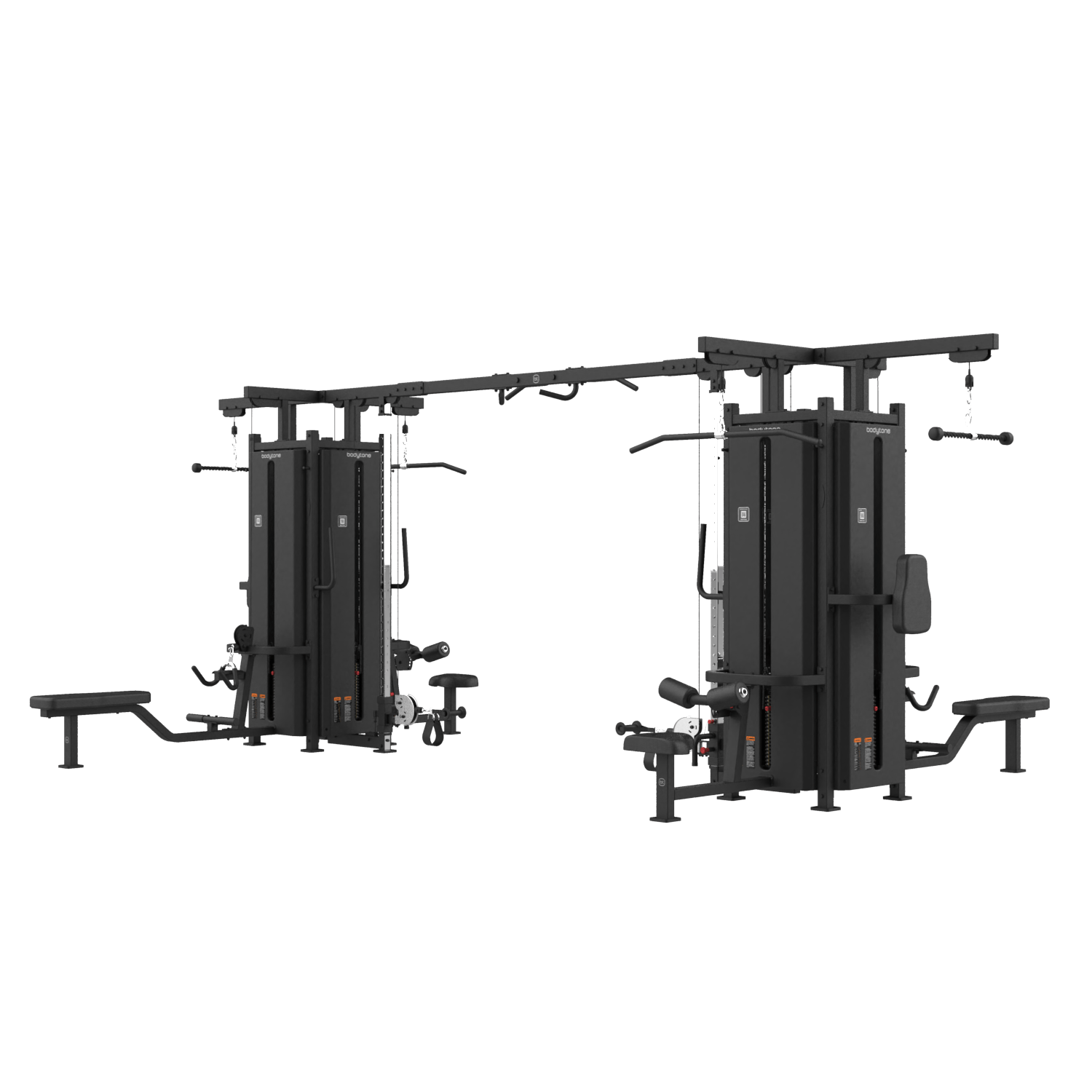
Are multi-station units a good compromise?
They are, where floor area is severely limited and concurrent use is low. On a busy floor they become a bottleneck because only one or two people can use the unit at once.
Building your equipment list
The right list depends on your floor plan, your peak occupancy and the sessions you programme. Send us those three things and we will return a costed configuration. Request a quote.