Professional Strength Training Station: How to Choose
If you are equipping a commercial gym, a school sports hall, a physiotherapy practice or a hotel fitness room, the professional strength training station is usually the first machine on the specification list. It concentrates the widest range of exercises into the smallest footprint, and it is the piece of equipment that will absorb the heaviest daily use over the longest period.
This guide covers what separates a genuinely professional station from lighter equipment, the materials worth examining, the safety points to check, and the questions to answer before you request a quotation.
What a professional strength training station actually is
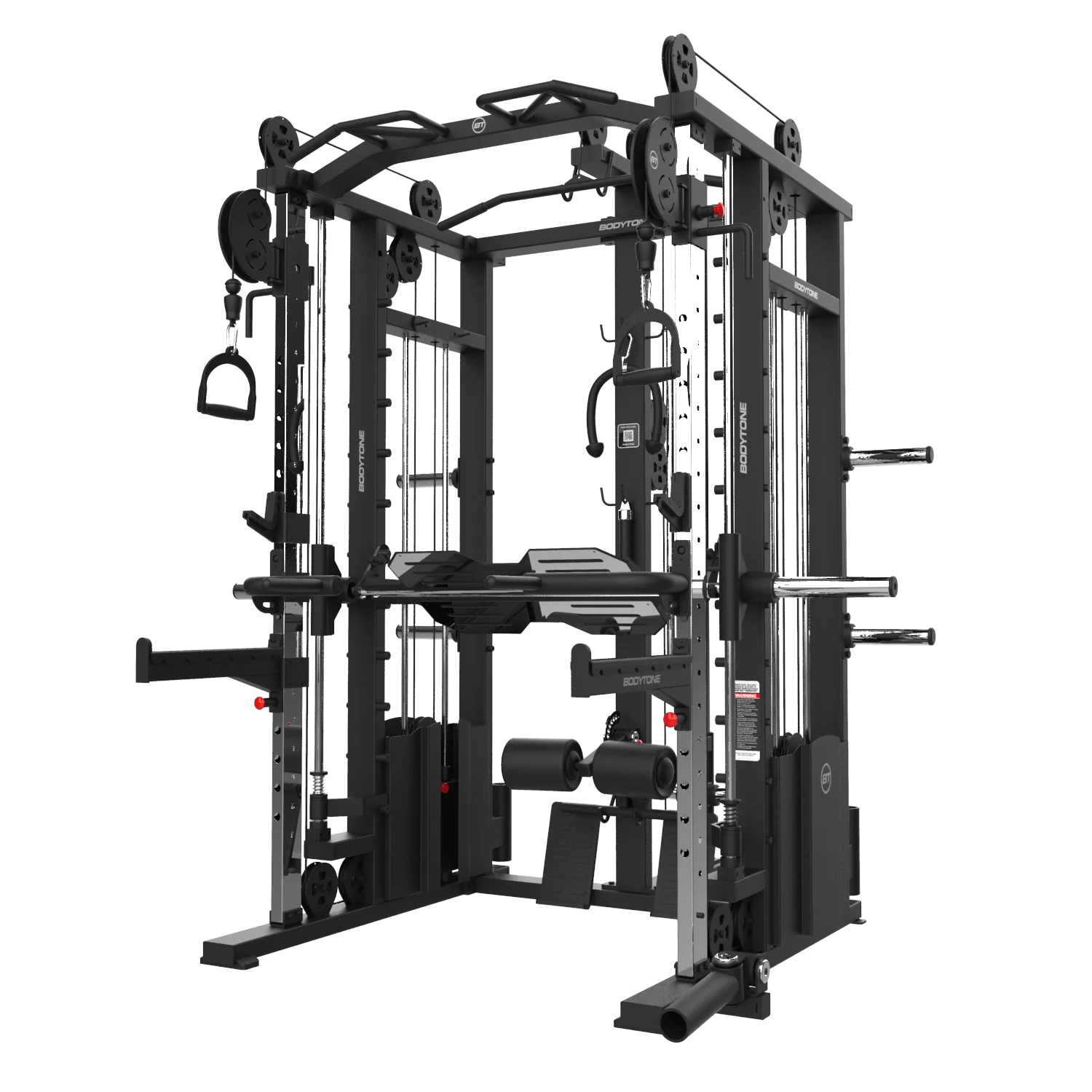
A professional station is a multi-function frame designed for continuous use in a supervised facility. Where a single machine trains one movement, a station combines several workstations on one structure: adjustable pulleys, a barbell support, dip bars, a pull-up bar, and dedicated upper-body and lower-body positions.
The applicable reference framework for indoor equipment of this kind is EN ISO 20957-1 class S, the class that covers machines intended for professional and commercial environments. It is what allows an operator to open the equipment to members without permanent one-to-one supervision and to an uninterrupted daily rotation.
Adjustable benches are part of most configurations, so the same frame serves several muscle groups without changing machine. Because the structure is modular, reconfiguring or relocating a station when a room is redesigned stays straightforward.
Rehabilitation is a second major use. Physiotherapists and clinics work with professional stations to build individual treatment plans: the load is adjusted in small increments and the movement path stays guided, which matters when a patient is returning to load after injury.
You can browse the full catalogue of professional strength training machines to see how the different families compare.
Materials: what really determines service life
Quality is the first thing to look at, and quality is decided by materials. They determine how a frame behaves after several years of loaded, repeated use.
Professional strength equipment is built around a steel structure. Steel is what makes both the load capacity and the safety of the assembly possible, and a well-built professional station stays in service for decades rather than seasons.
Four points are worth examining on any quotation: the section and thickness of the steel tubing, the quality of the welds at load-bearing joints, the surface treatment protecting the frame from sweat and humidity, and the wearing parts, meaning cables, pulley bearings and upholstery, which take the daily abuse and should be replaceable individually.
Buying professional equipment is what allows a facility to run a real, sustained strength and conditioning programme. Our team is available to review your configuration before you commit to it.
Shared equipment has to be safe by design
On equipment used by dozens of different people every day, safety is not a feature, it is the specification. Premium build, finish and design come together on this point: rounded edges where users pass, guarded weight stacks, clear pin travel, and a frame that does not move under an off-centre pull.
A professional station is also safer because it guides the movement. Changing the angle of work or fitting a different handle lets you target another muscle group without asking the user to stabilise a free load. That versatility is exactly why professional equipment dominates staffed gyms and performance centres.
Finally, high-grade materials keep their tolerances. If you need equipment that will take regular use without visible wear or developing play, the investment has to go into build quality, not into the accessory count.
The main configurations
Stations come in a range of sizes and layouts, each with its own workstations for training different muscle groups under heavy load:
- height-adjustable facing pulleys
- barbell support
- dip station
- pull-up bar
- dedicated upper-body and lower-body positions
Several stations can also be combined to build a coherent training circuit. A common approach is to start from an adjustable-resistance station and add one or more loaded bars around it.
Then comes the layout itself. Free-standing training stations often integrate shelving for accessories, which keeps the surrounding floor clear. Wall-mounted stations suit rooms where floor area is the constraint and where you want to limit circulation around moving parts. A multi-station gym concentrates several exercises on a single frame and is generally the best answer when one machine has to cover a whole programme.
For guided-resistance work with fine load increments, the cable stations range is the other option worth comparing.
Why invest in a strength training station
The arguments are consistent across facility types: a small footprint for the number of exercises delivered, an assembly that a technical team can handle, and a steel structure that underwrites safety. Over the life of the room, one station replaces several single machines, which is where the saving actually comes from.
Small footprint
A station delivers a full programme on a floor area that a set of individual machines could never match.
Straightforward assembly
The large majority of stations are simple to assemble, and many are up and usable within a few hours.
Several body areas at once
Facilities short on floor area gain the most: one frame trains several body areas in the same session and keeps traffic flowing.
A wide range of settings
Stations are versatile enough for commercial gyms, school and club halls, hotel and campsite fitness rooms, municipal facilities and rehabilitation centres alike.
The checks to run before you order
The room and the intended use
Start with the environment. Is the room open to the public or reserved for a squad? Is there enough clear space around the frame? What does the programme require: squats, leg press, pulling work, or all of it? Answer these first, then start comparing machines.
Machine size
Measure the space you actually have, not the space you would like. If the room is tight, look at stations that can be dismantled or moved when the space is needed for something else. Note also that some frames have rounded corners and others square ones: a corner installation calls for rounded corners. Wheeled bases make repositioning far easier.
Materials and assembly
Look at what the frame is made of and whether it can be taken apart when it is not needed. For daily use, choose high-grade materials and a design that assembles cleanly.
Load capacity
Read the manual for the model you are considering: some units accept only 70 kg while others go up to 135 kg. That single figure often decides whether a station fits your user profile.
Stability
If the machine has to take a heavy load, check that the base is wide enough to keep the frame planted. Read the technical documentation in detail rather than relying on the photograph.
Accessories supplied
Ask what comes with the machine. A leg extension bar, a dip station or additional pulley attachments change what the station can deliver. A station supplied with the right accessories covers a far wider programme.
Light In Fitness
Light In Fitness supplies professional strength and conditioning equipment to gyms, clubs, schools, hotels, public facilities and rehabilitation centres. Alongside strength stations, the catalogue covers treadmills, upright and recumbent bikes, ergonomically designed rowers and indoor cycling machines, as well as mats and floor protection.
The strength station range spans several load capacities and structural formats, so a configuration exists for most programmes and most room sizes. Clean design is not only about appearance here: uncluttered frames are easier to supervise, easier to clean and easier to maintain.
Single-station machines such as the Power Line assisted pull-up and dip machine are often specified alongside a main station to spread traffic at peak hours.
Frequently asked questions
Is a professional station suitable for a rehabilitation setting?
Yes. Guided movement paths and fine load adjustment are exactly what a clinical protocol needs, which is why physiotherapy practices specify the same equipment as performance gyms.
How much load can a station take?
It varies by model, from around 70 kg on the lighter units up to 135 kg on others. The manual for the specific model is the reference, and the figure should be matched to your heaviest regular user, not your average one.
Free-standing or wall-mounted?
Wall-mounted stations save floor area and reduce circulation around moving parts. Free-standing stations are easier to reposition and usually offer more integrated storage. Room shape decides more often than programme does.
How long does a professional station last?
Built from high-grade materials and maintained normally, a professional frame stays in service for decades. Wearing parts such as cables and upholstery are consumables and should be replaceable on their own.
Specify your station with us
Whether you are equipping a rehabilitation room or raising the ceiling on athlete performance, the right station is the one matched to your floor area, your user profile and your programme. Send us your room dimensions and your intended use and we will come back with a configuration and a costed proposal: request a quote.