Why a Fully Equipped Power Rack Is the Heart of Strength Training
A modern power rack is far more than a stand for an Olympic barbell. Equipped and programmed properly, it becomes the centre of a complete strength programme, from a first-time member to a high-level athlete. For a gym operator, a performance centre or a club it is also one of the few pieces of equipment that concentrates a large part of the training offer into a single footprint.
What a power rack is really for
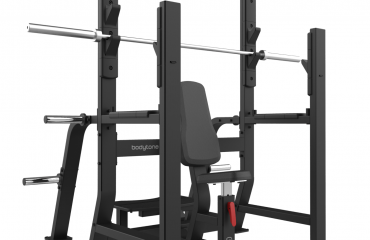
Using a rack only as a barbell holder for a few back squats means missing most of what it can do. With the right accessories – safety catches, additional bars, resistance bands, handles, lifting platforms – a rack covers:
- maximal strength
- power, meaning speed combined with load
- hypertrophy
- technical work on the fundamental lifts
In practice, one well-specified rack can carry almost an entire strength programme. That matters when floor space is the real constraint, which it is in most commercial gyms and hotel fitness rooms. Browse the full range of racks and cages to see how configurations differ.
Maximal strength: heavy loads, controlled risk
For maximal strength work – squats, presses, heavy pulls – the rack:
- secures heavy barbells with adjustable safety catches
- allows work from different heights: partials, work out of the hole, lockouts
- makes training without a spotter possible while keeping a real safety margin
An open rack is enough for basic work, but a closed cage gives a higher level of protection, especially as members approach loads close to their maximum. In a commercial setting that difference is a supervision question as much as a training one. Compare formats in the squat racks and power racks section.
Power and work from a dead stop
Power training is where a rack really pulls ahead:
- work at a percentage of maximum, with moderate load but maximum bar speed
- starts from the safety catches, a dead stop at the bottom position, on squats, presses, pulls and weightlifting variations
The goal is to maximise speed and force production without forcing athletes to handle extreme loads, which reduces joint stress. It also makes the movement easier to coach: with the bar starting from a fixed height, every repetition begins in the same position.
Three training zones inside one rack
Rack work can be structured into three types:
- Explosive power zone, 1 to 2 reps
- weightlifting variations, jumps with the bar, explosive upper-body work
- starts from the safety catches, with the emphasis on speed
- Strength and controlled power zone, 3 to 5 reps
- squats, presses and pulls with pauses, work with bands or chains
- use of stops, safety bars and elastic resistance to shape the strength curve
- Hypertrophy and accessory zone
- pull-ups, dips, barbell rows, band work, unilateral exercises
- additional attachments and accessories around the frame
A single structure therefore becomes a complete station for a strength athlete or a committed member.
Why high-rep strength endurance does not belong in a rack
Very long sets, 15 or more heavy barbell repetitions, performed inside a rack:
- place heavy wear on the musculoskeletal system
- make clean technique hard to maintain
- return little for the risk taken
For strength endurance, machines, moderate loads, circuits and lower-risk variations are the better answer. Selectorised and plate-loaded strength training machines are designed for exactly that part of the programme, and they also free the rack for the members who need it.
A standard in high-level facilities
Fully equipped racks are found in:
- professional teams: ice hockey, basketball, American football, rugby, football, combat sports
- performance centres and elite strength and conditioning departments
- a growing number of performance-oriented commercial gyms
Their spread is changing how training floors are designed. Instead of lining up isolated machines, operators now build the room around versatile strength stations, with open circulation and a clear coaching sightline across the platform.
Frequently asked questions
Open rack or closed cage?
An open squat rack takes less space and suits a small studio or a hotel fitness room. A closed cage protects the lifter on both sides of the bar and is the safer choice as soon as unsupervised heavy training is expected.
How much space should be planned around a rack?
Plan for the barbell length plus free circulation on both sides, and enough clear height for overhead pressing and pull-ups. Exact figures depend on the model and on the ceiling, so confirm them against the technical sheet of the frame you select.
Which accessories matter most?
Adjustable safety catches, a solid pull-up bar, band pegs and a stable platform cover most needs. Dip handles, landmine attachments and storage horns are the usual next step.
Can a single rack serve a whole gym?
In a small facility, yes. Beyond that, throughput becomes the limit: a rack is occupied for long sets with long rest periods, so busy sites usually pair several frames or add a rig.
Specifying your strength area
A rack is a structural choice, not an accessory purchase: it sets the layout, the flooring, the clear height and the training offer for years. Light In Fitness manufactures and supplies professional strength equipment for gyms, clubs, performance centres, hotels and public facilities. Send us your floor plan and your intended use and we will come back with a configuration and a costed proposal – request a quote.