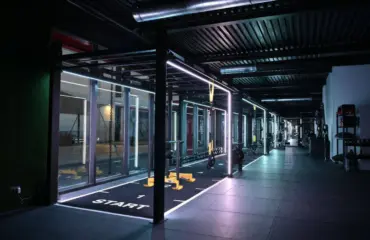
Europe's Number One in Professional Strength Training Equipment
Strength training does far more than build muscle. For a professional operator it is the category that drives dwell time, retention and revenue per square metre, and it is also one of the most effective tools your members have for managing body composition. The question is rarely whether to install strength equipment, but which mix of machines will serve a full floor at peak hours, year after year.
Why the strength area decides the economics of a facility
A cardio row empties when the weather improves. A well-planned strength area does not. It is used by beginners following a guided circuit, by experienced members working through split routines, and by rehabilitation clients rebuilding capacity under supervision. Because each station serves a different movement pattern, the area absorbs far more simultaneous users than the same surface given over to a single discipline.
That is also why equipment selection cannot be improvised. The machines have to survive continuous commercial duty, accept users of very different sizes and abilities, and be arranged so that a supervisor can see the whole floor at a glance.
What professional actually means: EN ISO 20957-1 class S
Indoor training equipment is covered by EN ISO 20957-1. Class S is the classification for equipment intended for professional and commercial use: reinforced frames, guarded moving parts, stability under continuous load and the durability testing that goes with unsupervised public access. Class I is the professional class covering inclusive access for users with reduced mobility; it is a different intended use, not a step above class S.
Every indoor machine in our range is specified to class S. If a supplier quotes you a machine without naming its class, treat the omission as an answer.
Selectorised, plate-loaded or free weights?
Selectorised machines guide the movement and let a user change resistance in a second with a pin. They are the safest entry point for beginners, the fastest option for circuit programming, and the least demanding in terms of supervision. Our selectorised strength machines cover the full set of pushing, pulling and lower-body patterns.
Plate-loaded machines reproduce a guided path with the feel of free weight and the visual appeal that experienced members look for. They cost less per station, need no cable maintenance, and scale simply by adding discs. See the plate-loaded range.
Benches and free weights remain the backbone of any serious floor. A rack of adjustable and specialised weight benches multiplies the number of exercises available without adding a single square metre of machine footprint.
Most facilities need all three. The proportions are what change: a hotel or residential gym leans heavily on selectorised stations and benches, a performance club on plate-loaded and racks, a municipal facility on guided equipment that a non-specialist team can supervise safely.
Building the area: a category checklist
- Abdominal and back stations – compact machines that stabilise the trunk and correct posture. They are the stations beginners come back to.
- Functional training equipment – complex, multi-joint movements involving several muscle groups at once, training coordination, mobility and strength endurance as well as hypertrophy.
- Benches – flat, incline, decline and specialised. Countless exercises can be run on a bench, many of them without any barbell at all.
- Small strength equipment – stands, lifting gloves, barbell collars and the accessories that make a session efficient rather than improvised.
- Accessories and storage – training gloves, pulling handles, grips and weight racks. Storage is not an afterthought: it is what keeps the floor safe and the audit clean.
The full catalogue of professional strength training machines is organised along these lines so you can build a room category by category rather than product by product.
Programming advice worth passing on to your members
Beginners should start calmly. Leave roughly 48 hours between sessions working the same muscle group on strength machines: the muscle recovers better and progress is faster than with daily repetition. That single rule prevents most of the early drop-outs a new strength area suffers, and it costs nothing to communicate on the floor.
Moderate training – a few sessions a week – is already enough to counteract the muscle loss that comes with sedentary weekdays. This is the argument that convinces the members you have not yet reached: better posture, better everyday capacity, better health, not only visible muscle.
Frequently asked questions
How much space should I allow for a strength area?
Plan around the movement envelope of each station and the circulation between them, not around the footprint printed in the catalogue. Send us your floor plan and we will return a layout with the real clearances.
Can selectorised and plate-loaded machines be mixed in one room?
Yes, and most well-used floors do exactly that. Group them by movement pattern rather than by technology so a member can complete a full session without crossing the room repeatedly.
Which equipment suits a supervised rehabilitation setting?
Guided, selectorised stations with fine resistance increments and easy access. Ask for the class I inclusive-access options where wheelchair transfer is required.
How long does professional strength equipment last?
Class S frames are built for continuous commercial duty. Lifespan on the floor is driven far more by upholstery, cable and bearing maintenance than by the frame itself, so budget for a service plan from day one.
Specify your strength area with us
Tell us the surface available, the profile of your members and the opening hours you need to cover, and we will come back with a station-by-station proposal and a costed quote. Start here: request a quote.