Bodytone FBC07 Olympic Incline Press: Specification, Use and Limits for Commercial Gyms
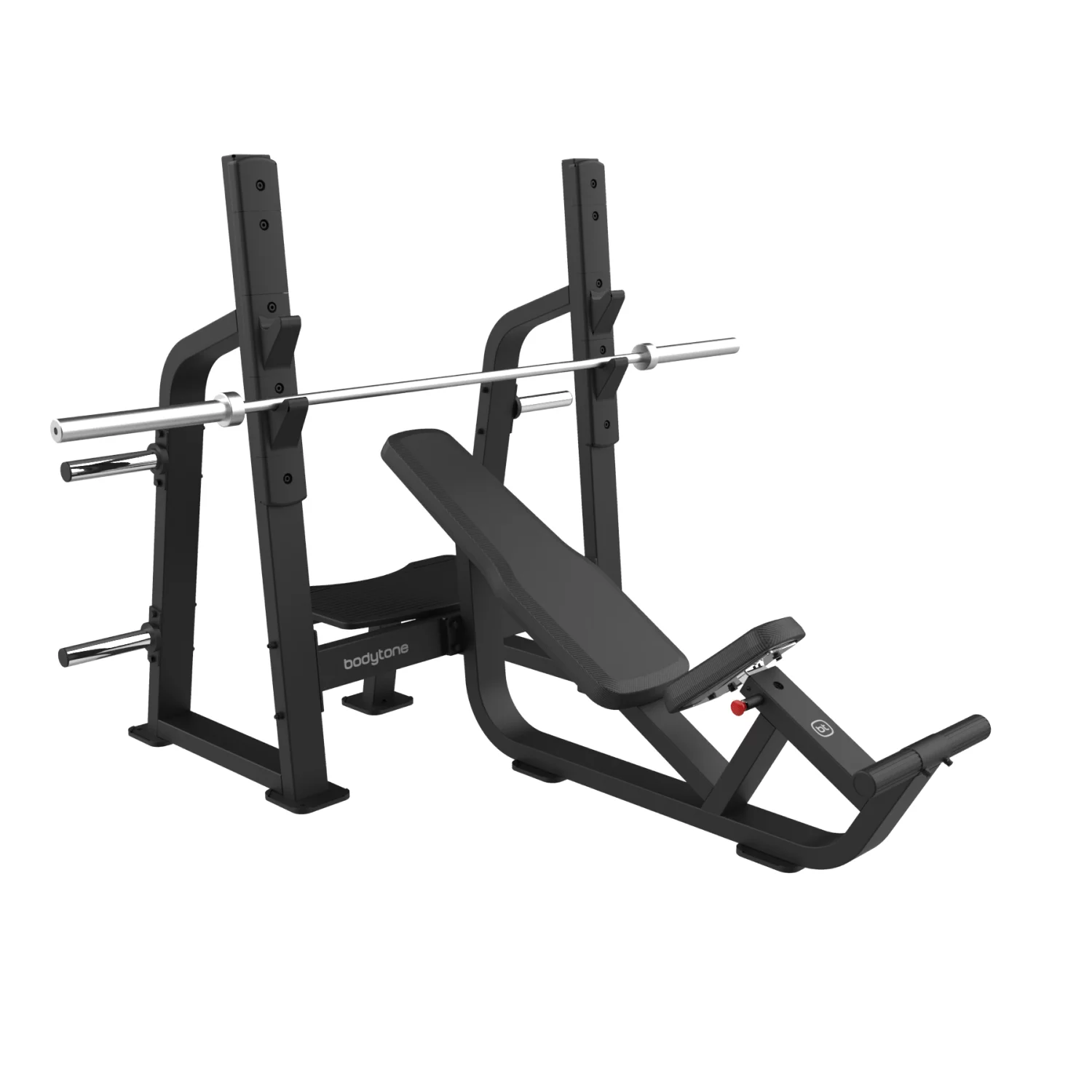
Chest work is where most commercial gym floors get congested, and the incline angle is where members queue longest. The Bodytone FBC07 olympic incline press is one answer to that problem: a plate-loaded station that reproduces the incline press movement on a fixed path, with olympic sleeves rather than a barbell rack. This guide sets out what the machine is, what it does well on a professional floor, where its limits lie, and how it compares with the other chest options you might specify instead.
What the FBC07 actually is
One point needs clearing up first, because the machine is often described loosely. The FBC07 is not a free-weight bench with a barbell. It is a plate-loaded machine: the user sits or lies in a fixed position, loads olympic discs onto the sleeves and pushes along a guided path. The advantage of the format is precisely that it does not require a spotter and does not depend on a lifter controlling a loose bar overhead.
That distinction matters when you specify equipment for a facility where members train without individual supervision. A guided pressing path limits the ways a repetition can go wrong. It does not remove the need for correct setup, but it removes the failure mode that makes free barbell pressing a supervised exercise.
Technical specification
The frame is high-grade steel with a chrome finish on the visible components. Load capacity is 300 kg, which covers the full range of users a commercial facility will see, including strength athletes.
The seat and back pads are upholstered for support through a full pressing range, and the station includes safety catches so that a user can rack a repetition they cannot complete. Olympic disc storage is built into the frame, which is the detail that decides whether a chest area stays tidy: plates that have nowhere to go end up on the floor.
The fixed incline angle is the design choice. It sets the emphasis on the upper portion of the chest and the front deltoid, and it does so identically for every user, every session. For a facility that wants repeatable member programmes, that consistency is a feature rather than a limitation.
As with any indoor station specified for professional use, check that the equipment is certified to EN ISO 20957-1 class S – the class required for a facility open to users you do not supervise individually. Class I is a professional class with inclusive access, not a higher intensity grade.
Why an incline plate-loaded press belongs on a commercial floor
The first argument is throughput. A dedicated incline station means the incline angle is always available, which takes pressure off your adjustable benches and your power racks at peak hours. In a busy club, that alone justifies the footprint.
The second is progression without a spotter. Plate loading gives fine-grained load increments and lets a member add weight session after session, which a fixed-stack machine allows only in the increments the stack provides. Members who want visible progression get it, and they get it without needing a partner.
The third is coaching simplicity. A guided path is quick to teach. A new member can be shown the setup in a couple of minutes and use the station safely afterwards, which is not true of barbell incline pressing.
The station also carries beyond the chest. With the seat and grip position adjusted, the same machine serves shoulder-focused pressing work, and the triceps are loaded throughout. See the wider professional strength training machines range for how it fits alongside the rest of a chest and shoulder area.
Getting the setup right
Most of the value of a guided press is lost if the user is positioned badly. Three checks cover the majority of cases.
Seat height first: the handles should start level with the upper chest, not above the shoulders. A seat set too low turns an incline press into an overhead press and loads the shoulder in a position it was not set up for.
Back and feet next: back flat against the pad, feet planted, core braced. A user who arches off the pad to move more weight is training something other than what the station is for.
Load last: start light enough to complete the full range, then add plates. The advantage of a plate-loaded station is that increments are yours to choose, so there is no reason to jump.
For programming, the incline press is a pressing movement like any other and needs recovery time between sessions targeting the same muscle group. Beyond that, the session structure belongs to the coach and the member, not to the equipment.
Limits worth knowing before you order
The first is footprint. A dedicated incline station occupies floor area permanently and does one job. In a facility short on space, an adjustable bench in a rack does several jobs for the same area – less well, but it does them.
The second is the fixed angle. A single incline is right for most users and wrong for some. Members with restricted shoulder mobility may find the start position uncomfortable, and there is no adjustment to accommodate them. Plan an alternative chest option for that population rather than assuming everyone will fit the station.
The third is that plate loading requires plates. Budget the olympic discs alongside the machine, and site the station near your plate storage.
How it compares with the other chest options
An adjustable weight bench with a barbell is the most versatile option and the most demanding: it covers every angle, and it needs a spotter or safety arms at working loads.
A flat olympic bench press station such as the Bodytone FBC08 does the same job as the FBC07 at a flat angle. Most facilities specify both rather than choosing between them, since they load the chest differently.
A pec deck or cable crossover isolates the chest with no pressing component at all – useful as a complement, not a substitute, because it does not load the triceps or the shoulder girdle in the same way.
A dip station loads the lower chest and triceps heavily but places significant demand on the shoulder and wrist, which limits how widely it can be prescribed across a general membership.
None of these is universally the best. A complete chest area normally combines a pressing station at two angles, one isolation option and one bodyweight option.
Frequently asked questions
Does the FBC07 need a spotter?
No. The pressing path is guided and the station has safety catches, which is the main operational reason facilities choose a plate-loaded press over a free barbell for unsupervised areas.
What is the maximum load?
300 kg, as specified by the manufacturer. That is well beyond what the great majority of members will load.
Is it suitable for a hotel or residential gym?
Yes, provided the space is there. A guided pressing station is a good fit for facilities without permanent staff, precisely because it does not require supervision to be used safely.
Can it replace a bench and barbell entirely?
Not for a strength-focused member base. It replaces the barbell for members who want to press safely without a partner, which in most general facilities is the majority.
Specifying your chest area
The FBC07 earns its place in a facility where the incline angle is in demand and members train without a spotter. Light In Fitness has equipped professional facilities since 2013 and supplies the Bodytone plate-loaded range in class S specification. Send us your floor area and expected traffic and we will propose the chest and shoulder configuration around it – request a quote.