Outdoor Stainless Steel Street Workout Stations: the Municipal Project Playbook
Une cage de street workout en inox supprime la corrosion et l'entretien anticorrosion, là où l'acier peint impose des reprises régulières. Le surcoût initial s'amortit dès le premier remplacement évité, ce qui le rend décisif pour une collectivité. La conformité à la norme EN 16630 reste requise indépendamment du matériau.
A successful public street workout project stands on four decisions taken together: normative compliance (EN 16630 for the equipment, EN 1177 for the impact-attenuating surface), the right steel for the site — stainless steel 316L for urban, coastal and long-life public installations — a properly engineered foundation, and a procurement route that secures public funding. This playbook takes a municipal project team through configurations, budgets, the six project stages and the maintenance plan that keeps the station compliant for decades.
Why municipalities keep choosing street workout
- Free at the point of use: no membership, no key, no social barrier — among the most inclusive sports facilities a municipality can build.
- Low operating cost: no energy, minimal maintenance with the right steel, 15–40 years of service life.
- Small urban footprint: a complete station occupies 40–80 m2 and fits a park, campus, housing estate or public square.
- Public-health value: a visible contribution to physical-activity and youth-engagement objectives, which is precisely why public funding schemes across Europe support these facilities.
The three standard configurations
| Configuration | Area | Contents | Turnkey budget (EUR excl. VAT) |
|---|---|---|---|
| A — Compact station | 25–40 m2 | Single module: 2–4 bars at varied heights, dip station, rings | 10,000–20,000 |
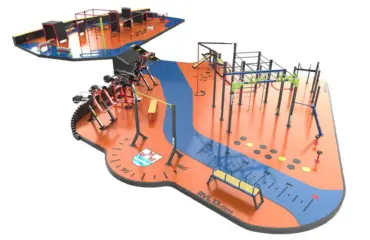
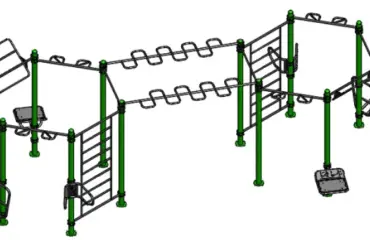
| B — Modular mid-size station | 50–80 m2 | Multi-module: pull-up bars, parallel bars, wall bars, horizontal ladder, core stations; 8–15 simultaneous users | 23,000–50,000 |
| C — Premium full station | 100–200 m2 | Full calisthenics cage, freestyle zones, rings, ropes, plyo elements; 20+ users | 55,000–140,000 |
Turnkey figures include equipment, EN 1177 surfacing, groundworks and installation; Configuration C also includes lighting, signage and street furniture. All are project estimates excluding VAT.
Choosing the steel: an honest hierarchy
- Painted (powder-coated) steel: lowest purchase price, but 5–8 years of outdoor life before visible corrosion and repainting every 2–3 years. A false economy for public installations.
- Hot-dip galvanised steel: 12–20 years of service, industrial grey finish. An acceptable compromise for inland trails and rural sites away from marine exposure — it is the material of our TRAINER, Steel4Fit and BL outdoor ranges.
- Stainless steel 304: 15–25 years in continental climates, but vulnerable to pitting corrosion near the coast.
- Stainless steel 316L (marine grade): 25–40 years, tolerant of saline, marine and polluted urban atmospheres, brushed premium finish. The rational specification for a long-life public street workout station, and the only defensible one within a few kilometres of the sea.
316L costs 30–50 percent more than painted steel at purchase, yet over 25 years the whole-life cost runs three to five times lower once repainting, premature replacement and downtime are counted. For the metallurgy in depth, see our guides to street workout steel grades and 316L stainless equipment for coastal sites.
The applicable standards
EN 16630 — permanently installed outdoor fitness equipment
- Clearance zones of at least 1.5 m around each piece of equipment.
- Documented resistance to dynamic loads (point loads on bars, with substantial rupture margins).
- Documented and managed free fall heights.
- Weather, UV and freeze-thaw resistant materials.
- Documented ground fixing: depth, torque values, anchoring certificate.
- No sharp edges, finger or hair traps, or crush points.
- Permanent manufacturer plate: name, standard, year, maximum load.
EN 1177 — impact-attenuating surfacing
Required wherever free fall height exceeds 60 cm. Indicative rubber tile thicknesses by critical fall height: 30 mm for 1.0 m, 40 mm for 1.5 m, 55–60 mm for 2.0 m, 80–100 mm for 2.5 m, 100–120 mm for 3.0 m. The surfacing must cover the entire falling space plus clearance. For the boundary between fitness and playground rules, see EN 16630 vs EN 1176.
The six stages of a municipal project
- Preliminary study and consultation (2–4 months): needs identification with residents, site selection (access, visibility, planning compatibility), ground survey.
- Funding application (3–6 months): most European public funding schemes for community sport cover 30–50 percent of eligible costs. See our guide to funding a sports facility.
- Specification and tender (2–4 months): write the technical specification precisely — stainless steel 316L (or justified galvanised alternative), EN 16630 and EN 1177 compliance, clearance zones, supply and installation — then publish according to procurement thresholds.
- Award and production (2–3 months): bid analysis, award, then manufacture — typically 6–10 weeks for European production.
- Works and installation (2–4 weeks): groundworks, reinforced concrete foundation of at least 15 cm in C25/30, impact surfacing, structure anchoring, signage and furniture.
- Acceptance (2–4 weeks): compliance inspection against EN 16630 and EN 1177, anchoring reports, 316L material certificates, as-built file — then the opening event.
The maintenance plan that keeps you compliant
| Frequency | Action |
|---|---|
| Weekly | Cleaning, litter removal, rapid visual check |
| Monthly | Torque check on main fixings, anchor verification, surfacing condition |
| Quarterly | Detailed EN 16630 checklist inspection: welds, bars, accessories, manufacturer plate |
| Annual | In-depth inspection with written report; preventive replacement of wear parts |
| Every 3–5 years | Full structural audit, marking renewal, anchor upgrades where needed |
The annual written report is what your liability insurer will ask for after an incident — treat it as a compliance document, not paperwork.
The five recurring project errors
- Painted steel to save money: over 20 years it costs several times the 316L option and takes the station out of service for repainting.
- Skipping the impact surface: a station without EN 1177 surfacing is non-compliant, and the municipality carries the liability after a fall.
- Undersized foundation: a 10 cm unreinforced slab cracks within 2–3 years under dynamic loads. Specify 15 cm reinforced C25/30 minimum.
- Ignoring urban integration: lighting, pedestrian flows, passive surveillance and neighbour proximity decide whether the station thrives or becomes a friction point that gets closed.
- Missing signage: EN 16630 requires usage pictograms, recommended age and maximum load markings; their absence aggravates liability after an accident.
What pairs well with a street workout station
Stations gain from being planned as part of a wider active zone: a waymarked fitness trail linking several stations, compact outdoor fitness modules (outdoor bikes, core benches, cable machines), parkour and ninja elements to EN 16899 for younger users, and a children’s play area nearby for intergenerational use. See our street workout and calisthenics park equipment guide for zone-level design.
Frequently asked questions
Is stainless steel 316L mandatory for public street workout?
No standard mandates it — EN 16630 requires weather-resistant materials without naming grades. 316L is the specification of choice because its 25–40 year life and corrosion resistance make it the cheapest option per year of service in urban and coastal environments; hot-dip galvanised steel remains defensible for sheltered inland sites.
What does a complete municipal station cost?
From roughly 10,000 EUR excluding VAT for a compact turnkey station to 140,000 EUR excluding VAT for a premium calisthenics park with lighting and furniture. Mid-size modular stations, the most common choice, land between 23,000 and 50,000 EUR excluding VAT. All figures are project estimates.
How thick must the safety surfacing be?
It follows the critical fall height of the equipment under EN 1177: indicatively 40 mm of rubber for a 1.5 m fall height and 55–60 mm for 2.0 m, covering the whole falling space plus clearance.
How long does a project take from decision to opening?
Twelve to eighteen months is typical once consultation, funding instruction, tendering, manufacture and works are chained together. The funding application is usually the critical path.
What inspections are required after opening?
A routine visual check weekly, an operational check monthly to quarterly, and a documented annual main inspection — mirroring the inspection regime familiar from playground management and expected by insurers.
Start your project with a site audit
Light In Fitness manufactures street workout structures in hot-dip galvanised steel and stainless steel 316L, and supports municipalities end to end: site audit, design, specification support, installation with anchoring reports, compliance certificates and preventive maintenance contracts. Request your free quote.
Réalisations documentées
- Cage street workout ultime, Carcassonne – armée française
- Cage street workout ultime, Tahiti – armée française, Polynésie
- Cage SP Max, centre EPIDE de Combrée – établissement public d’insertion
- Cage SP Max, lycée Saint-Bénigne de Dijon – établissement scolaire
Sources et références
- NF EN 16630 – modules fixes d’entraînement physique de plein air : exigences de sécurité et méthodes d’essai (AFNOR)
- Code du sport, article L322-2 – garanties d’hygiène et de sécurité des établissements d’activités physiques et sportives (Légifrance)
- Décret n° 96-1136 du 18 décembre 1996 – prescriptions de sécurité relatives aux aires collectives de jeux (Légifrance)
- NF EN 1176-1 – Équipements et sols d’aires de jeux, partie 1 : exigences de sécurité et méthodes d’essai générales (AFNOR)