Street workout and calisthenics park equipment: a station-by-station specification guide
Un parc de street workout se compose de stations distinctes, chacune répondant à un public et à un niveau : traction, dips, suspension, gainage et travail au sol. Le matériau, acier galvanisé ou inox, se choisit selon l'exposition du site, et le sol amortissant selon la hauteur de chute libre. Cette analyse détaille les stations une à une.
A street workout park is judged station by station, not bar by bar: a pull-up bar that flexes, a badly anchored monkey ladder or steel that rusts after two winters destroys both the investment and the footfall. A well-specified calisthenics park covers six movement families — pull, push, core, balance, power and mobility — across eight station types, on a surface sized to the critical fall height under EN 1177 and with structures declared to EN 16630. Individual street workout elements are published from 474.00 EUR excluding VAT and complete park configurations from 2,028.00 EUR excluding VAT. This guide breaks down what to install, in which material, for which user group and on which surface.
The eight stations a complete park needs
- Multi-height pull-up bars. The most used station in any park. Several bar heights let teenagers, adults and advanced athletes train at the same time: strict pull-ups, muscle-ups, levers and hanging work. Never specify a single height.
- Parallel bars and dip stations. Dips, L-sits, assisted handstands and planche work. Spacing and rigidity decide usage: a bar that vibrates discourages deep dips. Check the wall thickness of the tube, not just the diameter.
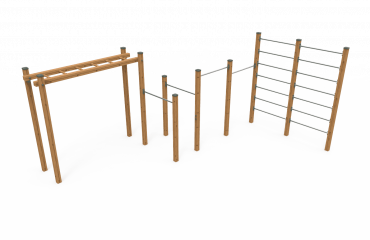
- Monkey bars and horizontal ladders. Grip strength, coordination and shoulder endurance. Varying the inclination across two or three ladders is what allows progression from a flat traverse to an inclined sequence.
- Wall bars and core stations. Trunk work, leg raises and stretching. The cheapest way to widen the user base beyond pure strength athletes.
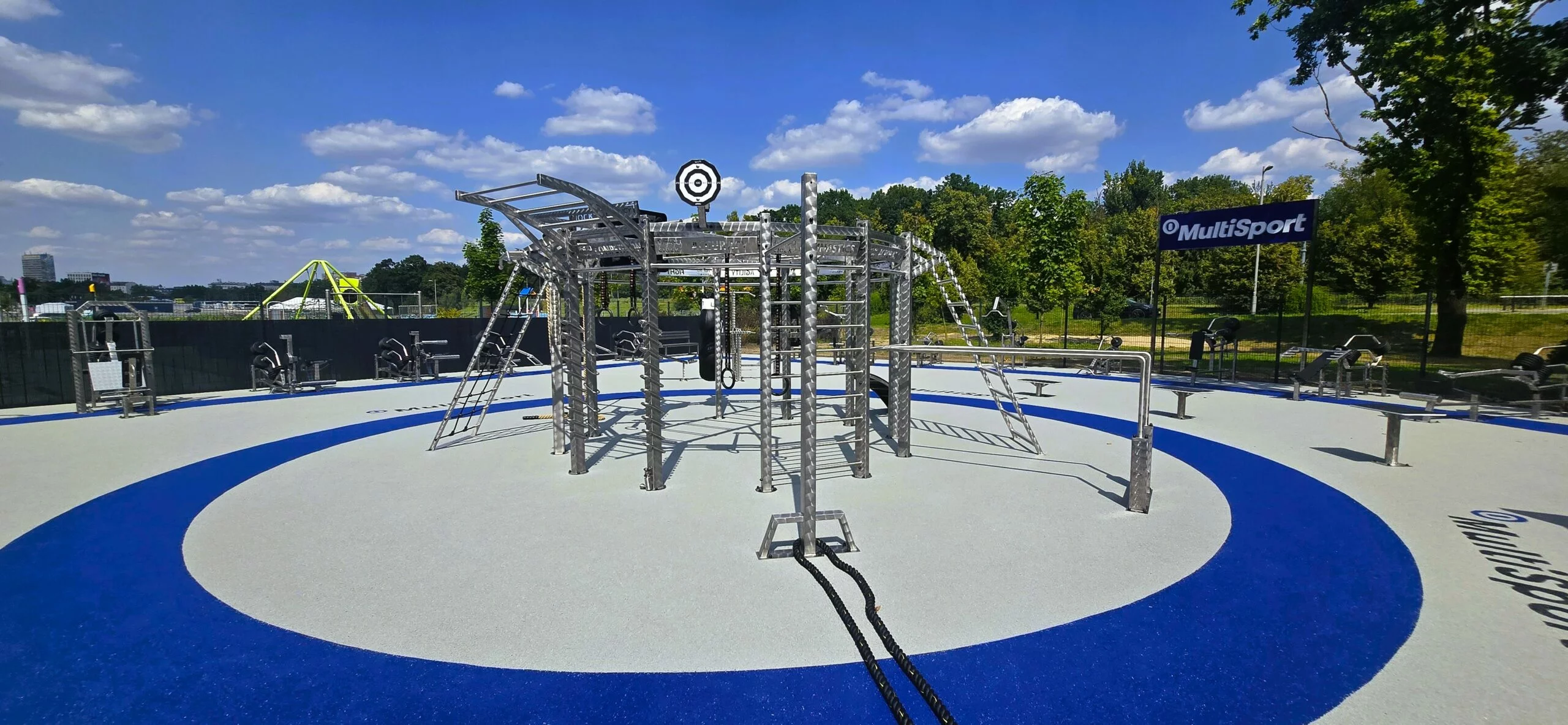
- Central multifunction cage. Fixed bars, high bars and parallel bars on one structure, for freestyle and strength alike. This is the visual centre of an ambitious park.
- Jump and balance stations. Plyometrics, precision and proprioception. A permanent slackline module is a strong differentiator where the budget allows.
- Information and instruction panel. Routinely omitted, and it directly determines real usage: opening hours, safety instructions and illustrated exercise guidance for beginners.
- Impact-attenuating surface. Under and around the stations the floor is part of the equipment, sized to the fall heights, not to the footprint of the structure.
Published prices: individual elements
| Element | Movement family | Price excluding VAT |
|---|---|---|
| Low parallel bars | Push, core | 474.00 EUR |
| Dip station | Push | 636.00 EUR |
| Balance beam | Balance | 648.00 EUR |
| Pole bar | Freestyle | 738.00 EUR |
| Suspended rope | Pull, grip | 876.00 EUR |
| Single fixed bar | Pull | 990.00 EUR |
| Horizontal bar | Pull, freestyle | 1,020.00 EUR |
| Parallel bars with posts | Push | 1,098.00 EUR |
| Rope module | Grip, climbing | 1,140.00 EUR |
| Horizontal ladder | Grip, coordination | 1,254.00 EUR |
| Punchbag structure | Conditioning | 1,320.00 EUR |
| Ring bar | Pull, gymnastics | 1,404.00 EUR |
| Vertical ladder | Climbing | 1,578.00 EUR |
| Bar with handles | Pull | 1,668.00 EUR |
| Suspended rings | Gymnastics | 1,818.00 EUR |
| Monkey bridge | Grip, endurance | 1,848.00 EUR |
| Long horizontal ladder | Grip, endurance | 1,932.00 EUR |
| Bridge module | Coordination | 2,316.00 EUR |
| Slalom module | Agility | 2,502.00 EUR |
Published prices: complete park configurations
| Configuration | Typical use | Price excluding VAT |
|---|---|---|
| Compact park, 3 stations | Schoolyard, residential development | 2,028.00 EUR |
| Mini cage, pull-up bar, ab bench, stepper | Small municipal plot | 2,780.00 EUR |
| Mini cage with wall bars and dips | Neighbourhood park | 3,050.00 EUR |
| City stadium multi-station park | Public park | 3,048.00 to 6,630.00 EUR |
| Mini cage, monkey ladder, pull-up, biceps bar, dips | Youth-focused site | 4,490.00 EUR |
| Mixed stainless and galvanised mini cage | Coastal or humid site, small footprint | 4,950.00 EUR |
| Multi-station park, 9 to 10 stations | Municipal flagship site | 9,204.00 to 10,044.00 EUR |
| Large cage structure | Club or training site | 12,000.00 to 19,500.00 EUR |
| Stainless steel cage, 8 stations | Coastal site | 16,999.00 EUR |
| Stainless steel cage, 12 stations | Coastal flagship site | 24,999.00 EUR |
| Extended park, full configuration | Regional destination park | 27,288.00 EUR |
Equipment only. Groundworks, foundations, drainage, impact-attenuating surfacing, signage, delivery and installation are quoted separately and commonly add 25 to 40% on an unprepared site.
Materials: get this right or repaint every three years
- Hot-dip galvanised steel with UV-stable powder coating — the standard for the TRAINER and Steel4Fit outdoor ranges and the correct default for inland parks, schools, campuses and barracks. The zinc layer is metallurgically bonded, so a surface scratch does not start a rust bloom.
- Stainless steel 316L — used on the ranges explicitly designated stainless. The molybdenum content resists chloride attack, which is what matters within a few hundred metres of the sea, beside pools, or on de-icing salt routes.
- Painted mild steel — avoid on any permanent outdoor installation. It is the cheapest line on a tender and the most expensive line over ten years.
Whatever the structure, specify fixings in the same family. Carbon-steel bolts in a stainless frame produce galvanic corrosion precisely at the load-bearing points.
Standards: what a public installation must satisfy
- EN 16630 — permanently installed outdoor fitness equipment: structural strength, entrapment, protrusions and the free space required around each station.
- EN 1176 — playground equipment, applicable where the installation is used by children or mixes play and fitness functions.
- EN 1177 — impact-attenuating surfacing and critical fall height. A pull-up bar at 2.4 m produces a substantially larger surfacing bill than one at 2.1 m; design the heights before you price the surface.
- EN 16899 — parkour equipment, where the park includes freestyle obstacle modules.
Ask for the declaration of conformity for the exact configuration proposed, not for the range. Configurations differ, and so do the impact areas they generate.
Which configuration for which footprint
| Available area | Recommended configuration | Indicative equipment budget excluding VAT |
|---|---|---|
| Under 60 m2 | Compact set: multi-height pull-up bars, parallel bars, bench, information panel | 2,000 to 3,500 EUR |
| 60 to 100 m2 | Mid-range park: cage, monkey ladder, dips, core station, balance module | 4,500 to 10,000 EUR |
| 100 to 180 m2 | Full park: central cage, two ladder variants, adjustable parallel bars, jump and balance stations | 12,000 to 22,000 EUR |
| Over 180 m2 | Destination park: extended configuration plus a parkour section or outdoor fitness stations | 25,000 EUR and above |
Two design rules that improve real usage: keep at least 2 m of clear circulation between station footprints so several users can train simultaneously, and orient the pull-up structures so the sun is not directly in the user’s eyes during peak evening use.
The project brief that gets you a useful quotation
Whatever supplier you approach, a quotation is only as good as the brief. Include all six:
- Available area and its dimensions, plus a photograph or plan showing slope and existing surface.
- User group: schoolchildren, general public, students, uniformed services, advanced athletes.
- Training objectives, ranked: pull, push, core, endurance, freestyle.
- Ground constraints: existing sub-base, drainage, noise sensitivity, underground services.
- Whether the site is coastal, pool-side or on a de-icing salt route — this determines the material.
- Budget envelope, split between equipment and civil works.
Frequently asked questions
Which stations are essential in a street workout park?
Eight cover the six movement families: multi-height pull-up bars, parallel bars and dips, monkey bars, wall bars and core stations, a central multifunction cage, jump and balance modules, an information panel and an impact-attenuating surface. Multi-height pull-up bars are the single most used station and should never be specified at one height only.
How much does a street workout park cost?
Individual elements are published from 474.00 EUR excluding VAT, compact three-station parks from 2,028.00 EUR, mid-range municipal parks between 4,500 and 10,000 EUR, and full destination parks from around 25,000 EUR. Add 25 to 40% for groundworks, surfacing and installation.
Which standard applies to a public calisthenics park?
EN 16630 for permanently installed outdoor fitness equipment, EN 1176 where children use it, EN 1177 for surfacing and critical fall height, and EN 16899 for parkour modules. Request the declaration of conformity for the exact configuration, not the product range.
Galvanised steel or stainless steel for a calisthenics park?
Hot-dip galvanised steel with a UV-stable powder coat is the right default inland. Stainless steel 316L is needed within a few hundred metres of the sea, beside swimming pools or on salted routes. Painted mild steel should not be used on permanent outdoor installations.
How much surface area does a park need?
Under 60 m2 supports a compact set, 60 to 100 m2 a mid-range municipal park, and 100 to 180 m2 a full park with a central cage. Keep at least 2 m of clear circulation between station footprints, and remember that the impact area required by EN 1177 usually extends beyond the structure itself.
Planning a calisthenics park? Send us the available area, the user group and your training priorities. Light In Fitness returns a station-by-station configuration with material specification, EN 16630 and EN 1177 references, a 3D layout, quantities and prices excluding VAT within 24 working hours — and supplies the impact-attenuating surface in the same package, so there is no interface gap between structure and ground. See also our guides to outdoor strength equipment and outdoor fitness trails.
Related guides: mountain and cold-climate sites.
Réalisations documentées
- Cage street workout ultime, Carcassonne – armée française
- Cage street workout ultime, Tahiti – armée française, Polynésie
- Cage SP Max, centre EPIDE de Combrée – établissement public d’insertion
- Cage SP Max, lycée Saint-Bénigne de Dijon – établissement scolaire
Sources et références
- NF EN 16630 – modules fixes d’entraînement physique de plein air : exigences de sécurité et méthodes d’essai (AFNOR)
- Code du sport, article L322-2 – garanties d’hygiène et de sécurité des établissements d’activités physiques et sportives (Légifrance)
À lire aussi sur le même thème
- Mountain and cold-climate outdoor sports facilities: how to specify them
- Funding a sports facility project: eligibility, evidence and the technical file
- Inclusive and para-sport equipment: specifying and funding accessible facilities
- Power towers, pull-up bars and wall bars: the bodyweight equipment specification guide