Wooden Outdoor Fitness Trails: Natural Strength and Wellbeing in the Open Air

A wooden outdoor fitness trail turns a park, a campsite, a school ground or a residential green space into a training area that is open permanently, free to use and supervised by nobody. For a local authority, a holiday village, a housing association or a rehabilitation centre, it is one of the few sports investments that serves every age group at once and keeps working in all weathers. This guide sets out what these circuits contain, what they deliver for the people who use them, and what a professional buyer should check before specifying one.
Why timber for an outdoor training circuit
Timber is chosen for outdoor fitness circuits for two reasons that matter to a specifier: it disappears into a landscaped setting, and it survives being left outside. A steel rig announces itself; a laminated pine station reads as part of the park. That difference is often what decides a planning discussion with residents or a heritage constraint on a site.
The second reason is practical. Users who will not walk into an indoor gym will use an open-air circuit on a footpath, and a wooden trail placed along a walking route captures that traffic without any membership, booking system or opening hours. The equipment is there when someone decides to use it, which is the whole point of a public fitness trail.
What a wooden fitness trail delivers for users
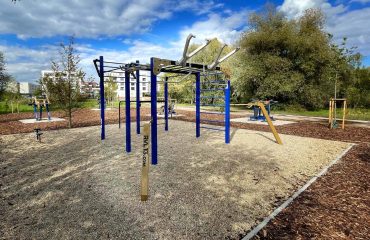
The physical case is straightforward. Each station on the circuit is designed around a different movement pattern, so a full loop works the upper body, the core and the lower body rather than repeating the same exercise under a different name. Pull-up bars, parallel bars and abdominal and lumbar benches together cover pulling, pushing, bracing and stabilising, which is more than most people get from an unstructured jog.
The mental side is less measurable but is consistently the reason users come back. Training outdoors, in a green setting, away from screens and enclosed spaces, lowers perceived stress and lifts mood in a way an indoor session rarely does. For a municipality this matters: an installation that people enjoy being at is an installation that gets used, and use is the only return on a public sports budget.
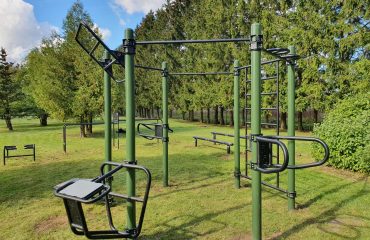
Finally, there is the connection to the setting itself. A circuit built from natural pine, positioned among trees rather than on a slab of tarmac, feels like part of the landscape. Users describe it as being outside first and training second, which is exactly the behaviour a public health programme is trying to produce.
The equipment on the circuit
A wooden fitness trail is modular. You specify the stations that suit your users and your available footprint, and the circuit is laid out along an existing path or around a clearing.
- Pull-up bars. Supplied with bars at two heights, so a beginner and an experienced user can train at the same station. The two-height design is what makes a public installation usable by teenagers and adults at once.
- Parallel bars. Dips, support holds, leg raises and balance work. Simple to use, hard to outgrow, and one of the highest-traffic stations on any circuit.
- Abdominal and lumbar benches. Ergonomically shaped for core and lower-back work, and the station most used by occasional visitors because it needs no technique to start.
- Additional stations. Climbing, balance and stretching modules complete the loop and let you tune the circuit to the profile of your site.
You can see the full range of stations in the wooden fitness trail category, and compare them against the wider outdoor fitness trail offer if part of your circuit needs a metal construction.
Materials, durability and maintenance
The structures are built from laminated Scandinavian pine treated in autoclave to class IV. That specification is the whole durability argument: class IV treatment is what allows timber to be used in permanent ground contact and exposed to rain, frost and sun without rotting. Laminated sections also hold their shape better than solid timber of the same dimensions, which is what keeps a bar level after several seasons outdoors.
Laminated timber left outside develops fine surface checks as it takes up and gives off moisture. This is normal, it is a property of the material, and it does not affect the structural strength of the station. It is worth saying so in advance to a client committee, because it is the single most common question raised after the first winter.
Maintenance is a periodic visual inspection and occasional cleaning. On the supply side, spare parts remain available for ten years, which is the figure that should go into your whole-life cost calculation rather than the purchase price alone. A circuit you can repair in year eight is a very different asset from one you have to replace.
Where a project mixes materials, our steel structures carry a warranty of up to 20 years and our stainless steel components are warranted for life. Individual stations such as the Multitractions BLO-075 pull-up station can be added to a timber circuit where a higher-traffic point needs a metal construction.
Who a wooden fitness trail is for
The honest answer is that the circuit works because it is not aimed at one group. Children get a safe, engaging way to move that is not a screen. Teenagers get pull-up bars and a place to compete with each other, which is the single most reliable driver of use in a public park. Adults get a training loop that costs nothing and needs no planning. Older users get low-impact, joint-friendly movement close to home, with the balance and mobility work that keeps independence going.
That mix is why the specification changes so much between sites. A campsite circuit and a school circuit contain different stations even though they look similar in a catalogue. Set out the age profile of your users first, then choose the stations.
Getting the installation used safely
Two things determine whether a circuit is used well. The first is siting: put the stations along a route people already walk, not in a corner of the site that has to be visited deliberately. The second is signage: a short instruction panel at each station raises correct use and lowers misuse more than any other single measure.
On the operational side, the fixings and the stability of each station should be checked as part of your routine grounds inspection, exactly as you would for any other outdoor structure. Users should be encouraged to start with the benches and the parallel bars before attempting pull-up work, and to use the circuit as a loop rather than repeating one station.
Frequently asked questions
How long does a wooden fitness trail last outdoors?
The structures are laminated Scandinavian pine treated in autoclave to class IV, which is the treatment specified for permanent outdoor exposure. Spare parts remain available for ten years, so individual components can be replaced rather than the whole circuit.
Are the cracks that appear in the timber a defect?
No. Fine checks are a natural characteristic of laminated timber exposed to weather and do not affect the strength of the station.
Can the same circuit serve children and adults?
Yes, and that is the usual specification. Pull-up bars are supplied at two heights for exactly this reason, and the station mix can be adjusted to the age profile of your site.
What maintenance does the circuit need?
Periodic visual inspection, occasional cleaning, and a check of the fixings and stability of each station as part of your normal grounds routine.
Can timber and steel stations be mixed on one circuit?
Yes. Timber is normally used where the installation has to blend into a landscaped setting, and steel where a station takes very heavy traffic.
Specifying your circuit
A wooden fitness trail is not an off-the-shelf purchase: the right circuit depends on your footprint, your ground conditions, the age profile of your users and the budget line it sits on. Light In Fitness has been equipping professional sites since 2013 and has delivered to more than 2,500 customers, from municipalities and campsites to schools, clubs and rehabilitation centres.
Send us your site plan and the profile of your users and we will come back with a station-by-station proposal and a costed layout. Request a quote and we will work through the specification with you.
Réalisations documentées
- Parcours ninja sur mesure, Rennes – îlot des Hautes-Ourmes
- Double mur ninja extérieur, Sallanches – Haute-Savoie
Sources et références
- NF EN 16630 – modules fixes d’entraînement physique de plein air : exigences de sécurité et méthodes d’essai (AFNOR)
- Code du sport, article L322-2 – garanties d’hygiène et de sécurité des établissements d’activités physiques et sportives (Légifrance)