Outdoor Gym Equipment: What Belongs in a Public Open-Air Fitness Area
Training in the open air is no longer a niche. Municipalities, campsites, hotel groups, housing associations and university campuses across Europe are installing open-air fitness areas, and the demand no longer comes only from runners and cyclists. Users who want to train for strength expect to find equipment outdoors too, and they will not carry a set of dumbbells to the park to get it. The question for the operator is therefore not whether to install an outdoor gym, but which equipment actually makes the site work.
What an outdoor gym has to survive
An outdoor fitness area is public equipment in permanent unsupervised use. Several hundred people a day may pass through a well-placed site, in all weather, with no reception desk and no instructor. That single fact drives every specification decision. Frames must resist moisture, frost and UV exposure; coatings must be specified for outdoor service rather than adapted from indoor products; fixings must be tamper-resistant; and bearings must be sealed, because nobody is going to grease them weekly.
Adult outdoor fitness equipment is covered by EN 16630, the European standard for permanently installed outdoor fitness equipment. It sets requirements for structural integrity, entrapment, fall zones and installation. Ask any supplier for the test documentation before you compare prices; two visually similar stations can sit on opposite sides of that line. Where an area is designed for children rather than adults, the applicable standards are different: EN 1176-1 for the equipment itself and EN 1177 for the impact-attenuating surfacing. The two families are not interchangeable, and EN 16630 equipment is not a substitute for playground equipment.
The equipment mix that keeps a site busy
The most common specification error is buying a row of identical stations. An outdoor gym has to serve a mixed and unselected population: the twenty-year-old doing pull-ups, the office worker starting again after ten years, the retired resident maintaining mobility. Range matters more than quantity.
The stations found in most well-used open-air gyms fall into a few recognisable families:
- Air walker and elliptical stations. Low-impact, self-paced whole-body movement. These are almost always the busiest units on any site, because anyone can use them immediately without instruction.
- Outdoor exercise bikes. A simple, robust aerobic station that suits older users and rehabilitation programmes.
- Rowing and pull stations. Upper-body and back work using bodyweight resistance, and one of the few outdoor movements that loads the posterior chain properly.
- Twist and mobility units. Hip and trunk mobility, valued heavily by older users and easy to place near a walking route.
- Pendulum and core stations. Abdominal, hip and back work.
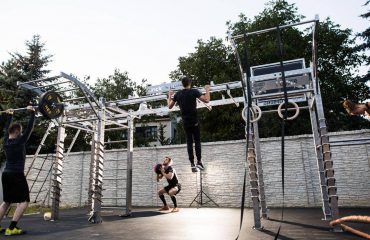
- Bars, rings, ladders and calisthenics frames. The backbone of any street workout area, and the reason a site attracts a younger, regular and highly visible user group.
Bodyweight-loaded machines have a practical advantage in an unsupervised setting: the resistance is capped by the user’s own mass, so the intensity cannot be misjudged the way a stack of plates can be. That is a real design benefit, but it is not a substitute for clear signage, sound installation and a documented inspection routine.
Three zones, one layout
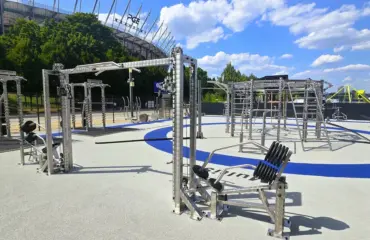
Sites that stay busy are usually laid out as three connected zones rather than a single line of machines. A cardio zone of walkers, bikes and cross trainers placed nearest the access path; a strength zone of loaded or bodyweight resistance stations; and a calisthenics zone built around a bar structure. Our outdoor gym equipment range covers the first two, and the street workout rigs range covers the third, including configurations designed for high-traffic public sites.
Circulation is part of the specification. Leave enough distance between stations for the fall zones required by the standard, keep a clear route through the area for pushchairs and wheelchairs, and place the highest-turnover stations where they are visible from the approach. An outdoor gym that looks empty from a distance stays empty.
Designing for every user, not the fittest one
An open-air fitness area is public infrastructure, and its user base includes older residents and people with reduced mobility. Equipment designed for wheelchair users and for seated transfer exists as a specific product family, and including two or three such stations changes who uses the site. Our accessible outdoor gym range is built for that purpose, with approach clearance and handle heights designed for seated use.
Inclusive design also means signage. Each station should carry a pictogram panel showing the movement, the muscle groups involved and the basic safety instruction, in the language of the site. This is the cheapest single item in the whole project and the one that most affects whether the equipment is used correctly.
Why outdoor training keeps people coming back
The operational argument for open-air fitness is straightforward. There is no membership barrier, no opening hours and no capacity limit, so participation rates in a public outdoor gym are far higher than in an equivalent indoor facility. Sites placed in green space, along a walking loop or beside a playground benefit from passing traffic that an indoor room never gets, and the same visit often combines exercise with time spent outdoors. For a council, a campsite or a residential operator, that combination is the return on the investment.
Frequently asked questions
How much space does an outdoor gym need?
It depends on the number of stations and on the fall zones each one requires under EN 16630. As a working rule, plan the footprint of the equipment plus the safety zones plus a clear circulation route, and confirm the final figures against the manufacturer’s installation drawings for the units you select.
What surfacing should be used?
Adult outdoor fitness equipment does not automatically require impact-attenuating surfacing, but the ground has to be stable, free-draining and even. Where children have access, or where the equipment creates a free height of fall that triggers it, surfacing tested to EN 1177 is required. Grass, gravel, rubber tiles and wet-pour all have their place; the choice follows the risk assessment for the site, not the budget line.
How much maintenance does an outdoor gym need?
Plan a routine visual inspection, a periodic operational inspection and an annual main inspection, in line with the inspection regime the manufacturer specifies. In practice this means checking fixings, coatings, moving parts and signage. Equipment specified with sealed bearings and outdoor-grade coatings keeps that workload low; equipment that was really designed for indoor use does not.
Can outdoor equipment be installed on an existing surface?
Usually yes, provided the substrate can take the anchoring method. Concrete foundations, ground sockets and surface-mounted baseplates are all used, and the right choice depends on the ground, the equipment and whether the installation needs to be reversible. This is worth resolving before the order, not after delivery.
Specifying your site
Light In Fitness manufactures and supplies professional outdoor fitness equipment for public authorities, campsites, hotels, residential developments and educational sites. If you have a site plan, a user profile and a budget, that is enough to start: send them over and we will come back with an equipment mix, a layout and a quotation. Request a quote and we will work from your actual constraints rather than a catalogue page.
Réalisations documentées
- Cage street workout ultime, Carcassonne – armée française
- Cage street workout ultime, Tahiti – armée française, Polynésie
- Cage SP Max, centre EPIDE de Combrée – établissement public d’insertion
- Cage SP Max, lycée Saint-Bénigne de Dijon – établissement scolaire
Sources et références
- NF EN 16630 – modules fixes d’entraînement physique de plein air : exigences de sécurité et méthodes d’essai (AFNOR)
- Code du sport, article L322-2 – garanties d’hygiène et de sécurité des établissements d’activités physiques et sportives (Légifrance)