Outdoor Sports Equipment for Parks and Public Spaces
Outdoor training has stopped being the fallback option for people who cannot reach a gym. In municipal parks, on residential grounds, in campsites and on school sites, permanently installed fitness stations now carry a large share of everyday physical activity. They are open, free to use and available at any hour: no membership card, no branded kit, no queue for a machine.
Why outdoor training keeps gaining ground
Fresh air and daylight change the experience of a workout. The same set of pull-ups performed outdoors feels different from the same set in a closed, overheated room, and adherence follows. That is the practical argument public buyers make when they open a budget line: an outdoor fitness area removes the two barriers that stop most people from training, cost and intimidation. Anyone can walk up in ordinary clothes and start.
Outdoor exercise is also no longer limited to running and cycling. Fully equipped, fully accessible open-air gyms now offer guided strength stations that can be adjusted to individual needs, and a companion training app makes it easy to get real value from each unit rather than improvising. The result is a facility used by parents with little spare time, by office workers at the end of the day, and by clubs running structured sessions.
What a modern outdoor fitness area contains
The equipment families below are the ones that appear on almost every specification we are asked to price:
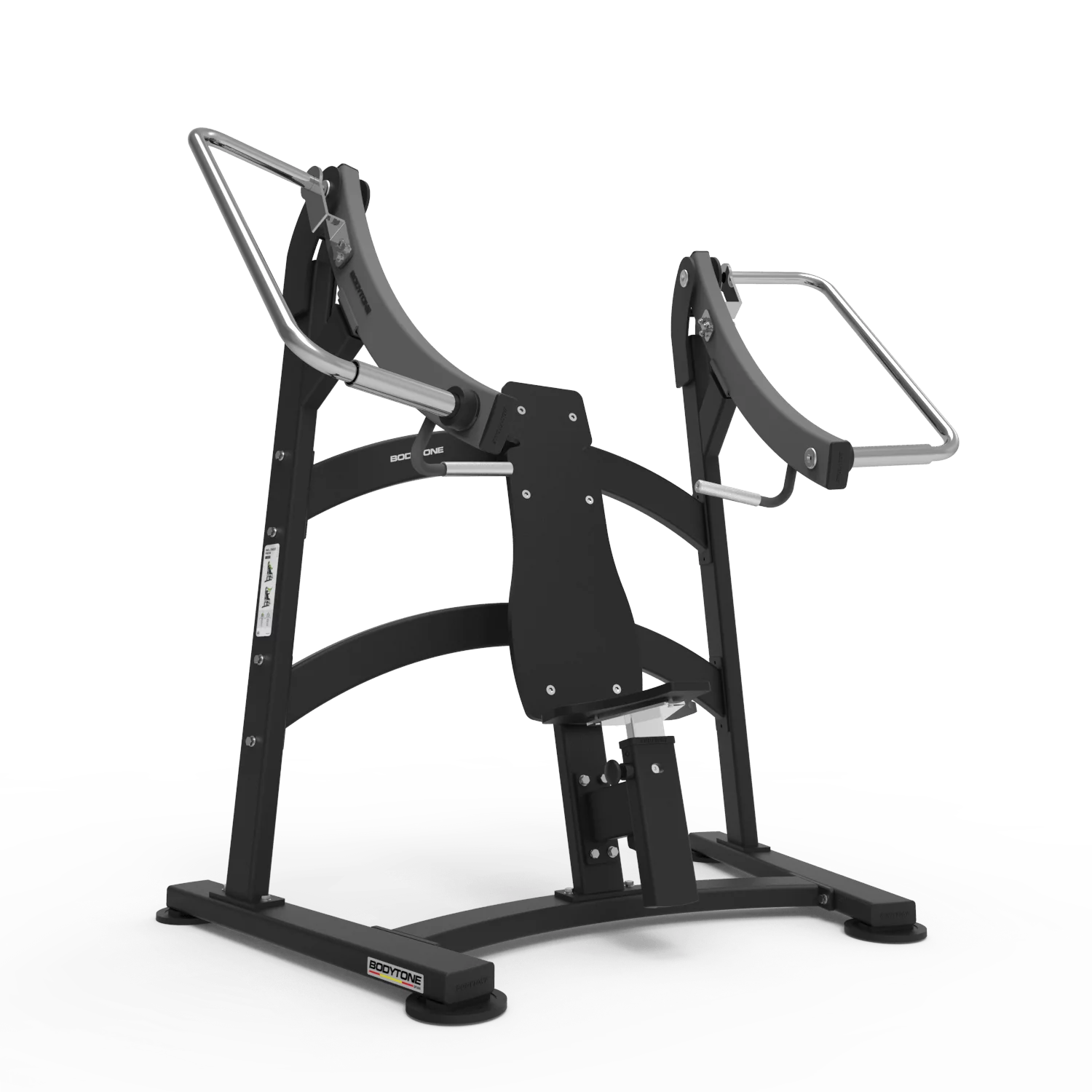
- Guided strength stations using body weight or hydraulic resistance, for chest press, lat pull, leg press and rowing movements.
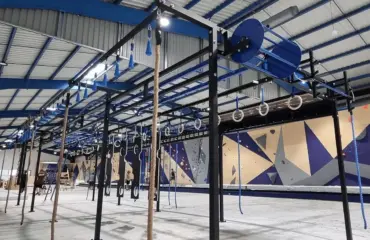
- Calisthenics and street workout rigs: pull-up bars, parallel bars, dip stations, wall bars and monkey bars on a single structure.
- Fitness trail stations spread along a walking or running loop, each one dedicated to a single exercise.
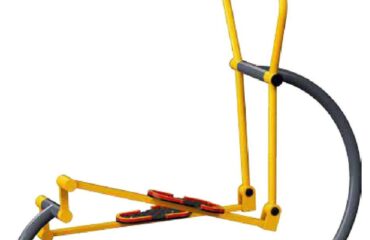
- Cardio units such as air walkers, cross trainers and outdoor bikes for warm-up and mobility.
- Stretching and mobility posts, usually placed at the entrance and the exit of the circuit.
Our outdoor gym equipment range covers these families, and the street workout rigs section groups the configurations designed for calisthenics and bodyweight training.
Standards, materials and service life
Equipment installed in a space open to the public is not consumer equipment with a coat of paint. The European reference standard for permanently installed outdoor fitness equipment for adults is EN 16630, which sets the requirements for safety, entrapment, structural strength and installation. Children’s play equipment falls under a different framework entirely: EN 1176-1 for the equipment and EN 1177 for the impact-attenuating surfacing. The two families are never interchangeable, and a piece of adult fitness equipment does not become a children’s unit because it is smaller.
Every unit we supply is checked for safety and function before it leaves the factory and carries the certification confirming its conformity. Materials are chosen for weather exposure rather than showroom appeal: hot-dip galvanised or stainless steel frames, powder-coated finishes, sealed bearings and fixings that survive rain, frost, salt air and ultraviolet light. That is what separates equipment still in service after a decade from equipment that has to be fenced off after three winters.
Who specifies these installations
Local authorities equipping a park or a riverside path, campsite and holiday-village operators adding a wellness offer, hotels, housing associations, schools, sports clubs and armed-forces sites all buy from the same catalogue but with different priorities. A campsite wants a compact, photogenic cluster near the pool. A local authority wants vandal resistance, accessibility and a maintenance file. A club wants throughput on a rig at peak hours. The outdoor fitness trail format suits long sites with a natural walking loop, while a single multi-station rig suits a small footprint.
Frequently asked questions
Does an outdoor gym need supervision?
No. These installations are designed for unsupervised, free public access, which is precisely why the standard framework and the anti-entrapment requirements matter so much. Clear instruction panels on each station replace the instructor.
What surfacing is required underneath?
It depends on the free height of fall of the equipment concerned. Grass is accepted for low units, while rigs with elevated bars normally require an impact-attenuating surface. The surfacing requirement is specified unit by unit and must appear in the installation file.
Can equipment be used all year round?
Yes, provided it was designed for it. Outdoor units stay installed through the winter; only the maintenance interval changes, with fixings and moving parts inspected more often on coastal or heavily used sites.
Getting your project specified
The right equipment list depends on the surface available, the users you expect and the budget cycle you are working to. Send us the plan of the site and the intended audience and we will return a layout, an equipment schedule and a price. Request a quote and our team will come back to you with a full proposal.
Réalisations documentées
- Cage street workout ultime, Carcassonne – armée française
- Cage street workout ultime, Tahiti – armée française, Polynésie
- Cage SP Max, centre EPIDE de Combrée – établissement public d’insertion
- Cage SP Max, lycée Saint-Bénigne de Dijon – établissement scolaire
Sources et références
- NF EN 16630 – modules fixes d’entraînement physique de plein air : exigences de sécurité et méthodes d’essai (AFNOR)
- Code du sport, article L322-2 – garanties d’hygiène et de sécurité des établissements d’activités physiques et sportives (Légifrance)