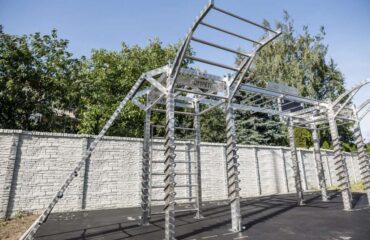
Outdoor Fitness Equipment for Exercise Trails and Playgrounds
Les équipements de fitness en plein air équipent parcs, espaces verts, places publiques, écoles et aires de jeux. Une station de gymnastique combine plusieurs agrès sur une même emprise, ce qui limite la surface mobilisée. Le public visé détermine la norme applicable : EN 1176 pour les enfants, EN 16630 au-delà de 1 400 millimètres.
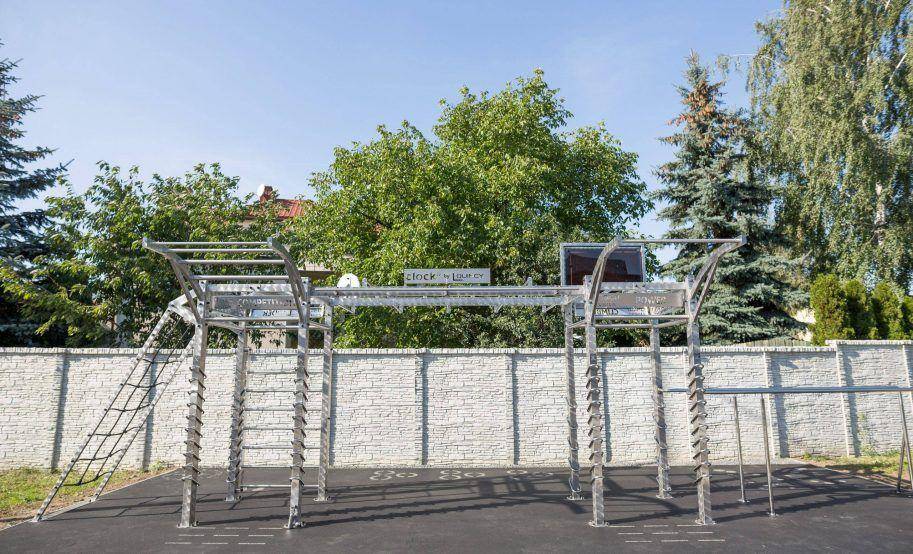
Outdoor exercise trails and open-air fitness equipment have become part of the standard fit-out of parks, green spaces, public squares, nurseries, schools and playgrounds. A calisthenics station or a fitness trail lets people train outdoors without depending on the opening hours and membership structures of organised sport. When a local authority decides to build an outdoor fitness park, the target group has to be defined, the location chosen and the right equipment selected during the very first planning phase.
Most outdoor fitness equipment is built in stainless steel: the units are durable, robust and weather-resistant and, at the right build quality, absorb extreme loads year after year. The selection and layout of the equipment, the choice of impact-attenuating surface (safety tiles, wood chips or sand) and the siting of the installation all have to be settled early.
Together, those factors decide whether a fitness trail or an outdoor gym is accepted by users and genuinely used.
A large number of manufacturers now supply equipment for outdoor sport. Playground builders and specialist designers have also moved into outdoor gym and street workout construction, and can advise on layout and installation. During planning, the following questions should be raised early and answered together with everyone involved:
- Which target groups (children, older adults, sports club members, general public) will mainly use the installation?
- Which outdoor fitness equipment matches the needs and the ability of those groups?
- Which existing infrastructure can be used, and at which location?
- How will the outdoor gym be financed, and which grants can be applied for?
Outdoor fitness equipment: compare prices, control the budget
A fitness trail can be designed individually and matched to its user groups simply by changing the mix of equipment. Defining the target group, running a short user survey and inspecting the existing outdoor facilities in the area are all useful first steps. A modern trail can combine any equipment you like: a pull-up bar, parallel bars, or a full training station for strength and mobility work.
Calisthenics equipment is increasingly integrated into outdoor fitness parks, because this form of intensive bodyweight training works either on dedicated calisthenics units or simply on bars and parallel bars.
Prices for outdoor fitness equipment vary with the manufacturer, the build quality and the materials used. Building an outdoor exercise trail also carries costs for design, for installation of the equipment and for the corresponding impact-attenuating surface. A complete outdoor fitness unit in stainless steel starts at around 3,500 EUR and can reach 5,000 EUR depending on specification. A realistic budget therefore covers three lines, not one: design, equipment and installation including the safety surface.
Our team can put together a full costing for an outdoor fitness project, covering the equipment itself, installation and the impact-attenuating flooring, so that the figures presented to a council or a board reflect the finished installation rather than the catalogue price alone.
Price guide: outdoor fitness equipment
The overview below gives indicative price ranges for outdoor fitness equipment:
| Equipment | Indicative price range |
|---|---|
| Back strengthening and massage unit (stainless steel) | 2,100 EUR – 2,600 EUR |
| Outdoor elliptical cross-trainer | 4,300 EUR – 5,400 EUR |
| Outdoor calisthenics station | 4,400 EUR – 13,800 EUR |
| Outdoor strength trainer (chest, shoulders, knees) | 4,000 EUR – 6,200 EUR |
| Complete stainless steel fitness unit | from 3,500 EUR to 5,000 EUR |
Beyond buying the individual units, clubs and local authorities need to budget for the design and construction of the installation from the outset. The fitness area should be planned in close cooperation with a designer or a manufacturer, and supported through the construction phase. Defining the target group (older adults, children, club members or fitness enthusiasts), the usage concept and the funding of the installation are the other basic building blocks of an outdoor gym project.
Browse the full range of outdoor gym equipment to see which configurations suit the surface area and the budget you have available.
Which standards apply outdoors
The applicable standard follows the intended user, not the look of the equipment. Permanently installed outdoor fitness equipment for adults is covered by EN 16630. Children’s play equipment falls under EN 1176-1, and the impact-attenuating surfacing beneath it under EN 1177. The two families are never interchangeable: a piece of children’s play equipment is not certified to EN 16630, and an adult outdoor fitness unit is not certified to EN 1176-1.
This distinction matters most on mixed sites, where a play area for younger children sits next to a fitness trail for teenagers and adults. In that case the two zones are specified, surfaced and inspected separately, even though they share a footpath. Our kids outdoor fitness range and our playground equipment are documented accordingly.
Building a fitness trail: grants and funding
Building an exercise trail and equipping it with outdoor fitness units can be supported by grant programmes, and the remaining budget can be raised through fundraising or a crowdfunding campaign. Depending on the country, funding for sports facilities may be available at European, national, regional or municipal level; the applicable schemes and the eligibility rules are set by each national and local authority, so the first step is always to check what is open in your own jurisdiction.
If the trail will also be used by a school or a nursery, further education-related programmes may become available for the construction of the facility.
A crowdfunding campaign can also collect donations and find supporters for the outdoor gym. A number of crowdfunding platforms now specialise in sport: the project is published, and all donations are processed through the platform. In most crowdfunding models the money is only released once a predefined target has been reached.
Outdoor fitness equipment for every age group
Outdoor training equipment is used in a wide variety of settings and for very different purposes. Depending on the target group and the usage concept, different units are chosen. Manufacturers now cover every type of training – strength, mobility, stabilisation, coordination – and every target group, from children to older adults.
- Green spaces and urban parks
- Sports club grounds and health centres
- Schools and other educational establishments
- Nurseries and day-care centres
- Children’s playgrounds and outdoor areas for older adults
- Residential care facilities
- Hospitals, clinics, spa and rehabilitation centres
- Residential developments
- Company grounds and business parks
- Wellness hotels, leisure facilities and hotels
Surfacing: the line item that is most often forgotten
Impact-attenuating surfacing is not an accessory. It is what makes the installation usable and what an inspection body will look at first. Loose-fill surfaces such as playground wood chips in 5-30 mm calibre are economical over large areas but need topping up; bonded tiles cost more per square metre but hold their level and suit smaller, heavily used zones. The required depth follows the free height of fall of the equipment installed above it, which is why surfacing can only be quoted once the equipment layout is fixed.
Frequently asked questions
How much space does an outdoor fitness trail need?
There is no single figure: the footprint depends on the number of units, on the safety zones each one requires and on the circulation between them. A compact station combining several exercises on one frame keeps the required area down, which is why it is often the first choice on a constrained urban site.
Is stainless steel worth the extra cost?
For a permanently installed outdoor facility, yes. Stainless steel resists weather and coastal air without repainting, which removes most of the recurring maintenance from the whole-life cost of the installation.
Can the same equipment serve children and adults?
No. The applicable standard depends on the intended user, and the two families of standards are separate. Mixed sites are laid out as two zones with their own equipment and their own surfacing.
Who inspects the installation once it is built?
Public outdoor sports and play installations are subject to routine visual checks and to periodic inspections by a competent body, at intervals set by the operator and by the national rules that apply. The inspection regime should be agreed before handover, not after.
Planning your outdoor fitness project
Light In Fitness has designed and supplied professional fitness equipment since 2013, for local authorities, clubs, schools, hotels, campsites and residential developments. Tell us the surface area available, the target group and the budget envelope, and we will come back with a layout, a matched equipment list and a costing that includes the surfacing. Request a quote and we will put a proposal together for your site.
Réalisations documentées
- Parcours ninja sur mesure, Rennes – îlot des Hautes-Ourmes
- Double mur ninja extérieur, Sallanches – Haute-Savoie
Sources et références
- Décret n° 96-1136 du 18 décembre 1996 – prescriptions de sécurité relatives aux aires collectives de jeux (Légifrance)
- NF EN 1176-1 – Équipements et sols d’aires de jeux, partie 1 : exigences de sécurité et méthodes d’essai générales (AFNOR)
- NF EN 1177 – revêtements de surface amortissants : détermination de la hauteur de chute critique (AFNOR)
- NF EN 16630 – modules fixes d’entraînement physique de plein air : exigences de sécurité et méthodes d’essai (AFNOR)