Can You Build Muscle in an Outdoor Gym? A Specifier Guide
Outdoor gyms have stopped being street furniture that nobody touches. In public parks, on campsites, inside residential schemes and on hotel grounds, the equipment is now used by adults of every age and every training level, not only by retirees passing the time or by children playing on the machines. For the organisation paying for the installation, that shift raises a very practical question: can people actually build muscle on an outdoor gym, or is the area only good for a warm-up?
Where to start with outdoor strength training
For years, outdoor fitness areas were under-used. Many visitors simply did not know how to train on the stations, and others were reluctant to be seen learning in public. That reluctance is fading, and outdoor gyms are being used the way they were designed to be used. The appeal is easy to understand: the area is free at the point of use, it is often visible from the user’s own window, and it removes the two biggest barriers to regular training, cost and travel time.
Fresh air, however, does not replace a full indoor equipment line. A realistic recommendation for a beginner is three to four sessions a week of around forty-five minutes, with at least part of that volume performed on indoor machines where load can be selected precisely and where coaching is available. Positioning an outdoor area as a complement rather than a replacement is also the honest message to give residents, members or guests.
An outdoor area cannot be reconfigured session by session the way an indoor gym can, but users can extend it considerably by bringing a mat or a pair of dumbbells. Training outdoors rewards planning: not everything is available on site, so the session has to be designed before arriving.
What outdoor equipment realistically delivers
Most outdoor fitness areas are built around aerobic-style stations. Those are excellent for raising body temperature and mobilising joints, but they contribute little to hypertrophy during the main part of a session. Strength progress comes from resisted work, and that means specifying the right station families:
- Calisthenics and street workout structures – pull-up bars, dip bars, parallel bars and wall bars, where bodyweight provides the load and progression comes from leverage and repetition quality.
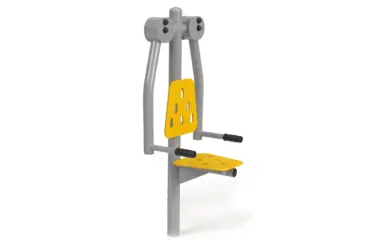
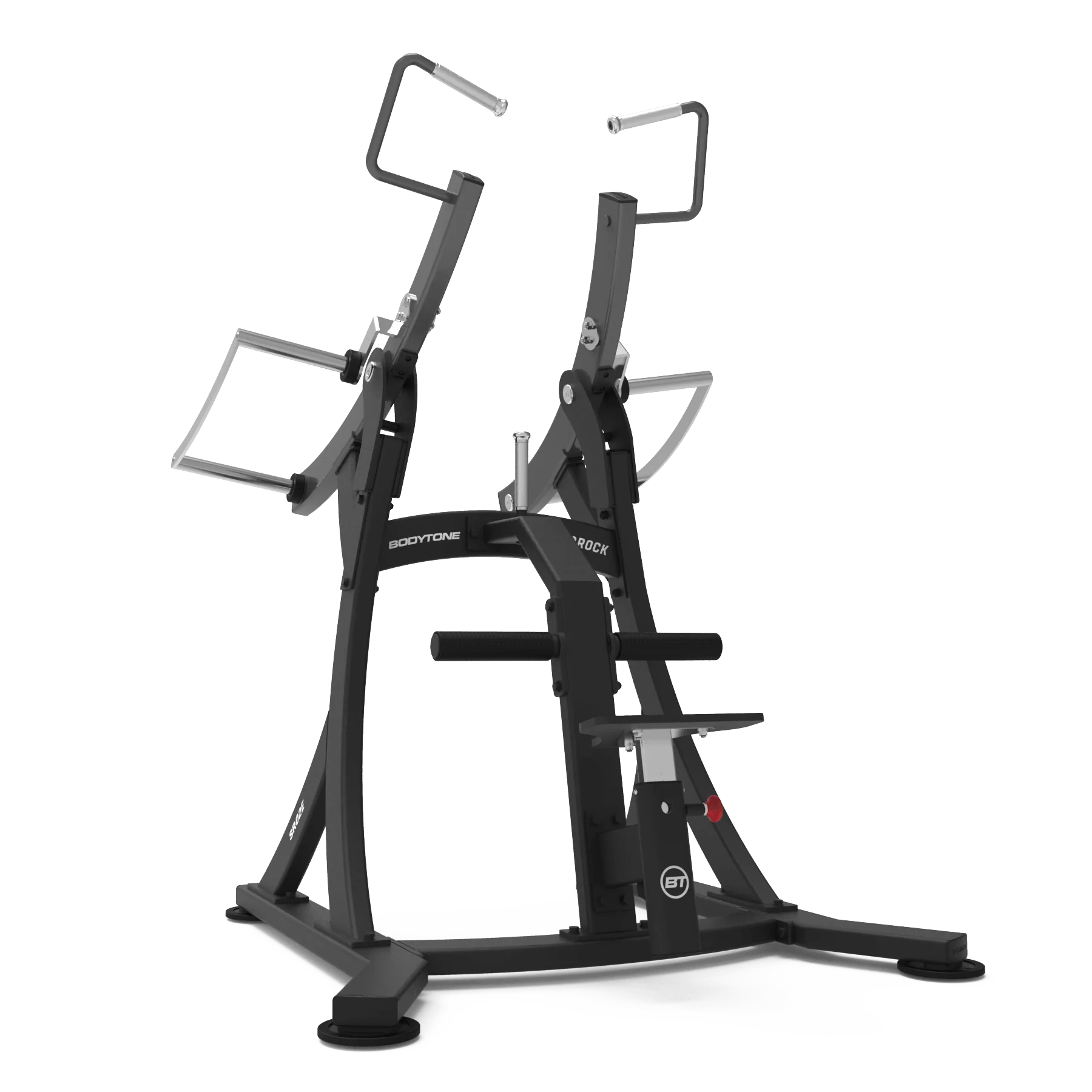
- Outdoor strength machines – chest press, lat pulldown, leg press and rowing stations that use bodyweight or hydraulic resistance in a guided path, suitable for users with no technical background.
- Aerobic stations – air walkers, cross trainers and steppers, best used at the start and end of the session.
The distinction matters at specification stage. An area made up only of aerobic stations will disappoint the users who are the reason it is busy in the first place. A balanced mix of outdoor gym equipment and a street workout rig covers both audiences on the same footprint.
Structuring a session that builds muscle
Every session starts with a warm-up. Ten to fifteen minutes of trunk rotations, bends and bodyweight squats is enough to prepare the muscles for the work that follows, and the aerobic stations are ideal here. Start light and short: the point is to raise temperature, not to accumulate fatigue.
Resistance work is then the main driver of muscle growth. A widely used guideline is around forty to sixty repetitions per body part, split into sets of six to twelve. Where a barbell would normally be used, dumbbells can usually be substituted, provided the load is neither too heavy nor too light. The simplest test is to complete one set: it will tell the user immediately whether the load needs adjusting.
Because outdoor training favours general, multi-joint movements, exercises that need no machine deserve priority: squats holding a dumbbell, push-ups, and the plank. There is rarely a coach on site to ask for a quick correction, which is another argument for planning the session in advance and for installing clear instruction signage on each station.
Cool-down and recovery
Every effort should close with stretching, which like the warm-up should last around ten to fifteen minutes. Walking on an aerobic station to bring the breathing rate down before stretching works well. Since muscle-building work is built on general development exercises, neither the warm-up nor the stretching phase should leave a body part out.
What this means for the buyer
Equipment for an unsupervised outdoor area is exposed to weather, continuous public use and vandalism, so it belongs to a different product family from indoor machines. Outdoor adult fitness equipment is designed and tested to EN 16630, and that is the reference to require in a tender. Indoor equipment installed in a club or a hotel gym follows EN ISO 20957-1 class S, the professional class for supervised and unsupervised commercial use.
Where the same site also serves children, the two frameworks must not be mixed: children’s play equipment falls under EN 1176-1, and its impact-absorbing surfacing under EN 1177. An adult outdoor fitness station is never a substitute for playground equipment, and a children’s area is never specified to EN 16630.
Beyond the standards, three points decide how the area ages: the corrosion protection of the structure (hot-dip galvanised steel or stainless steel in coastal and pool environments), the surfacing under the stations, and the availability of spare parts. An outdoor fitness trail laid out over a larger site follows the same logic, simply spread across several zones.
Frequently asked questions
Is an outdoor gym enough on its own to gain muscle?
It can produce real progress, especially for beginners and for users returning to training, because bodyweight and guided-resistance stations provide genuine resistance. Advanced users will eventually need selectable loads that only indoor machines offer.
How many stations should an area have?
That depends on the expected number of simultaneous users and on the available footprint, not on a fixed rule. The useful approach is to cover the main movement patterns – push, pull, legs, core – and then add capacity, and this is exactly what a layout study establishes.
Does outdoor equipment need supervision?
Public outdoor areas are designed for unsupervised use, which is why clear pictograms, safe distances between stations and appropriate surfacing matter as much as the machines themselves.
Can the same area serve adults and children?
Yes, provided the zones are separated and each is specified under its own standard: EN 16630 for adult stations, EN 1176-1 and EN 1177 for the children’s area.
Planning your outdoor fitness area
An outdoor gym that people use to build strength is not a matter of buying a few stations. It is a matter of choosing the right mix, sizing it for the site and specifying it to the correct standard. Send us your site plan and your expected user profile and our team will put together a layout and a costed proposal: request a quote.