Professional Outdoor Fitness Equipment: A Complete Overview
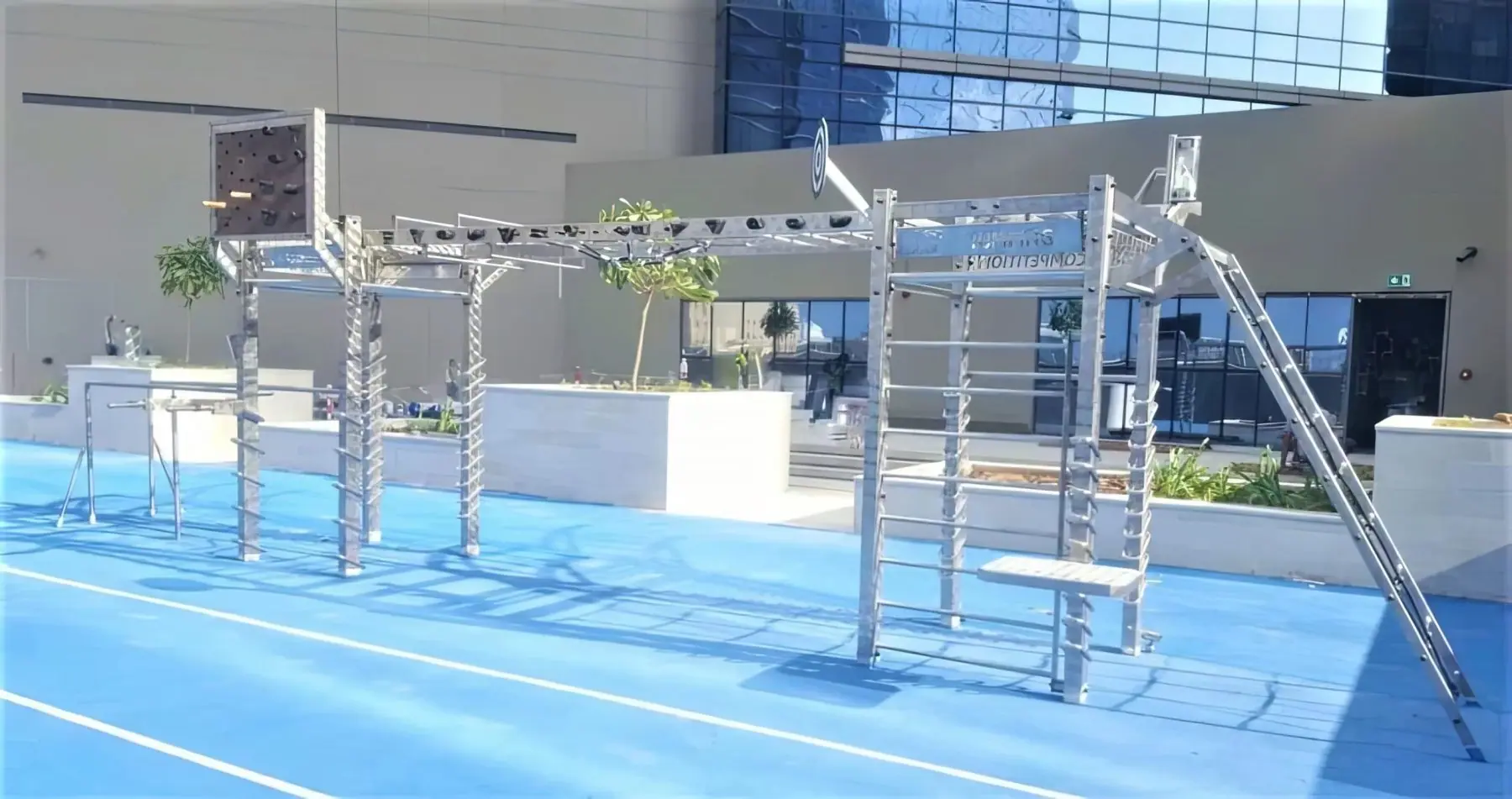
Outdoor fitness is growing faster than any other segment of the industry. Whether you manage a sports park, a municipality, a holiday village, a residential development or a club, it is now possible to equip open space with professional fitness equipment that is robust, well designed and built to stay outdoors permanently. The question is no longer whether the equipment exists – it is which equipment belongs on which site, and to which standard.
Why professional equipment for outdoor installations
Specifying professional outdoor equipment rather than adapted indoor equipment carries several concrete advantages.
- Durability and resistance. Equipment designed for outdoor use withstands weather, heavy loads and intensive use, year after year, without the corrosion and fastener failures that indoor equipment develops within a season outdoors.
- Safety. Compliance with the applicable European standards, and the certification behind it, is what protects users on an installation that nobody supervises.
- Versatility. Strength stations, benches, pull-up bars, street workout structures and cross-training equipment cover a wide range of training approaches from the same footprint.
- Appearance and integration. Modern design and proper finishing let an installation sit within a park, a residential courtyard or a seafront without looking like industrial hardware dropped into a green space.
The main equipment categories
- Stainless steel outdoor fitness stations. Built for intensive use, they cover every major muscle group, with corrosion-resistant materials and finishes specified for permanent outdoor exposure. This is the category to specify on coastal sites and anywhere de-icing salt is used.
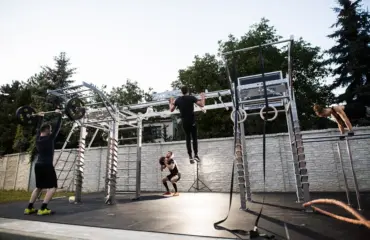
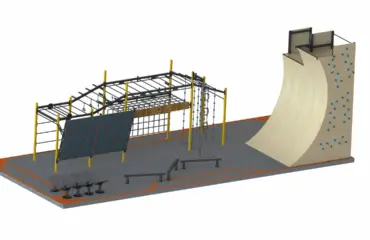
- Pull-up bars and street workout structures. Suited to strength work, mobility and endurance. The modules are configurable, so the same system serves a compact residential courtyard and a full public park.
- Impact-attenuating sports flooring. A wide range of high-resistance rubber tiles certified for outdoor use, offering shock absorption, acoustic insulation and grip that holds in wet conditions. Tiles are available in thicknesses from 10 mm to 100 mm and in various dimensions, covering everything from play areas to weightlifting zones.
- Outdoor cardio equipment. Selected cross trainer and bike models are built for outdoor installation, with heavy-duty structures and weather-resistant finishing.
Standards: which one applies to what
This is where outdoor projects most often go wrong, because the relevant standards are not interchangeable and the wrong one on a specification is a real problem later.
Adult outdoor fitness equipment falls under EN 16630, the standard written for permanently installed outdoor fitness equipment.
Children’s playground equipment falls under EN 1176-1, and the impact-attenuating surfacing under it under EN 1177. These are separate standards covering separate things, and neither of them applies to adult fitness equipment.
An installation that mixes adult and children’s provision on one site needs both sets of requirements met, each on its own equipment. Specifying a single standard across a mixed project is the most common error we see on incoming briefs.
What a complete project involves
- Design and bespoke manufacture. Projects are supported from design through to installation, so the configuration matches the site rather than the site being forced to accept a catalogue layout.
- Standards and certification. Equipment is specified to the standard that applies to its category and its users, and the documentation follows the delivery.
- Long warranties. Extended warranty terms are the practical measure of how long a manufacturer expects its own equipment to last outdoors.
- Delivery and installation. Delivery is arranged with technical support for the installation itself, which matters more outdoors than indoors because groundworks and anchoring are part of the job.
Typical installations
Outdoor fitness trails. Strength stations, pull-up bars, benches and street workout modules distributed along a route, so users complete a full circuit rather than queueing at one station.
Cross-training and weightlifting areas. Impact-attenuating rubber tiles, lifting platforms and Olympic bar storage, laid out so that loaded work happens on surfacing specified for it.
Outdoor cardio zones. Cardio equipment built for outdoor conditions, including consoles rated for weather exposure.
Frequently asked questions
Can indoor equipment be installed outdoors?
No. Indoor machines are not built for weather exposure and will corrode, seize and fail, usually within the first year. It is also the wrong specification from a safety point of view, since outdoor installations are used without supervision.
Which standard applies to my project?
EN 16630 for adult outdoor fitness equipment; EN 1176-1 with EN 1177 surfacing for children’s playground equipment. If the site serves both audiences, both apply, each to its own equipment.
What flooring thickness is needed?
It depends on the equipment, the fall heights involved and the intended users, which is why surfacing is specified with the structure rather than chosen afterwards. Tiles are available from 10 mm to 100 mm to cover the full range of cases.
Is stainless steel always necessary?
Not always, but it is the right specification for coastal sites, for locations exposed to de-icing salt, and anywhere the installation has to look new after a decade. Elsewhere, treated steel with an appropriate finish performs well.
Transform your outdoor space
Whether the project is a park, a municipal site, a residential development or a private facility, the starting point is always the same: available surface, intended users, and how the space should be used across the year.
Send us those three pieces of information and we will come back with a layout, the applicable standards and a costed proposal. Request a quote and our team will work through your project with you.
Réalisations documentées
- Cage street workout ultime, Carcassonne – armée française
- Cage street workout ultime, Tahiti – armée française, Polynésie
- Cage SP Max, centre EPIDE de Combrée – établissement public d’insertion
- Cage SP Max, lycée Saint-Bénigne de Dijon – établissement scolaire
Sources et références
- NF EN 16630 – modules fixes d’entraînement physique de plein air : exigences de sécurité et méthodes d’essai (AFNOR)
- Code du sport, article L322-2 – garanties d’hygiène et de sécurité des établissements d’activités physiques et sportives (Légifrance)
- Décret n° 96-1136 du 18 décembre 1996 – prescriptions de sécurité relatives aux aires collectives de jeux (Légifrance)
- NF EN 1176-1 – Équipements et sols d’aires de jeux, partie 1 : exigences de sécurité et méthodes d’essai générales (AFNOR)