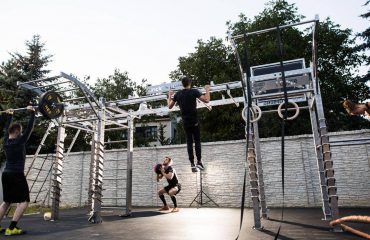
How to Build an Outdoor Gym Park: Complete Guide

Building an outdoor gym park is one of the most effective ways to make training accessible: it opens physical activity to people who would never join a club, and it puts equipment where the population already is. Whether you are a local authority, a company, a housing operator or a private developer, the demand for quality outdoor equipment keeps growing. Working with a specialist supplier, you can design a park that is optimised, safe and usable at every fitness level. Here are the steps that decide whether the project works.
1. Choosing the right location
Location is the decision everything else depends on. A large open space is not automatically a good one: accessibility and practicality matter more than surface area. Well-placed public parks, busy urban areas and sites next to existing sports facilities all generate the regular footfall that keeps a park alive and visible.
Site criteria
- Proximity to amenities: toilets, parking and drinking water.
- Access for everyone, including wheelchair users and people with reduced mobility, which is both a safety and an inclusion requirement. Dedicated accessible outdoor gym stations exist precisely for this.
- Firm, level ground, so the equipment can be anchored properly and stays stable.
A site chosen against these criteria will be used, and a site chosen only because it was free usually will not.
2. Selecting the equipment mix
A well-designed park offers a range broad enough that a beginner and an experienced athlete both find something to do. The aim is to cover the whole body while offering several ways to train.
- Bodyweight and functional stations: pull-up bars, parallel bars and dip stations are the backbone of any park. They train the whole upper body and are popular precisely because they are simple and effective. Our street workout rigs are built around exactly this.
- Strength equipment: outdoor leg presses, benches and squat stations give a dedicated area for heavier, more targeted work.
- Cardio: rowers, cross trainers and weatherproof outdoor treadmills let users combine strength and cardio in the same session.
- Toning and recovery: an area for lighter conditioning and a space for stretching, yoga or pilates rounds out the offer and widens the audience.
All of it has to be designed for the outdoors: weather resistant, UV resistant and compliant with the applicable safety standard. For outdoor fitness equipment intended for adults, that reference is EN 16630. Where a park also includes equipment for children, different standards apply: EN 1176-1 for the play equipment itself and EN 1177 for the impact-attenuating surfacing. The two families are never interchangeable, and adult outdoor equipment must never be presented as children’s equipment.
3. Layout and safety
Layout has to combine ergonomics with safety. Non-slip rubber surfacing or artificial turf considerably reduces the consequences of a fall or a mistimed movement.
- Appropriate surfacing: our outdoor sports flooring absorbs impact while staying stable and non-slip. Where a fire classification is required by the specification, it must be quoted in full, including the smoke index, exactly as certified.
- Equipment safety: structures should be galvanised steel or another corrosion-resistant material, and anchored solidly. Plan regular inspections and maintenance from the start; they extend service life and keep the park safe to use.
4. Programming and coaching
Free access to equipment brings people once. Programming brings them back. Working with qualified coaches, run varied sessions and events to build an active community around the site.
- Coaching: individual or group sessions with different objectives, from conditioning to strength work.
- Outdoor classes: cross training, HIIT or relaxation formats such as yoga attract a wide audience and make the park visible.
Mobile apps and online platforms can extend this with remote programmes and follow-up, and the layout of the park should reserve the open space those group formats need.
5. Building a loyal community
To keep users coming back, plan a calendar of weekly activities, challenges and rewards.
- Introductory offers: free trial sessions for newcomers, reduced rates for regular users, or a referral scheme where the site is operated commercially.
- Social media: share news, run challenges and highlight what members achieve. Digital visibility is what turns a piece of equipment into a destination.
6. Maintenance and evolution
Regular maintenance is what keeps the equipment safe and durable over the years.
- Preventive maintenance: scheduled checks of the steel structures, the surfacing and the fixings.
- Evolving the offer: listen to users, then extend. Adding cross training or street workout zones, or a wellness area, keeps the site attractive as the audience grows. Our outdoor gym equipment range is modular for exactly that reason.
Frequently asked questions
Which standard applies to outdoor fitness equipment?
EN 16630 covers permanently installed outdoor fitness equipment for adults. Children’s play equipment falls under EN 1176-1, with EN 1177 for the impact-attenuating surface, and the two must not be mixed on the same station.
How much space does an outdoor gym park need?
It depends on the stations chosen and their safety zones, which are defined by the standard rather than by preference. Send us the plot dimensions and we will lay out what fits.
What maintenance should be budgeted?
Periodic inspection of fixings, structures and surfacing, plus corrective work as needed. Budgeting it from the start is far cheaper than replacing a station that was never checked.
Planning your park
Creating an outdoor gym park is a long-term commitment that rewards careful planning: the right site, the right equipment mix, compliant surfacing, real programming and a maintenance plan. Send us your site plan, your audience and your budget and we will propose a layout, an equipment list and a price. Request a quote and our team will design the park with you.
Réalisations documentées
- Cage street workout ultime, Carcassonne – armée française
- Cage street workout ultime, Tahiti – armée française, Polynésie
- Cage SP Max, centre EPIDE de Combrée – établissement public d’insertion
- Cage SP Max, lycée Saint-Bénigne de Dijon – établissement scolaire
Sources et références
- NF EN 16630 – modules fixes d’entraînement physique de plein air : exigences de sécurité et méthodes d’essai (AFNOR)
- Code du sport, article L322-2 – garanties d’hygiène et de sécurité des établissements d’activités physiques et sportives (Légifrance)