Outdoor sports facilities and leisure parks: what to install and why
Outdoor sport is the cheapest footfall a site can buy, and the hardest to specify badly without it showing. A fitness trail, a calisthenics rig or a play area is open at every hour, needs no reception desk and no supervision, and is judged by users within seconds of arriving. This guide sets out the families of outdoor sports and leisure facilities an operator can install, what each one attracts, and the safety questions that decide the specification before the aesthetics do.
Why outdoor provision has become a core amenity
Outdoor sport and recreation is an opportunity to explore the surrounding environment and to push personal limits, and the benefit is not only physical: the mental and emotional side is what brings users back. From beaches for surfing to parks for camping, the range of activity is wide, and the operator who provides the ground for it captures the traffic.
For a municipality, a campsite, a hotel, a residential developer or a school, that translates into a simple commercial fact. Natural terrain and open ground are already there; equipment turns them into a reason to come, to stay longer, or to renew a membership. Walking around town gets dull, so the sites that offer something to do outdoors are the ones that fill.
Free access sports facilities that carry footfall
The first family covers equipment installed in the open, in free access, and used without booking or staff.
| Facility | Who it attracts | What the project needs |
|---|---|---|
| Outdoor fitness trail | Adults of all levels, walkers, runners, older users | A route, spaced stations, a stable surface at each station |
| Street workout and calisthenics rig | Teenagers and young adults, bodyweight training | Concentrated footprint, fall zone surfacing, generous clearance around bars |
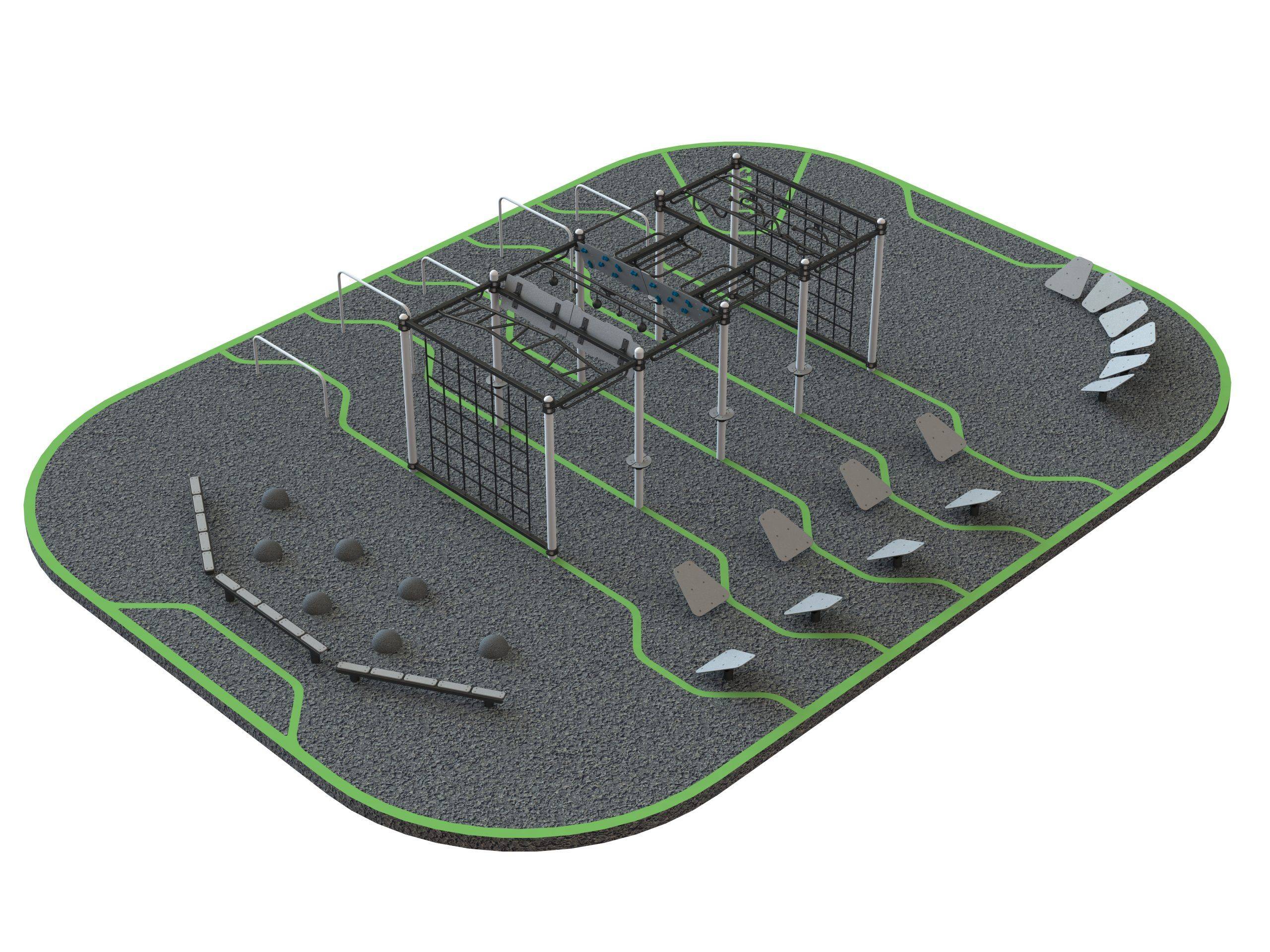
| Ninja and obstacle structures | Mixed ages, families, event use | Longer footprint, controlled fall heights, high visual impact |
| Children’s sports park | Children and accompanying adults | Age banded equipment, impact absorbing surfacing, sightlines for supervision |
Our outdoor fitness trail range and our street workout and calisthenics cages cover the two families that generate the most repeat use per square metre, because they are trained on rather than played on.
Adventure and leisure areas
The second family is about the thrill rather than the training. Adventure structures work on a different logic: they are visited, photographed and talked about, and their value to the site is the visit itself.
Obstacle and ninja style structures are the closest equivalent an operator can build without water or rides. They deliver the sensation of a challenge course while remaining a fixed installation with a known footprint and a known maintenance load, which is why ninja warrior rigs have moved from television into municipal parks, campsites and resorts.
Whatever the format, the same operator rule applies: the structure has to be readable from a distance. A user decides in a few seconds whether an installation is for them, and an adventure area that does not announce its own difficulty level is used by nobody or by the wrong people.
Team sport surfaces
Team sport facilities are the oldest category and still the most requested. Football pitches serve the daily cardio habit and, unlike a stuffy indoor room, they let users breathe fresh air while they sweat. Basketball and volleyball courts bring out the competitive instinct, and racket sports, tennis and badminton, work in a smaller footprint and suit sites with limited space.
Baseball, softball and cricket grounds exist in the same family but demand far more land, which is why they are normally a municipal or club decision rather than a hotel or campsite one.
The point common to all of them, from an operator’s perspective, is that the surface is the whole project. The goals, nets and posts are a fraction of the budget; the ground they stand on decides how many hours a week the facility can actually be used and how long it survives.
Safety measures to keep in mind
In any outdoor sport or leisure activity, safety must always be the top priority, and for an operator that means two distinct responsibilities.
The first is the user’s own preparation: appropriate equipment for the activity, a helmet, a life jacket or ropes where the discipline calls for them, a first aid kit within reach, and awareness of personal limits. Weather can change quickly, so forecasts should be checked before any session outdoors. Signage that states this plainly is part of a well designed facility, not an afterthought.
The second is the installation itself, and this is where the operator carries the liability. Equipment installed for public use has to comply with the standards applicable to outdoor fitness equipment and, where children are the intended users, with the separate standards that govern play equipment and impact absorbing surfacing. These are not interchangeable, and equipment designed for adults must not be placed in a children’s area. Where a structure creates a fall height, the surface beneath it is part of the compliance, not a finishing touch. We confirm the applicable requirements for your country and your intended user group in writing with the quotation.
Frequently asked questions
Which family gives the highest use per square metre?
Equipment that is trained on repeatedly, fitness trail stations and calisthenics rigs, generates more sessions per square metre than adventure structures, which are visited less often but attract more first time users. Sites that need both usually place a compact rig near the entrance and the adventure structure deeper in.
Can adult and children’s equipment share one area?
They can share a site but not a zone. The equipment families are governed by different standards, the fall zones are calculated differently, and mixing them creates both a safety and a compliance problem. The usual answer is two adjacent areas with a clear physical separation and separate surfacing.
How much supervision does free access equipment need?
None on a daily basis, which is the commercial argument for it. What it does need is a documented inspection routine, because free access means unsupervised use and the operator remains responsible for the condition of the structure.
What decides the surfacing under a structure?
The fall height created by the equipment, the age of the intended users and whether the area is indoor or exposed. This is calculated per structure, which is why surfacing is quoted with the equipment rather than separately.
Planning your outdoor facility
Outdoor sport and recreation belongs in everyone’s routine: it keeps users healthy and it changes their perspective on the place they live in. For the operator, it is an amenity that works without staff, seven days a week, for years.
Send us the plan of the site, the surface area available, the age groups you want to serve and whether the area will be in free access or supervised, and our technical team returns a layout, a surfacing specification and a detailed quotation. Request a quotation to get the project moving.
Réalisations documentées
- Cage street workout ultime, Carcassonne – armée française
- Cage street workout ultime, Tahiti – armée française, Polynésie
- Cage SP Max, centre EPIDE de Combrée – établissement public d’insertion
- Cage SP Max, lycée Saint-Bénigne de Dijon – établissement scolaire
Sources et références
- NF EN 16630 – modules fixes d’entraînement physique de plein air : exigences de sécurité et méthodes d’essai (AFNOR)
- Code du sport, article L322-2 – garanties d’hygiène et de sécurité des établissements d’activités physiques et sportives (Légifrance)