The Best Strength Training Equipment for a Commercial Gym
La transformation physique dépend de la surcharge progressive et de la régularité, pas du choix d'une machine particulière. Les mouvements polyarticulaires, squat, presse, tirages et développés, produisent le plus de résultats par unité de temps. Les machines d'isolation complètent ce socle sans le remplacer.

Strength equipment is what turns a room into a gym. Whichever segment you operate in, from a club to a hotel fitness room, a school facility or a rehabilitation centre, the equipment list has to cover every major muscle group without wasting square metres. This guide reviews the categories that matter, what each one delivers and which members it serves.
1. Weight benches
A weight bench is a non-negotiable item in any training room. Flat, incline or adjustable, it supports a wide range of movements: the bench press for the chest, abdominal work on a declined bench, and support for dumbbell work on the upper body. A well built bench also serves as a reference point around a rack.
For a commercial floor, adjustability and frame stability are the two criteria that decide how long a bench stays in service. The professional weight bench range covers flat, incline and fully adjustable configurations.
2. Dumbbells and free weights
Dumbbells are the natural tool for shaping the biceps, triceps and shoulders. Free weights give a wide freedom of movement and load the muscles dynamically, which is what builds structural strength and volume. They are also central to cross training formats, where they contribute to energy expenditure while reinforcing the whole body.
A dumbbell rack is one of the busiest square metres in any facility, so the specification is driven by the weight increments you need and by the traffic they will take. Our professional dumbbell range is built for that duty cycle.
3. Strength machines and multi-station units
Strength machines, such as a chest press station, and multi-station units are strongly recommended where beginners make up a large share of the membership. They support and guide the movement, which reduces the risk of injury when supervision is light. With adjustable elements they cover every major muscle group, including the thighs, the glutes and the back.
They are also the answer to a supervision problem as much as a training one: a guided station is the equipment a first-time member can use safely on day one.
4. Cross trainers and treadmills
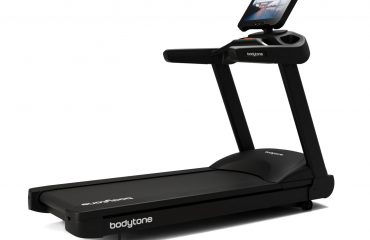
To combine strength and cardio in the same programme, cross trainers and treadmills are strong choices. They condition the body while developing cardiovascular endurance, and they contribute to weight management while working the muscles of the legs and glutes.
In floor planning terms, these are the machines that set your ceiling on peak attendance, so their number is decided from your busiest hour rather than from your average one. The full professional cardio range covers both families.
5. Rowers and stair climbers
Rowing machines and stair climbers are two further options worth planning for. The rower recruits the muscles of the upper and lower body while developing endurance, whereas the stair climber concentrates the demand on the thighs and the glutes. Both work well as an effective warm-up station or as an integral part of a strength programme.
6. Resistance bands and rehabilitation equipment
Resistance bands are often underestimated and remain extremely effective for strengthening and conditioning. They allow work against resistance while remaining gentle on the joints, which is why they are widely used in rehabilitation programmes and in small group formats where the load has to stay progressive and controlled.
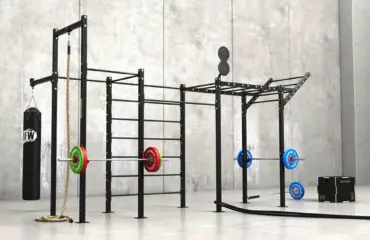
7. Pull-up bars and Roman chairs
For back and arm strength, a pull-up bar is an essential piece of equipment. A Roman chair adds a wide catalogue of movements, in particular for the abdominals, the back and the glutes. Both are compact, which makes them efficient additions where floor area is scarce.
8. Abdominal machines and abdominal benches
To target the abdominal muscles directly, abdominal machines and abdominal benches are sound choices. They strengthen the trunk and the lumbar region, which contributes to better posture across the rest of the programme.
Frequently asked questions
Where should a facility start when the budget is limited?
With benches, dumbbells and one or two guided stations. That combination covers the widest range of members for the smallest footprint, and it can be extended later without being replaced.
Guided machines or free weights for beginners?
Guided machines, because they support the movement and reduce the risk of incorrect execution when supervision is light. Free weights are added as members gain competence.
How much cardio equipment does a strength focused facility need?
Enough to serve the warm-up and conditioning demand at your busiest hour. The number follows from peak attendance rather than from total membership.
Building your equipment list
Choosing the right equipment depends on the objective you are equipping for: building strength, general conditioning or weight management. Qualified coaching alongside the equipment is what turns a well specified room into a programme members stay with. Free weights, guided machines and cardio each have their own role, and the value comes from the combination rather than from any single item. Send us your floor plan and your membership profile and we will return a costed equipment list. Request a quote.