How to Choose an Outdoor Fitness Trail for Your Town: The Complete Guide
Un parcours santé communal se décide sur trois points : le tracé de l'itinéraire, le matériau des agrès et le sol de réception. Les équipements relèvent de la norme EN 16630 et engagent la responsabilité de la commune en tant qu'exploitante. La signalétique et le registre de contrôle font partie du dispositif.
An outdoor fitness trail is one of the few pieces of municipal infrastructure that is open to everyone, costs nothing to use and works every day of the year. Done well, it turns an underused park into a destination and gives residents a reason to be outside. Done badly, it becomes six rusting stations that nobody uses and that the town still has to inspect. This guide takes a municipality through the five decisions that determine which of those two outcomes you get: where to put the trail, what to put on it, what it should be made of, how to sign it, and how to maintain it.
Why a town invests in an outdoor fitness trail
The case for a fitness trail is rarely about sport alone. Four benefits come up in almost every project.
- Public health. It gives residents a free, unintimidating place to be active, which reaches people who will never join a gym.
- Inclusion. Properly specified, a trail serves every age and every fitness level, from teenagers to older adults, and can include stations usable by people with reduced mobility.
- Better use of green space. It gives a park a function rather than just a lawn, and it draws footfall to areas that would otherwise be crossed and forgotten.
- Local attractiveness. Families, runners and visitors use trails, and a good one becomes something a town points at.
| Decision | Why it matters |
|---|---|
| Location | Determines who can reach it and whether it feels safe |
| Equipment mix | Determines how many different users it serves |
| Materials | Determines how long it lasts and how much it costs to keep |
| Signage | Determines whether it is used correctly |
| Maintenance plan | Determines whether it is still open in five years |
1. Choosing the right location
Location decides usage more than equipment does. A well-specified trail in the wrong place stays empty; an ordinary trail in the right place is busy from the first week.
- Access. Choose somewhere reachable on foot, by bike and by public transport. If people have to drive to it, most will not.
- Perceived safety. Lit routes, open sightlines and proximity to places where other people already are. A trail hidden behind a hedge will be used by nobody after four in the afternoon.
- Setting. Parks, woodland edges and riverside paths work because the walk between stations is pleasant, which is half of what makes a trail habit-forming.
A practical tip: design loops of different lengths rather than one linear route, so that walkers, runners and cyclists can each use the trail at their own level without meeting head-on.
| Setting | Advantages |
|---|---|
| Urban park | Accessible, already busy, easy to supervise informally |
| Woodland or tree-lined area | Natural setting, shade, quiet |
| Riverside or lakeside | Attractive route, cooler in summer |
2. Selecting equipment that serves everyone
A trail that serves only one type of user wastes most of its budget. A good mix covers four functions.
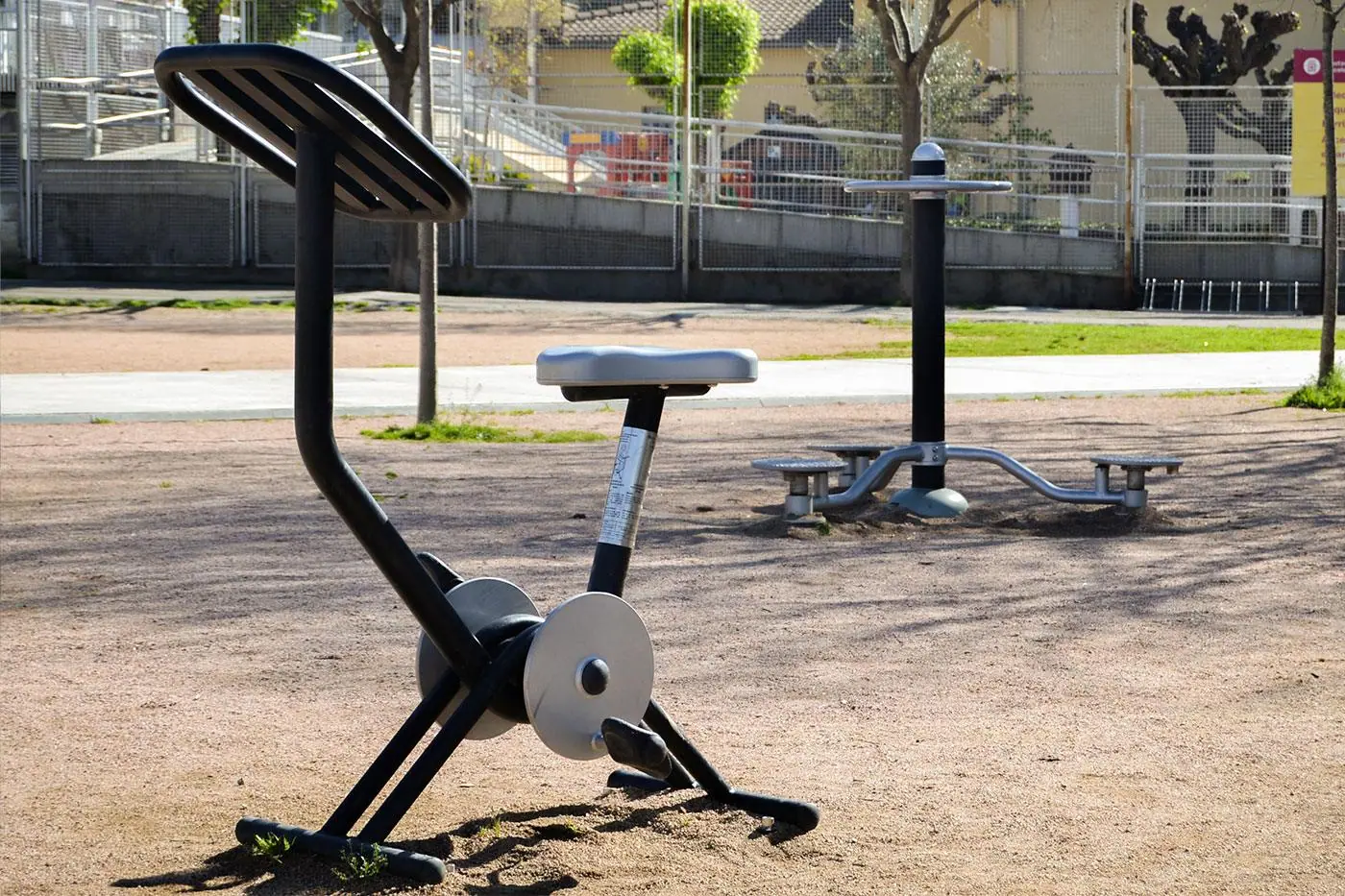
- Cardio stations. Air walkers, cross trainers, steppers and outdoor bikes for endurance work.
- Strength stations. Pull-up and dip bars, sit-up benches and body-weight stations for upper body and core.
- Stretching and mobility. Stretching posts and bars, which cost little and are used constantly, before and after everything else.
- Play and agility. Obstacle and agility elements that bring families to the site rather than only individual adults.
One point deserves emphasis because it is regularly got wrong at specification stage. Outdoor fitness equipment for adults is designed and tested to EN 16630. Equipment intended for children is a different category entirely: it is playground equipment designed and tested to EN 1176-1, installed over impact-absorbing surfacing tested to EN 1177 with a critical fall height matched to the free height of fall. If your trail includes agility or obstacle elements meant for children, they must be specified against the children’s standards, not against EN 16630, and they need the surfacing that goes with them. Mixing the two on one plan is the most common and the most expensive error in municipal trail projects.
| Equipment type | Example | Benefit |
|---|---|---|
| Cardio station | Air walker, outdoor bike, stepper | Endurance and cardiovascular health |
| Strength station | Pull-up bar, sit-up bench, dip bars | Upper body and core strength |
| Stretching zone | Stretching posts and bars | Flexibility, injury prevention |
Our outdoor fitness trail range covers complete circuits, and the individual fitness trail stations can be combined to build a route around the site you actually have. For sites that need accessible provision, the accessible outdoor gym range includes stations usable from a wheelchair.
3. Choosing materials that survive the climate
Outdoor equipment is exposed to everything, permanently, with no supervision. The material choice determines both the lifespan and the maintenance bill, and it should follow the site rather than the catalogue.
- Stainless steel. Corrosion resistant and the right answer for coastal sites, humid locations and anywhere with salt in the air. It costs more at purchase and less over its life.
- Treated timber. Visually at home in parks and woodland, warm to the touch in cold weather, and appropriate where the trail has to sit gently in a landscape.
- Galvanised steel. The general-purpose structural answer for inland sites, robust and cost-effective.
- Non-slip surfaces and rubber components. Grip in the wet and shock absorption at contact points. This is not a detail; wet metal footplates are the single most common source of complaints.
| Material | Advantages |
|---|---|
| Stainless steel | Corrosion resistant, minimal maintenance, coastal sites |
| Treated timber | Natural appearance, robust, suits parks and woodland |
| Rubber components | Better grip, absorbs impact at contact points |
The wooden fitness trail range suits woodland and park settings, the galvanised steel fitness trail range covers standard inland installations, and stainless steel outdoor fitness is the specification for coastal and humid sites.
4. Signage and instructions
Signage is what turns equipment into a trail. Without it, users invent their own exercises, use the stations wrongly and stop coming. Three types of sign do the work.
- Instruction panels. One per station, with a simple illustrated description of the exercise. Pictograms beat text, because they work for every language and every reading level.
- Difficulty levels. Beginner, intermediate and advanced options for the same station, so one piece of equipment serves three users.
- Safety reminders. Warm up, hydrate, and what to do if a station is damaged, including who to report it to.
Signage also protects the operator. A station with clear instructions and a visible reporting contact is a station where the town has demonstrably done its job.
| Sign type | Function |
|---|---|
| Instruction panel | Shows correct execution of the exercise |
| Difficulty indication | Helps users choose the right variant |
| Safety reminder | Warm-up, hydration, damage reporting |
5. Planning maintenance from day one
The town that installs the trail is its operator, and the operator carries the responsibility for keeping it safe. That obligation starts on handover day, so the inspection regime and the budget for it belong in the original project, not in a later one.
- Routine checks. Frequent visual inspection for obvious damage, vandalism and debris. Frequency follows use and risk: a busy urban trail needs looking at far more often than a quiet rural one.
- Operational inspection. A more detailed periodic check of fixings, moving parts, wear and stability.
- Annual main inspection. A full assessment of structural integrity and foundations, normally carried out by a competent inspector, with a written record.
- Cleaning. Leaves, mud and debris are a slip risk and they hide damage. Regular clearing is inspection as much as it is housekeeping.
- Prompt repair. Take a damaged station out of service until it is fixed. A taped-off station is an inconvenience; an unrepaired one is a liability.
Keep a written inspection record for every visit. It is the document that shows the trail was maintained, and it is the first thing anyone asks for if something goes wrong. A maintenance contract with the supplier is often the simplest way to guarantee the periodic and annual inspections actually happen.
| Frequency | Recommended task |
|---|---|
| Routine, frequent | Visual check of the site, damage and debris |
| Periodic | Inspection of fixings and moving parts |
| Annual | Main inspection, structure and foundations, written record |
Frequently asked questions
Which standard applies to an outdoor fitness trail?
Outdoor fitness equipment for adults is covered by EN 16630. Equipment intended for children is covered by EN 1176-1 with impact-absorbing surfacing to EN 1177. The two are not interchangeable.
How many stations does a trail need?
There is no fixed number. It depends on the length of the route, the space available and the user profile. A shorter, well-signed circuit that people complete is worth more than a long one they abandon halfway.
Does a fitness trail need special surfacing?
Adult outdoor fitness equipment has its own surfacing requirements depending on the station and the site. Children’s equipment always requires impact-absorbing surfacing matched to the fall height. Ask for the surfacing calculation with the layout, not after it.
Who is responsible if someone is injured?
The operator of the site, which for a public trail means the municipality. That is precisely why the inspection record matters.
Can a trail be made accessible to wheelchair users?
Yes. Accessible stations exist and can be integrated into a standard circuit, provided the path surface and the approach to each station are designed for it from the start.
How long does an outdoor fitness trail last?
That depends on material, exposure and maintenance rather than on any single figure. Stainless steel in a coastal setting with a real inspection regime outlives untreated alternatives by a wide margin.
Planning your trail
The municipalities that end up with a trail people use start from the site and the users, not from the catalogue. Walk the route. Count who already passes through. Decide which age groups you are serving before deciding which stations to buy. Then specify the materials for the exposure you actually have, sign every station, and put the inspection schedule in the budget from the beginning.
Light In Fitness designs, supplies and installs outdoor fitness trails and outdoor fitness equipment for municipalities, parks, campsites, schools and institutional operators. If you are planning a trail and want a layout and a specification built around your site, your users and your exposure, request a quote and we will work from your plans.
Réalisations documentées
- Parcours ninja sur mesure, Rennes – îlot des Hautes-Ourmes
- Double mur ninja extérieur, Sallanches – Haute-Savoie
À lire aussi sur le même thème
- Découvrez les bienfaits du parcours santé pour une vie active et équilibrée
- Outdoor fitness trail equipment compared: features, benefits and buying advice
- Outdoor Fitness Trail Equipment: The EN 16630 Planning Guide
- Rubber Tiles Compared: Recycled, Virgin and EPDM
- Advanced Strength Techniques: Drop Sets, Supersets, Failure