Inclusive and para-sport equipment: specifying and funding accessible facilities
Making a sports facility genuinely usable by people with disabilities is a specification exercise with three parts: equipment declared to EN ISO 20957-1:2024 class I (inclusive professional use), an approach and transfer zone that actually works for a wheelchair, and a maintenance plan that keeps both intact. Adding one token piece of accessible equipment to an otherwise standard installation does not achieve any of it. Light In Fitness publishes wheelchair-accessible outdoor stations from 720.00 EUR excluding VAT to 3,875.00 EUR excluding VAT, which makes it realistic to allocate 15 to 20% of an outdoor equipment budget to inclusive provision rather than a single gesture unit. This guide covers the technical specification and the funding logic.
The standard first: what class I actually means
EN ISO 20957-1:2024 defines the classes that must appear on a declaration of conformity:
- Class S — professional and commercial use. The baseline for any staffed or publicly accessible facility.
- Class I — inclusive professional use: equipment designed to be used by people with disabilities, in a professional or commercial setting.
- Class H — domestic. Not appropriate in a public facility, whatever the sales tier is called. “Semi-professional” does not exist under the standard.
For outdoor installations, add EN 16630 for permanently installed outdoor fitness equipment, EN 1176 where children use the site and EN 1177 for impact-attenuating surfacing. Where the facility is publicly accessible, national accessibility legislation and the European Accessibility Act framework apply to the route, the signage and the built environment around the equipment, not just to the machines.
What makes equipment genuinely usable, not merely reachable
Five criteria separate accessible equipment from equipment that a wheelchair user can theoretically get near:
- Approach and manoeuvring space. A wheelchair needs a firm, level approach and a turning circle of approximately 1.50 m diameter in front of the station. Impact-attenuating surfacing must be firm enough to wheel on — loose fill is not.
- Use from the chair. The best inclusive stations are used with the wheelchair remaining in place, under the frame or against it. Anything requiring a transfer immediately halves the addressable population.
- Grip and control forces. Handles must be operable with limited grip strength: large diameter, no pinch grip required, no small adjustment knobs.
- Reach zone. Controls and handles between roughly 400 and 1,200 mm above the ground, reachable without trunk extension.
- Shared-use design. Mixed stations — usable both from a wheelchair and standing — avoid segregating the accessible area, which is both better socially and better for utilisation.
Published prices: wheelchair-accessible outdoor stations
| Station | Function | Price excluding VAT |
|---|---|---|
| Upper twister | Trunk rotation, mobility | 720.00 EUR |
| Seated pull-up trainer | Upper body pull | 892.80 EUR |
| Arm trainer | Upper body push and pull | 1,020.00 EUR |
| Helm wheel | Shoulder mobility | 1,188.00 EUR |
| Push and pull stations | Upper body strength | 1,188.00 EUR each |
| Hand wheels | Shoulder mobility | 1,195.20 EUR |
| Arm cycle | Upper body cardio | 1,206.00 EUR |
| Upper or lower body trainer | Strength | 1,278.00 EUR each |
| Accessible bike | Cardio | 1,224.00 EUR |
| Tai chi wheel | Mobility, coordination | 1,450.00 to 1,500.00 EUR |
| Arm cycle and seated pull combination | Combined station | 1,476.00 EUR |
| Hand wheels and helm combination | Combined station | 1,676.40 EUR |
| Pec deck and reverse pec deck | Chest and back | 1,716.00 EUR each |
| Vertical ladder, accessible | Mobility, stretching | 1,865.00 EUR |
| Rotary trainer | Shoulder mobility | 1,878.00 EUR |
| Asymmetric bars | Transfer, upper body | 2,065.00 EUR |
| Arm cycle on inclined post | Upper body cardio | 2,084.40 EUR |
| Accessible stepper | Lower limb mobility | 2,142.00 EUR |
| Upper and lower body trainer pair | Full body | 2,352.00 EUR |
| Parallel bars, accessible | Gait rehabilitation | 2,655.00 EUR |
| Two-station multifunction unit | Combined | 2,688.00 EUR |
| Push and pull combination | Combined | 2,722.80 EUR |
| Stepper and bike combination | Cardio | 2,829.60 EUR |
| Mixed-use pec deck, seated or standing | Shared station | 2,970.00 EUR |
| Accessible basketball hoop | Sport, play | 3,222.00 EUR |
| Three-station multifunction unit | Combined | 3,396.00 EUR |
| Double lat pulldown, accessible | Back and shoulders | 3,625.00 EUR |
| Seated press and high pull station | Full upper body | 3,650.00 EUR |
| Double chest press, accessible | Upper body push | 3,875.00 EUR |
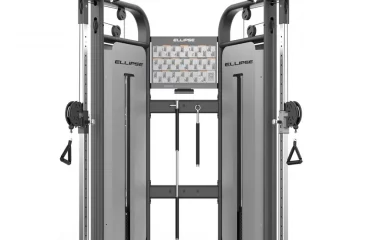
Indoors, adapted cardio and cable work follow the same logic: a double-pulley personal training station with integrated mirror, at 3,095.00 EUR excluding VAT, gives seated users a full upper-body programme with fine load increments and visual feedback.
Worked configurations
| Project | Configuration | Equipment budget excluding VAT |
|---|---|---|
| Minimum credible inclusive provision | Arm trainer, upper twister, hand wheels, accessible bike | Approx. 4,159 EUR |
| Inclusive circuit within a public park | Six accessible stations plus a mixed-use station | Approx. 11,000 to 14,000 EUR |
| Dedicated accessible fitness area | Three-station multifunction unit, seated press and pull, parallel bars, accessible basketball | Approx. 13,000 EUR |
| Care setting or rehabilitation garden | Low-intensity mobility stations plus accessible parallel bars | Approx. 8,000 to 10,000 EUR |
Equipment only. Firm level approach surfacing, signage, seating and shade are additional and are as important to real usage as the equipment itself.
Funding: how to build the case
Public funding schemes for sports facilities differ by country, but the assessment criteria are strikingly consistent. A fundable accessibility case almost always has to evidence five things:
- Documented need. Local population data, distance to the nearest accessible provision, and letters of support from disability sport clubs or care providers.
- Design credibility. A layout showing approach routes, transfer zones and surfacing — not a product list. Assessors reject shopping lists.
- Compliance evidence. Class I declarations, EN 16630 and EN 1177 references, and confirmation that the route to the equipment complies with accessibility requirements.
- Financing plan. Co-funding sources, own contribution and any reduced VAT rate available in your jurisdiction for adapted equipment — check this locally, because rates and eligible categories vary.
- Operating sustainability. Who maintains it, who programmes activity on it, and what happens in year five. Capital grants are increasingly conditional on a credible operating answer.
The practical advice is to build the technical file first — layout, standards, quotations, maintenance plan — and then map it onto whichever scheme is open. A file built to the standards travels between schemes; a file built to one application form does not.
Frequently asked questions
What standard covers inclusive fitness equipment?
EN ISO 20957-1:2024 class I designates equipment for inclusive professional use, alongside class S for general professional and commercial use. Outdoors, add EN 16630 for permanently installed fitness equipment and EN 1177 for impact-attenuating surfacing. Ask for the declaration of conformity naming the class before ordering.
How much does accessible outdoor fitness equipment cost?
Individual wheelchair-accessible stations are published from 720.00 EUR excluding VAT for an upper twister to 3,875.00 EUR for a double chest press, with combination stations between 2,688.00 and 3,396.00 EUR. A credible minimum provision of four stations is around 4,159 EUR, and a full inclusive circuit between 11,000 and 14,000 EUR.
What surfacing is needed around accessible equipment?
A firm, level, wheelable surface with an approach and a turning circle of about 1.50 m diameter in front of each station. Loose fill materials meet impact-attenuation requirements but are not wheelable, so bonded rubber or rubber tiles are usually the correct answer where accessibility and fall protection overlap.
Should accessible equipment be grouped separately?
Preferably not. Mixed-use stations that work both from a wheelchair and standing keep the accessible provision inside the main circuit, which improves both social integration and utilisation. Reserve a dedicated area only where the programme requires it, such as a rehabilitation garden.
How do I make an accessibility project fundable?
Build the technical file before choosing the scheme: evidenced need, a layout showing approach and transfer zones, class I declarations and standards references, a financing plan including any reduced VAT rate available locally for adapted equipment, and a written answer on who maintains and programmes the facility after delivery.
Planning an inclusive facility? Send us the site plan and the user population you need to serve. Light In Fitness returns a 3D layout showing approach routes and transfer zones, standards references, quantities and prices excluding VAT within 24 working hours, and can manufacture bespoke heights and configurations where the site requires it. See also our guides to outdoor fitness trails and outdoor strength equipment.
Related guides: mountain and cold-climate sites.
Sources et références
- Code du sport, articles R322-4 à R322-43 – garanties d’hygiène et de sécurité applicables aux établissements d’activités physiques et sportives (Légifrance)
À lire aussi sur le même thème
- Outdoor fitness trail supplier: stations, EN 16630 and installation
- Modular Obstacle Course for Adults: What It Is and What It Brings to Your Business
- Where to Buy an OCR Obstacle Course: A Buyer's Guide for Clubs, Campsites and Local Authorities
- Dumbbells, kettlebells and professional free weights: the complete buying guide
- Power towers, pull-up bars and wall bars: the bodyweight equipment specification guide