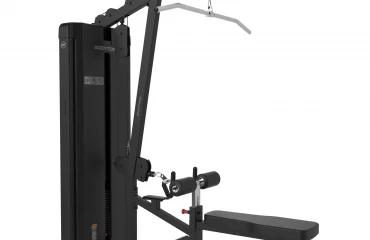
Adductor Machine: The Complete Guide for Gym Operators
La machine à adducteurs sollicite les muscles internes de la cuisse en adduction contrôlée, sur une amplitude guidée. Elle complète le travail des abducteurs et des chaînes principales, sans les remplacer. Dans un plateau de salle, elle occupe une emprise réduite et convient aux publics débutants comme à la rééducation.

The adductor machine is one of the quietest workhorses on a gym floor. It occupies a small footprint, it is immediately usable by beginners and rehabilitation clients, and it isolates the inner thigh muscles that compound lower-body work rarely loads directly. This guide is written for the person who has to specify one: what the machine does, how the adductor and abductor functions differ, which configuration suits which facility, and what to check before signing an order.
What an adductor machine actually does
The machine loads hip adduction: the user sits with the back supported, places the legs against lateral pads and brings them together against an adjustable resistance, through a guided range of motion. Because the movement path is fixed and the trunk is supported, the exercise isolates the adductors without recruiting the rest of the chain, and it does so with a very low technical barrier.
That is exactly why it earns its place in a commercial facility. It complements the abductor function, which loads the outer hip, and together the two cover the frontal plane of the hip joint. Neither replaces squats, lunges or hinge patterns; both fill a gap those movements leave.
Adductor, abductor, or both in one frame
There are three configurations on the market and the choice is a floor-planning decision more than a biomechanical one.
- Dual inner and outer thigh – one frame, one seat, both movements selected by a pin or lever. The most space-efficient answer, and the standard specification for hotel gyms, corporate facilities and clubs where floor area is the constraint. The Bodytone FH56 inner and outer thigh machine is the reference in that format.
- Two dedicated stations – a separate adductor and a separate abductor. Higher throughput at peak hours because two members train at once, and no changeover time. This is the right call above a certain membership density, for example with the Etenon R5506 adductor machine.
- Plate loaded versus selectorised – selectorised suits mixed-ability memberships and rehabilitation, where fast, small load increments matter. Plate loaded suits strength-focused facilities and reduces moving parts to maintain. The full selectorised range is in our selectorised strength machines section.
Specification points that matter in a commercial setting
Equipment placed in an unsupervised or semi-supervised commercial environment should be built and certified to EN ISO 20957-1 class S, the class for professional indoor use. Beyond that classification, four practical points separate a machine that survives a decade from one that does not.
- Weight stack increments – small increments make the machine usable by deconditioned and post-injury users, which is a large share of its actual traffic.
- Range-of-motion adjustment – a start-position adjustment lets a physiotherapist or coach limit the range, which is what makes the station usable in rehabilitation programmes.
- Pad and upholstery quality – the lateral pads take direct, repeated loading; upholstery is the first component to fail and the first thing members notice.
- Footprint and access – the seated position and low frame make this one of the easier stations to place in a corner or against a wall, but leave clearance for the legs to open fully.
Programming guidance to give your floor staff
Your instructors will be asked how to use it. The straightforward protocol: adjust the load to a moderate starting resistance, sit with the back flat against the pad, position the legs on the supports with the feet stable, bring the legs together in a slow controlled movement without locking out, hold the contraction for around a second, and return under control. For general conditioning and toning, two to three sessions per week of three to four sets of ten to fifteen repetitions is a reasonable prescription. Hypertrophy-focused programming requires individual supervision to set loads and avoid overtraining.
Advise members to warm up before loading the adductors, and to pair the station with compound work – squats and lunges – so the leg develops in balance rather than in isolation.
Who buys this machine, and why
- Commercial gyms and clubs – a high-usage station with a low intimidation barrier, valuable for member retention among new joiners.
- Rehabilitation centres and physiotherapy practices – controlled, measurable loading of a specific muscle group with an adjustable range.
- Hotels, residences and corporate facilities – the dual configuration delivers two exercises in one footprint.
- Municipal and school facilities – simple to use safely with limited supervision.
Frequently asked questions
What is the difference between an adductor and an abductor machine?
The adductor machine loads the inner thigh by bringing the legs together; the abductor machine loads the outer hip by pushing them apart. They are complementary halves of the same joint, and many facilities buy them as a pair or as a single dual-function frame.
Should I choose a dual machine or two separate stations?
Floor area and peak-hour density decide it. A dual frame saves space; two stations remove the queue and the changeover. Below roughly one strength zone in a compact facility, the dual frame is almost always the better use of the square metres.
Is the machine appropriate for rehabilitation use?
Yes, provided it offers small load increments and a range-of-motion adjustment. Isolation with a guided path and a supported trunk is precisely what a controlled reconditioning protocol needs. The clinical protocol itself remains the responsibility of the practitioner.
What are the risks for the user?
They stay low when the load is set appropriately and the movement is controlled. Abrupt movements or excessive loads can produce muscular strain, which is an argument for specifying a machine with fine load increments rather than large jumps.
Specifying your strength area
An adductor station is rarely bought alone. Tell us the surface area, the membership profile and the rest of the strength line-up, and we will return a costed layout that balances coverage against floor space: request a quote.