Best Olympic Strength Training Machine: Buyer Guide
Une machine dite olympique se caractérise par sa compatibilité avec une barre de 2,20 m et des disques de 51 mm de diamètre intérieur. Cage, rack et banc olympique constituent l'équipement de base d'une zone de force. Le choix se fait sur la charge maximale admissible et la présence de barres de sécurité.
Olympic strength training is still the backbone of every serious gym floor: it builds maximal strength, muscle mass and general conditioning with equipment designed to last. But there is no single answer to the question of the best Olympic machine. For a gym owner, a cross-training box, a hotel, a sports club or a rehabilitation centre, the right choice depends on the floor space available, the profile of the users and the load the frames have to absorb day after day. This guide sets out what actually defines an Olympic machine, which stations form the core of a strength area, and the criteria that separate professional equipment from the rest.
What makes a machine Olympic?
An Olympic machine is defined by its loading system, not by its finish or its brand. It accepts a 2.20 m Olympic barbell and plates with a 51 mm inner diameter, the international reference used in competition and in professional training. Everything else follows from that specification: sleeve diameter, weight horn spacing, frame section and the geometry of the safety catches. A frame that only takes smaller bore plates is not an Olympic machine, whatever the description says.
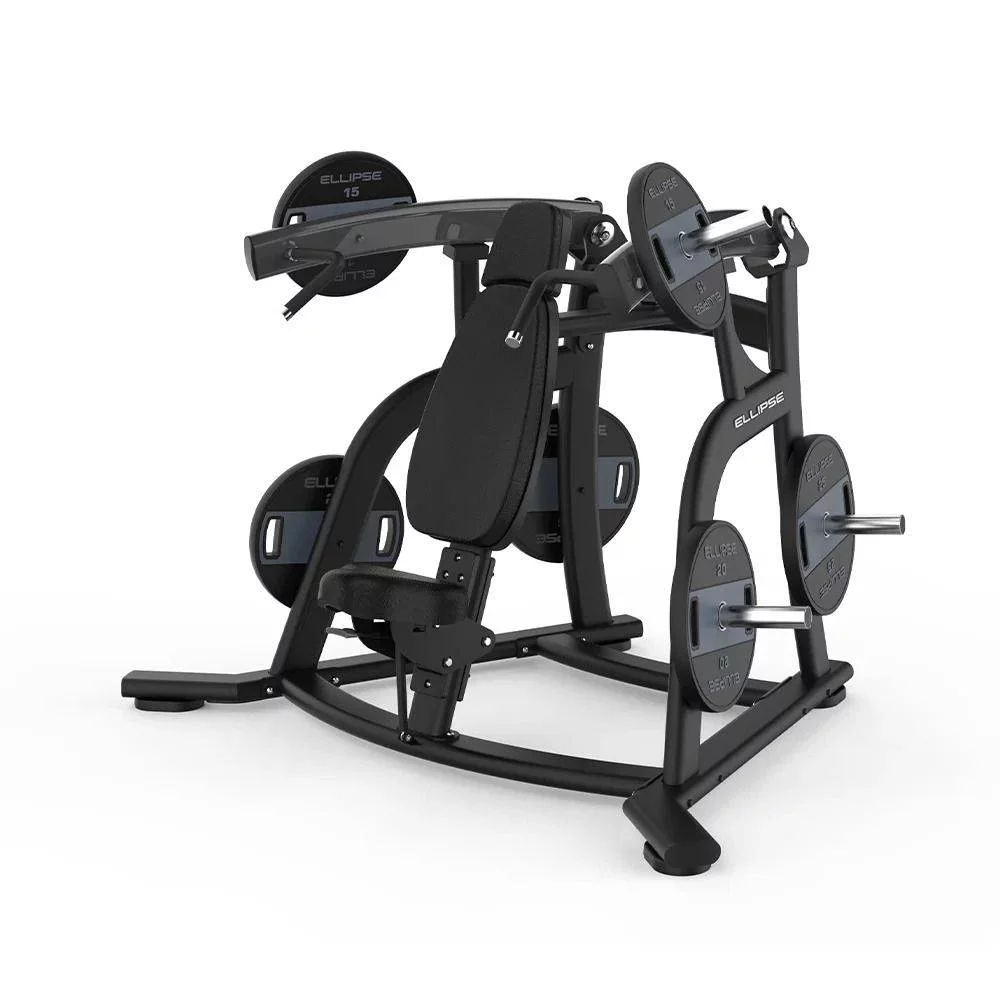
The second defining feature is the load path. Olympic machines are plate loaded: the user adds discs directly onto the horns and the resistance follows a converging arc rather than a fixed cable line. The result is a free weight feel combined with the guidance and the safety of a frame, which is precisely why these stations have become standard in commercial gyms.
The core stations of an Olympic strength area
The bench is the starting point. Designed so that users can train safely and work each muscle group in turn, it comes in several formats: flat, incline, fully adjustable and folding for rooms where floor space is shared with classes. Robustness and the maximum load rating matter more here than any other criterion, because the bench carries both the user and the bar.
Around the benches, a complete Olympic area typically combines a Smith machine, dumbbells, selectorised machines, racks, Olympic barbells and multi station gyms. Together they cover the upper body, the lower body and the core: chest, back, shoulders, biceps, triceps, quadriceps, hamstrings, glutes, calves and abdominals. The bench press remains the reference movement for the chest, performed with an Olympic bar and free weights, while the squat, on a rack or on a guided station, remains the most efficient way to load the thighs and glutes. Pull ups, rows and pressing movements complete the picture.
Which station for which need
| Station | Main use | Why it belongs in the area |
|---|---|---|
| Olympic bench | Bench press, incline press, dumbbell work | Entry point of the area, highest turnover of users |
| Rack or power cage | Squat, overhead press, pull ups | Free weight training with safety catches |
| Plate loaded converging machine | Chest, back, shoulders, legs | Free weight feel with a guided path |
| Selectorised machine | Isolation and circuit training | Fast load changes, ideal for beginners and busy hours |
| Leg press | Quadriceps, glutes, hamstrings | Heavy lower body loading without spinal compression |
Plate loaded or selectorised?
Both families belong in a professional gym, and they answer different questions. Plate loaded Olympic machines suit strength focused members, cross training boxes and clubs where users already know how to handle a bar. Selectorised machines suit circuit layouts, hotel gyms, corporate facilities and rehabilitation settings, where load changes need to be immediate and supervision is limited. In practice, most gyms that equip a room from scratch build a plate loaded core and surround it with selectorised stations for accessibility and flow.
Adjustable handles and pulleys widen the range of movements available on a single frame while protecting the joints. Quality upholstery and adjustable loading let beginners and advanced users work on the same equipment, which is what keeps a floor productive across the whole opening day.
What to check before you buy
Four points decide whether a machine will still be in service in ten years. First, the maximum load rating and the section of the steel: this is where professional equipment separates from lighter ranges. Second, the presence and adjustability of safety bars, non negotiable on any station used without a spotter. Third, conformity with EN ISO 20957-1 class S, the class for equipment intended for supervised professional use, which is the only relevant reference for a commercial gym. Fourth, the availability of spare parts and the warranty on the steel structure and on the upholstery.
Manufacturers such as Light In Fitness, Ellipse, Bodytone and Lexco build ranges around these constraints, covering strength training, cardio, cross training, rehabilitation and general conditioning. Comparing them means comparing frames, load ratings and after sales support rather than headline specifications.
Frequently asked questions
Is an Olympic machine only for advanced users?
No. The Olympic format refers to the bar and the plate bore, not to the training level. With adjustable loading and safety catches, the same station serves a first time member and an experienced lifter, provided the load is adapted and a proper warm up precedes each session.
How many Olympic stations does a gym need?
That depends on the floor area and on the expected attendance at peak hours rather than on a fixed ratio. The usual approach is to size the strength area around the bench, the rack and the leg press, then add converging stations as traffic grows. A layout study before ordering avoids both congestion and unused frames.
Can Olympic machines be used in a rehabilitation centre?
Yes, with the right selection. Guided converging machines and selectorised stations offer controlled ranges of motion and progressive loading, which suits supervised reconditioning work. Free weight racks are usually reserved for a separate zone.
What about flooring under an Olympic area?
Any area where loaded bars are handled needs a rubber floor sized for impact, both to protect the slab and to control noise. This is part of the equipment budget, not an accessory.
Choosing with a project in mind
The best Olympic machine is the one that matches the room, the users and the intended service life. In practice that means a wide range of exercises on a limited footprint, optimal safety, adjustable loading, a frame built for continuous use and after sales support that keeps the equipment running. Start from the layout, not from the catalogue.
Useful ranges to explore: Olympic and adjustable weight benches, Gold Line converging plate loaded machines and the Bodytone FBC08 Olympic bench press. For a room by room selection and a costed proposal, request a quote and our team will build the layout around your constraints.