How to Choose a Professional MMA Cage
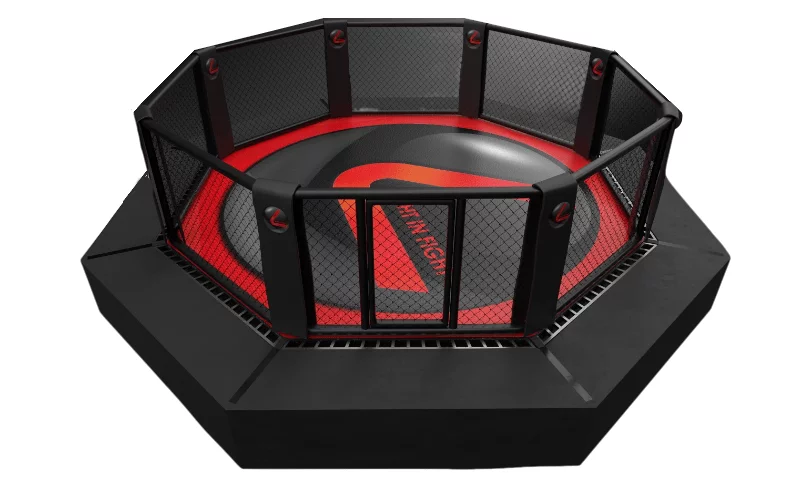
An MMA cage is the single most structural investment a combat sports club makes. It defines the training area, it carries the impact of takedowns and clinch work against the fencing, and it is the piece of equipment inspectors, federations and insurers look at first. Mixed martial arts combines judo, boxing, karate, Brazilian jiu-jitsu, kickboxing and Muay Thai, so the cage has to withstand striking, grappling and ground work in the same session. Choosing the right one is a procurement decision, not a matter of taste.
What a professional MMA cage has to do
Fighters work against the fence: they push off it, they trap opponents on it, they use it to set up takedowns, submissions and chokes. The cage is therefore a load-bearing structure, not a decorative boundary. The steel frame and the mesh panels must absorb repeated lateral impact without deflecting, and every fixing point has to stay tight through hundreds of training hours. Any cage that flexes visibly under a clinch is a safety problem long before it is a durability problem.
Size and geometry
Competition cages are octagonal and come in several sizes depending on the competition format. Do not pick a diameter from a catalogue photograph. Start from the ruleset your athletes actually compete under, check the dimensions published by the governing federation in your country, and then check the room. A cage that fits the rules but leaves no safe circulation space around it is unusable. For clubs that mix disciplines, a cage that is generous enough to allow free movement and the full range of striking and grappling techniques is worth more than a cage sized to the minimum.
Structure, panels and fencing
The frame is built from steel uprights and mesh panels. Look at the gauge of the mesh, the way panels are joined, the padding on the uprights and the coating on the top rail. Padding thickness and coverage matter more than colour: exposed steel at head height is the most common defect on entry-level cages. Ask for the full specification sheet rather than a marketing description, and compare it with what you can see on our floor-level MMA cages and podium MMA cages.
The floor is part of the cage
The surface inside the cage has to absorb throws and ground impact. Professional installations use tatami mats laid over a level, load-bearing base; the mat density and thickness should be chosen for the discipline mix, not simply for the price per square metre. A cage supplied without a properly specified floor is only half an installation. Our tatami mats range covers the densities used in club and competition settings.
Floor-level or podium?
A floor-level cage sits directly on the training surface. It is easier to install, easier to access and better suited to daily club training and to rooms with limited ceiling height. A podium cage is raised on a platform, which gives spectators and cameras a clear line of sight and is the usual choice for event promoters and clubs that host competitions. Many clubs buy floor-level for training and hire or add a podium structure for events.
Assembly, dismantling and transport
If the cage travels to competitions, assembly time and packing volume become selection criteria in their own right. Panel-based systems that bolt together without welding, with numbered components and a transport case, are far more practical than a structure that has to be partly dismantled with specialist tools. Ask how many people are needed for a full assembly and how the panels are protected in transit.
Federation requirements
Rules on cage construction, dimensions, padding and fencing are set by the national MMA federation that sanctions your events, and they differ from one country to another. Before ordering, confirm the current requirements with the federation that will sanction your competitions, and ask your supplier to confirm in writing that the model you are buying meets them. A cage that is perfectly good for training may not be accepted for a sanctioned event.
The equipment around the cage
A combat sports club is not only a cage. The strength and conditioning area that surrounds it should be built with professional indoor equipment to EN ISO 20957-1 class S, and the floor outside the mat area should be specified for dropped loads. Planning the cage and the surrounding zones together avoids the classic mistake of a superb cage installed in a room that cannot take the rest of the programme.
Frequently asked questions
Is an octagon the only option?
Octagonal cages are the reference format in competition MMA. Other footprints exist for training rooms where space is constrained, but if your athletes compete in an octagon, they should train in one.
Can a cage be installed in a room with a low ceiling?
Usually yes for a floor-level cage, provided there is clearance above the top rail and the room ventilation and lighting are adapted. Podium versions need more height. Send us the room dimensions and we will confirm.
What maintenance does a cage need?
Regular inspection of fixings, padding and mesh tension, and immediate replacement of any damaged panel or pad. Build the check into the weekly opening routine rather than an annual audit.
Can the cage be branded?
Padding and mat colours are usually configurable, which lets clubs and promoters match club identity or sponsor requirements. Confirm lead times before committing to an event date.
Getting the specification right
The best MMA cage is the one that satisfies the federation ruleset you compete under, keeps your athletes safe, fits the room you actually have and lets fighters concentrate on the work instead of the equipment. Send us your floor plan, your discipline mix and your competition format and our technical team will build the specification with you. Request a quote and we will come back with a costed proposal for the cage, the matting and the surrounding training zones.