
Where to Buy an MMA Cage: A Professional Buyer Guide
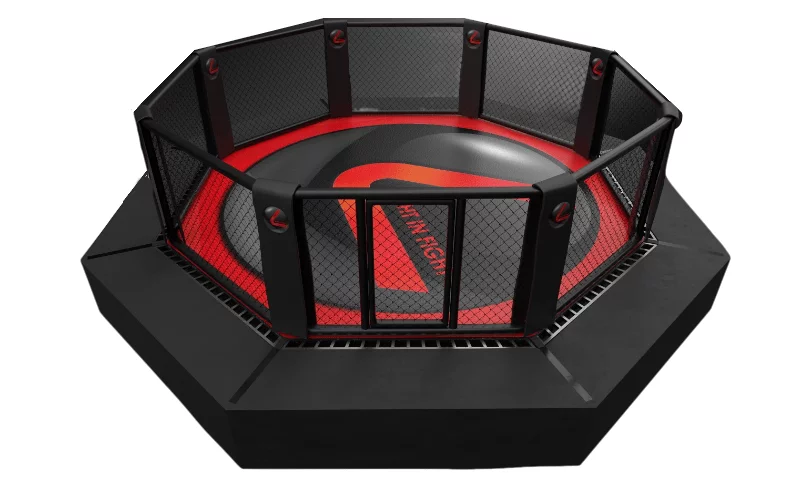
Buying an MMA cage is rarely an impulse decision. Whether you run a combat sports club, a cross-training box, a municipal sports hall or a fight promotion, the cage is the single most scrutinised piece of equipment you will install: it carries the athletes, the officials and, in competition, the reputation of the event. This guide sets out where professional buyers actually source cages, what separates a manufacturer from a reseller, and which specifications deserve a second look before you sign an order.
Who supplies MMA cages, and how they differ
Three channels dominate the market. Specialist combat sports retailers stock a limited catalogue of standard models and are quick to quote, but customisation is usually restricted to colours and padding covers. Sports equipment manufacturers, by contrast, build the structure themselves: they can adapt the diameter, the frame, the gate position and the finishes to the room you actually have, and they stand behind the product with a manufacturer warranty. The third channel is the second-hand market, mostly former promoters and clubs reselling a cage after an event cycle.
For a professional installation, the manufacturer route is almost always the right one. A cage is a load-bearing structure, not a consumable: the quality of the welds, the tension of the mesh and the density of the padding determine whether it is still safe after three seasons of daily sparring.
Floor-level or podium: the first structural decision
Before comparing brands, decide how the cage sits in the room. The two families answer very different needs.
| Configuration | Best suited to | What to plan for |
|---|---|---|
| Floor-level MMA cage | Daily club training, academies, multi-purpose halls | Level, load-bearing floor; surrounding mat area; easy athlete access |
| Podium MMA cage | Competition, televised events, show venues | Raised deck, access stairs, sightlines for spectators and cameras |
A floor-level cage is the workhorse of a training facility: athletes step straight in, coaches work from the perimeter, and the structure integrates with the surrounding tatami mats without a change of level. A podium cage is an event product. If your venue does both, plan the training cage first and hire or specify the podium separately.
Dimensions and the specification sheet
Cages are typically supplied between 6 and 10 metres in diameter. The smaller end suits club training rooms and dedicated academies; the larger end matches competition formats and gives officials room to work. Measure the room before you shortlist anything: you need the cage footprint plus a clear working perimeter for coaches, medical staff and, at events, camera positions.
Beyond diameter, ask every supplier for the same short list: steel section and surface treatment of the frame, mesh gauge and how it is tensioned, padding thickness and cover material on the posts and top rail, gate type and locking, and whether the structure is bolted or free-standing. Ask how long assembly takes and how many people it needs, because a cage that is dismantled between events has very different requirements from one that is installed once.
Options that matter for events
Promoters increasingly specify integrated lighting, LED signage, camera mounts and audio. These are worth discussing at the quotation stage rather than retrofitting: mounting points, cable routing and the load they add to the frame all have to be designed in. A manufacturer can integrate them; a reseller usually cannot.
Buying second-hand: what to inspect
Used cages do circulate, and for a young club the saving can be meaningful. The risk is structural. Inspect the welds at every post base, check the frame for deformation, confirm that the mesh is intact and still tensioned evenly, and look closely at the padding: compressed or torn foam is an injury risk and is often the most expensive part to replace. Ask for the original documentation and the assembly instructions. If the seller cannot produce either, treat the cage as an unknown quantity.
Frequently asked questions
What diameter should I choose for a club?
Most club installations sit at the lower end of the 6 to 10 metre range, because the room has to accommodate the cage plus circulation and warm-up space. Competition formats push towards the larger diameters.
Can a cage be customised?
Yes, when you buy from a manufacturer. Diameter, gate position, padding colours, branding on the covers and integrated event equipment are all specification choices rather than catalogue options.
How long does installation take?
It depends entirely on the model and the configuration, so ask your supplier to state assembly time and crew size in the quotation rather than assuming a figure.
Does a cage need a specific floor?
It needs a level, load-bearing surface. In practice most facilities combine the cage with a matted training area, and the floor build-up should be specified together with the structure rather than afterwards.
Specifying your cage
The right cage is the one that matches your room, your usage intensity and your event ambitions. Send the room dimensions, the intended use and any event requirements to a manufacturer and compare like-for-like quotations rather than headline prices. Request a quote with your project details and you will get a configuration built around the space you actually have.
