The Complete Guide to Selecting Gym Equipment
Le choix d'un équipement de fitness se fait sur quatre critères : la classe d'usage, la disponibilité des pièces, l'emprise au sol et la facilité de réglage. Ces paramètres prédisent le coût d'exploitation mieux que le prix d'achat. Ils s'appliquent au cardio, à la musculation, au cross-training et à la récupération.
Selecting equipment is one of the few decisions in a fitness facility that is very hard to undo. A poor choice is paid for twice: once at purchase, then every month in downtime, service calls and members who move elsewhere. This guide sets out how a professional buyer – gym operator, box owner, hotel, club, local authority, rehabilitation centre – should work through cardio, strength, cross-training and recovery.
The four criteria that actually matter
Equipment selection rests on four criteria: usage class, spare parts availability, footprint and ease of adjustment. These predict the running cost of a floor far better than the purchase price does, and they apply to every family of equipment.
- Usage class. Indoor equipment for a facility open to third parties is specified to EN ISO 20957-1 class S. That is the professional class, and it is the baseline for any site with paying or public users. Class I is the professional class for inclusive access, not a step above class S.
- Spare parts. A console, a belt, a bearing or a cable will fail. The question is how quickly the part arrives and for how many years it stays available.
- Footprint. Not the machine outline, but the machine plus its safety and circulation envelope. This is what fixes how many stations a room can actually hold.
- Ease of adjustment. Every second a member spends fighting a seat pin is a second of throughput lost and a small risk of poor positioning.
Everything below is an application of those four points.
Cardio equipment
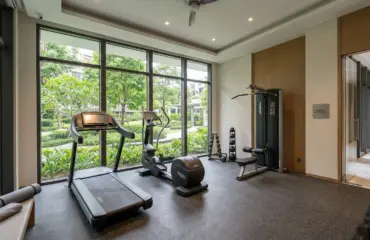
The core of a cardio floor is built from treadmills, cross trainers and exercise bikes.
- Treadmills carry running and walking indoors, independent of the weather. They are the highest-wear machines on the floor and the ones where deck, belt and motor specification matter most.
- Cross trainers are low impact and work the whole body, which makes them efficient in a small footprint and popular with a wide range of members.
- Exercise bikes suit seated training. They are gentle on the joints and raise heart rate without impact, which makes them the natural entry point for deconditioned or returning users.
Whichever machines you choose, the selection has to match the population you actually serve. Where joint problems are common – a rehabilitation centre, a senior-heavy club, a hotel with an older guest profile – weight the mix towards low-impact machines. Programming should start conservatively and build intensity progressively. The full range is set out under cardio equipment.
Strength equipment
Beyond cardio, strength training is where most facilities differentiate themselves. Strength work is associated with better bone density, with support for weight management and with a lower risk of chronic disease, which is why it now appears in almost every membership offer.
Dumbbells are among the most versatile tools on the floor. They cover a wide range of exercises across muscle groups, and because they run from very light to very heavy they let a member progress load gradually.
Barbells allow heavier loads, recruit more muscle groups and build strength faster than dumbbells alone. They are the tool for deadlifts, squats and other multi-joint lifts, and they require a rack and a suitable platform around them.
Kettlebells sit close to dumbbells but the handle changes the movement. They suit functional training – swings, cleans, squats, the snatch that takes the bell from floor to overhead in one movement – and they take almost no space.
Resistance bands complete the set. They load muscles differently from free weights, isolate specific groups, add variation and let a coach scale difficulty instantly. They are also the cheapest way to widen what a small studio can offer.
For machine-based strength, selectorised stations are the workhorse: fast to adjust, safe to use unsupervised and easy to circuit. See the Gold Line selectorised machines for a typical professional configuration.
Cross-training equipment
Cross-training equipment is how an operator breaks the monotony of a traditional floor and opens a second revenue line in class formats.
- Rowing machines give a full-body workout and cardiovascular conditioning with low joint impact, which makes them gentler than running on a treadmill.
- Battle ropes build work capacity and muscular endurance, and they need only a fixed anchor point and a few square metres.
- Skipping ropes are compact and inexpensive, and deliver high-intensity conditioning where there is no room for a rower or ropes.
The structural decision behind all of this is the rig or cage that anchors the area. It defines how many members can train at once, what can be suspended and how the class is coached. Configurations are shown under cross-training cages.
Recovery equipment
Recovery is no longer an afterthought. Members train hard and come back sore, and a facility that supports recovery keeps them training.
Foam rollers release muscular tension and support mobility, and they work equally well as a warm-up tool. Massage guns target specific muscle groups and reach deeper tissue. Stretching mats are the base of any recovery zone: a comfortable surface, easy to roll up and store, and cheap enough to deploy in numbers.
A recovery corner costs little, uses dead floor space and gives coaches somewhere to send members between sets. Mats, rollers and small tools sit in the fitness accessories range.
Buying advice
Buying equipment is difficult the first time. A few rules keep the decision sound.
- Research and compare before committing. Do not buy the first item you see and regret it later.
- Work to your real space and budget. There has to be enough room to use the equipment comfortably, and enough budget left for the rest of the project: flooring, storage, signage, installation.
- Check reviews and warranties. The point is a product that lasts rather than one that is repeatedly repaired or replaced.
- Take the time to look at every aspect. The right answer depends on the objectives of your own site, not on what is fashionable.
Frequently asked questions
What class of equipment does a commercial site need?
Indoor equipment used by third parties is specified to EN ISO 20957-1 class S. Anything below that class is outside the scope of a professional installation, regardless of how the machine is marketed.
Should a small facility start with cardio or with strength?
It depends on the membership you expect. A hotel or a residential fitness room usually starts with cardio and a compact strength station; a performance-oriented club starts with racks and free weights. In both cases the recovery corner is the cheapest way to add perceived value.
How much space should be planned per station?
Plan the machine footprint plus its safety and circulation envelope, not the machine alone. Exact envelopes vary by model and are given in each technical sheet, so a layout should always be checked against the specific machines selected.
Is buying second-hand a reasonable option?
Only where the usage class is documented and the spare parts are still supplied. A machine with no parts channel is a machine with a short and unpredictable remaining life.
Building your equipment list
Choosing the right equipment makes training more effective and reduces the risk of injury, and on a commercial floor it decides how many members a room can serve per hour. Light In Fitness manufactures and supplies professional fitness equipment for gyms, clubs, hotels, local authorities, schools and rehabilitation centres. Send us your floor plan, your member profile and your budget, and we will return a configuration and a costed proposal – request a quote.