Leg Extension Machines: The Buying Guide for Professional Gyms
Quadriceps strength is one of the clearest indicators of how well a training floor has been specified. In a commercial gym, a club fitness room or a rehabilitation unit, the leg extension station is where the quadriceps are isolated under a controlled, measurable load, which no compound movement does with the same precision. This guide is written for the people who sign the purchase order: gym operators, cross-training box owners, hotel and campsite leisure managers, local authorities, sports clubs and rehabilitation centres.
Why the quadriceps deserve a dedicated station
The quadriceps are the largest muscle group of the thigh. They drive walking, running, jumping and every lifting pattern that starts from the floor, and they stabilise the knee joint in each of those movements. On a busy training floor, that makes quadriceps work non negotiable: it serves the strength member, the rehabilitation client returning from injury and the older member working on autonomy, all on the same machine.
A leg extension station also solves a throughput problem. Squats and lunges need a rack, a barbell, floor protection and coaching supervision. A guided leg extension can be set up and used in seconds, which matters when a class of twenty members rotates through a circuit.
The types of leg extension equipment
Four families of equipment produce a knee extension. They are not interchangeable, and each one answers a different specification.
Plate-loaded leg extension
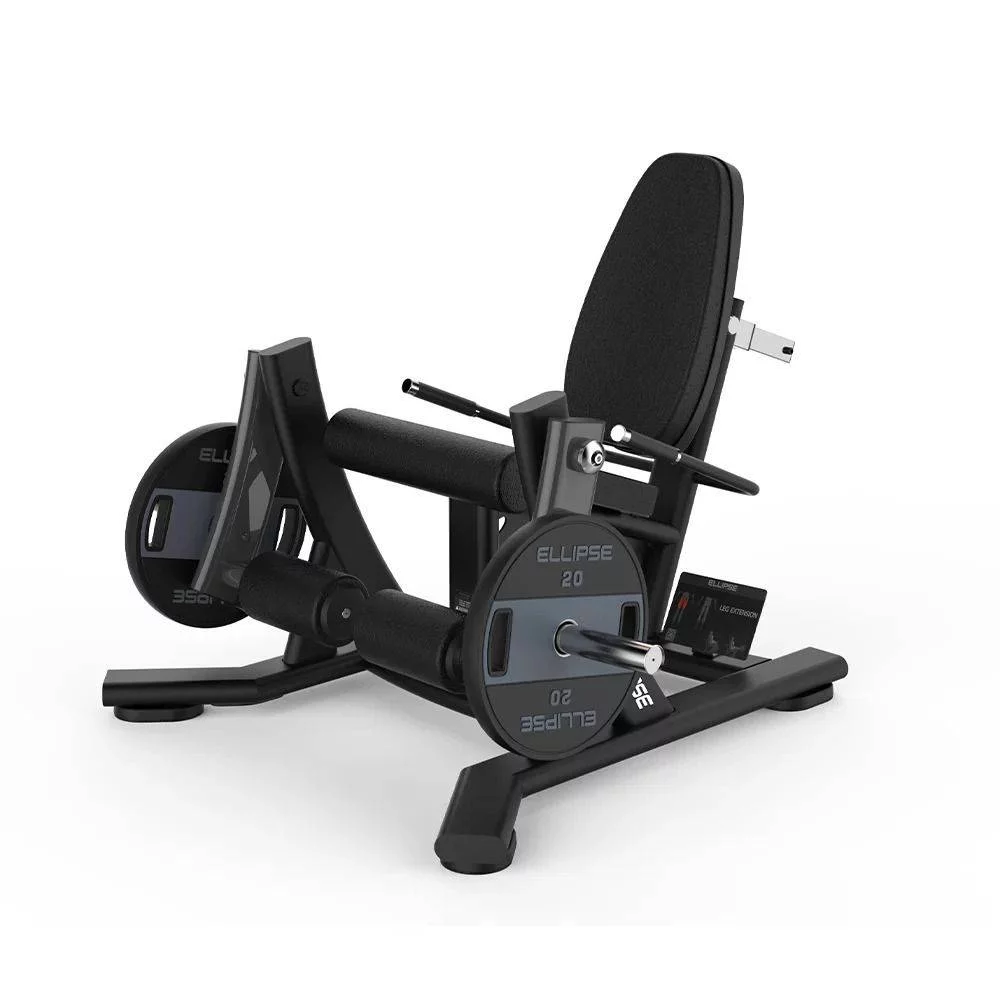
The plate-loaded machine takes the highest loads of the four and lets you keep adding weight as the member progresses. Its range of motion is generally the widest, which gives a deeper stretch on the quadriceps. It suits strength focused facilities and any room that already stocks olympic discs. Browse the plate-loaded machines range for the configurations available.
Selectorised leg extension
The selectorised machine gives a more controlled movement and lets the user change resistance with a pin, without handling discs. It is the default choice for mixed membership clubs, hotels, corporate rooms and any site where supervision is light, because it removes the loading and unloading step entirely. The selectorised machines range covers the usual seated leg extension formats.
Cable-based leg extension
A cable station reproduces the movement with more freedom and allows several working angles on the quadriceps. It is the space efficient option, because the same column also serves a dozen other exercises. Look at the cable stations if floor area is your binding constraint.
Resistance band leg extension
Bands are inexpensive, store in a drawer and give a genuinely demanding stimulus. Treat them as a warm up, activation or rehabilitation tool rather than as a substitute for a station: they cannot be load managed the way a machine can, and they do not solve the capacity question on a busy floor.
What to check before you specify a machine
| Criterion | What to look at |
|---|---|
| Standard | Indoor equipment for professional use must be EN ISO 20957-1 class S. Ask for the declaration in writing before ordering. |
| Total cost | Purchase price is only part of it. Frame warranty, upholstery replacement and cable or bearing availability decide the ten year cost. |
| Footprint | Check the overall dimensions against your circulation plan, not only against the free floor area. Users need access on at least one side and a safe exit path. |
| Range of motion | Ranges differ between models. Confirm the machine gives the amplitude your programming actually needs, especially if you serve rehabilitation clients. |
| Adjustability | Back pad, seat depth and shin roller should adjust quickly and hold their setting, so the knee axis lines up with the pivot for a 1.55 m user and for a 1.95 m user. |
| Ease of use | The fewer the steps to set up, the more the station gets used. Clear pictograms reduce the load on your floor staff. |
How to coach the movement correctly
The station is only as good as the technique it is used with. Post these steps near the machine and brief new members on them.
- Set the load so the last repetitions are demanding but form stays clean.
- Sit with the back firmly against the pad and the feet flat on the footplate before starting.
- Adjust the seat so the knees are aligned with the pivot of the machine. This isolates the quadriceps and protects the knee joint.
- Place the front of the lower legs against the roller, ankles in a neutral position.
- Extend the legs slowly until they are straight, contracting the quadriceps from the very start of the movement, keeping the trunk engaged and avoiding momentum.
- Lower under control, stopping just before the weight stack returns to rest.
The usual faults are a load that is too heavy, bouncing the legs or using momentum, arching the back, and letting the hips shift during the movement. Start light and add resistance progressively.
Benefits of the leg extension exercise
Isolating the quadriceps produces a controlled movement that guarantees correct recruitment of the muscle fibres. The result is greater activation and hypertrophy, and stronger, better defined quadriceps. Knee extension strength improves, which carries directly into walking, running and jumping.
The exercise also reduces injury risk. Strong quadriceps absorb impact and stabilise the knee joint, preventing it from twisting or rotating abnormally, and limiting potential ligament and meniscus damage. Better knee stability can also relieve knee pain, in particular for members with patellofemoral pain syndrome, because a stabilised joint reduces abnormal tracking of the kneecap.
Complementary and alternative movements
Not every member gets on with a leg extension machine, and a well programmed floor never relies on a single station.
- Squats work the quadriceps together with the glutes, hamstrings and trunk.
- Lunges can be run anywhere on the floor and modified in many ways, including with added load.
- Step-ups need only a step or a bench, and train balance and stability alongside the quadriceps and glutes.
- Bulgarian split squats are a demanding unilateral movement that exposes and corrects side to side imbalances.
The practical answer for most facilities is a combination: a guided leg extension for isolation and safe progression, plus free weight patterns for transfer to real movement.
Frequently asked questions
Is a leg extension machine safe for the knees? Used with the knee aligned on the pivot and a load that allows controlled movement, it is one of the most predictable ways to load the quadriceps. Problems come from excessive load and momentum, not from the movement itself.
Plate-loaded or selectorised for a commercial gym? Selectorised for mixed membership and light supervision, plate-loaded when the site is strength focused and already handles discs. Many facilities install one of each.
What standard should I ask for? EN ISO 20957-1 class S for indoor professional equipment. Anything specified below that class is not intended for a commercial training floor.
Can a cable station replace a dedicated leg extension? It can cover the movement, and it is the right answer when floor area is scarce. A dedicated station is still faster to use and easier for unsupervised members.
Specifying your training floor
A leg extension station is a small line on a fit out budget and a large part of what members feel in their programming. Choose the loading system that matches your supervision level, confirm the class S declaration, check the footprint against your circulation plan, and pair the station with the free weight movements that complete the pattern. Request a quote and our team will size the strength area with you.