Gym Machines for a Fitness Club: How to Choose the Right Ones

Choosing the machines that will fill a training floor is the decision an operator lives with the longest. Members judge a club on what they can actually use, and equipment that is wrong for the membership stays unused while equipment that is right for it queues. Getting the selection right is less about brand preference than about matching three things: what your members train, how hard the machines will be worked, and how many different exercises each square metre has to deliver.
Start from what your members actually train
Before comparing specifications, define the demand. Which sessions fill up, and which stay empty? Which muscle groups do your members come in to work, and which are served by classes rather than by machines? A club whose floor is busiest at lunchtime with short strength circuits needs a different mix from one whose peak is evening cardio.
The answers change the shortlist immediately. A membership oriented towards guided strength work justifies a broad line of selectorised stations; one oriented towards conditioning justifies depth in cardio and functional space instead. Answering these questions honestly is what stops a fit-out from being a catalogue order.
Build quality is what makes the purchase economic
Machines on a commercial floor face a level of use no domestic product is designed for: continuous hours, users of every size and technique, and no maintenance window. Frames, bearings, cables, upholstery and guide rails all have to be specified for that.
Look at how the frame is welded and finished, whether cables and pulleys are replaceable items or part of a sealed assembly, and whether upholstery panels can be re-covered rather than scrapped. Ask what the warranty actually covers and how long spare parts remain available, because the real cost of a machine is the purchase price plus everything you spend keeping it on the floor. Equipment built for institutional and commercial use costs more at the outset and less over its life.
Ergonomics decides whether a machine gets used
A machine that does not fit the user is a machine that stays empty. Adjustment range matters most: seat height, back pad, lever length and starting position have to accommodate a wide spread of body sizes without tools, and the adjustment has to be obvious enough to make without asking staff.
Movement path matters as much. A guided path that respects joint alignment protects beginners, which is exactly the population most likely to be injured and least likely to complain before leaving. Clear pictograms on the machine reduce the coaching load on your team and raise the proportion of members who use the floor unaided.
Variety and resistance range across the floor
A well-composed floor lets members work every major muscle group and progress over years, not months. That means covering the main movement patterns rather than duplicating the popular ones, and it means resistance increments fine enough for a deconditioned beginner and top loads high enough for an experienced lifter.
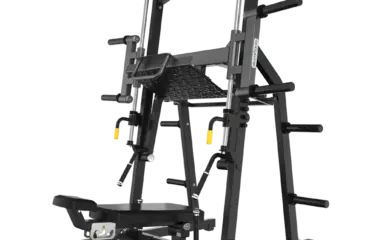
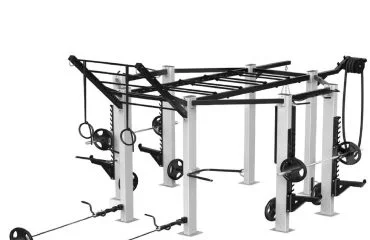
Mixing machine types achieves this more efficiently than buying more of the same: selectorised machines for guided, fast-turnover work, plate-loaded machines for heavier training, and cardio equipment sized to your peak hour rather than to your average one. The full professional strength range is built to be combined this way.
Frequently asked questions
How many machines does a gym floor need?
There is no universal ratio, because it depends on peak attendance rather than on total membership and on how long each station is occupied. Count the members present in your busiest hour, not on your list, and specify against that figure.
Is it better to buy one full range or mix suppliers?
A single range gives a consistent look, consistent adjustment logic for members and a single point of contact for parts and service. Mixing is defensible when a specific machine has no equivalent in your main range, but each additional supplier adds a separate warranty and spare-parts chain.
Should cardio and strength be bought at the same time?
Planning them together is what keeps the layout coherent: circulation, power supply positions and sightlines all depend on where each zone sits. The purchase can still be phased, but the layout should be designed once, for the finished floor.
Specifying your floor
Choosing gym machines well comes down to defining your members needs, insisting on build quality and ergonomics, and covering enough movement patterns and resistance ranges to serve beginners and experienced members from the same floor. Send us your floor plan and your attendance profile and our team will propose a machine mix and a layout costed for your project — request a quote.