Where to Buy an Outdoor Obstacle Course for Your Site
Outdoor obstacle courses have moved a long way from the improvised trail at the back of a field. Campsites, holiday villages, local authorities, schools, sports clubs, armed forces and adventure parks now buy them as permanent installations, with anchoring, impact attenuating surfacing and an inspection regime. The question is therefore less where to find one than which supply route gives you a structure that passes an acceptance inspection and still stands up after ten seasons of public use. There are three, and they do not serve the same projects.
Three routes to buying an outdoor obstacle course
The first route is the general leisure supplier. These catalogues cover a broad mix of outdoor play products and are useful when the requirement is small and the site is private. They rarely carry certified documentation for public installations, and the ranges are sized for light traffic rather than for a municipal park open all year.
The second route is online ordering, directly from a manufacturer or through a marketplace. It is fast and it makes comparison easy, but the specification has to be read carefully: delivery conditions, whether installation is included, anchoring method and the ground preparation expected on site. A structure delivered without an anchoring plan or without a surfacing specification is not ready to open to the public.
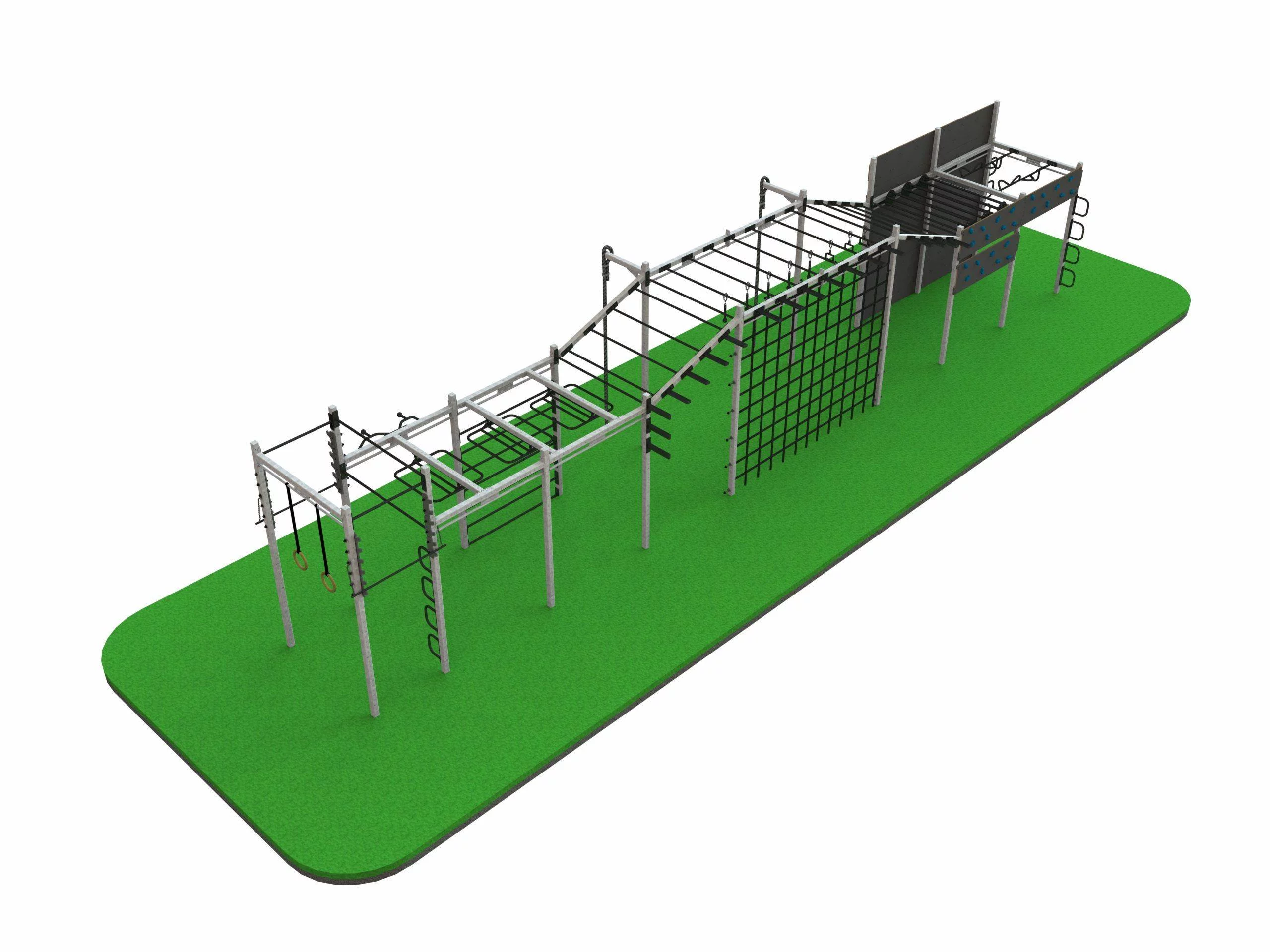
The third route is the specialist manufacturer that designs, supplies and installs the course. This is the route used for bespoke configurations that follow the shape of the site, combine modules such as warped walls, hanging grips, cargo nets, monkey bars and a sliding pole, and integrate with existing paths and planting. It is also the route that produces the technical file a public buyer needs.
Standards decide the specification, not the catalogue
This is the point that separates a compliant installation from a liability. Obstacle courses intended for children as play equipment fall under EN 1176-1, and the impact attenuating surfacing beneath them under EN 1177: the two are separate requirements and a course cannot be signed off with only one of them addressed. Adult outdoor training equipment, including OCR and ninja style rigs used by clubs, military units and fitness trails, falls under EN 16630. These frameworks are never interchangeable, and EN 16630 must never be applied to equipment intended for children.
The practical consequence is that the intended user group has to be fixed before the quotation, not after. It determines the module heights, the free space around each obstacle, the surfacing depth and the inspection schedule. Ask any supplier for the standard their structure is declared against, in writing.
Which configuration for which buyer
| Buyer | Typical configuration | Applicable framework |
|---|---|---|
| Campsite, holiday village | Compact modular course, mixed ages, high seasonal traffic | EN 1176-1 with EN 1177 surfacing for the children zone |
| Local authority, school | Play focused course integrated into an existing area | EN 1176-1 with EN 1177 surfacing |
| Sports club, cross training box | Ninja rig, OCR modules, timed lanes | EN 16630 |
| Armed forces, emergency services | Heavy duty course, high frequency training use | EN 16630 |
| Adventure park, event operator | Bespoke layout following the terrain | Depends on the declared user group |
What to check before you sign
Compare offers on the same basis, and read past the headline price. The points that matter are the declared standard and the certificate that goes with it, the material and its treatment, the anchoring system and the foundations required, whether the surfacing is quoted or left to the buyer, whether installation and commissioning are included, and what the warranty covers on structure and on moving parts. Ask for the maintenance and inspection instructions at quotation stage rather than on delivery: a public installation needs a documented inspection routine from the day it opens.
Reviews and references are useful, but on this kind of equipment a site visit to a comparable installation tells you more than any rating. Ask to see a course that has been open for several seasons.
Frequently asked questions
Can one course serve both children and adults?
Not as a single zone. Equipment for children and adult training equipment are covered by different standards with different geometry and different clearance requirements. Mixed sites are built as two adjacent zones with their own signage, surfacing and access.
Is surfacing always required?
Wherever there is a fall height to attenuate, yes. For children play equipment the surfacing is governed by EN 1177 and is part of the installation, not an optional extra. Grass alone is not a compliant surface under an elevated module.
Can a course be adapted to an irregular site?
Yes, and that is the main reason to go to a manufacturer rather than a catalogue. A bespoke layout follows slopes, mature trees and existing paths, which usually gives a better course than forcing a standard straight line onto the plot.
What maintenance does an outdoor course need?
Routine visual checks, periodic operational inspection of moving parts and fixings, and an annual main inspection. The supplier should provide the schedule and the spare parts list with the installation file.
Buying with the site in mind
The right supplier is the one that starts from your site, your user group and your inspection obligations, and only then proposes modules. Fix the user group, fix the standard, then compare structures on steel or timber section, anchoring and after sales support.
To explore the ranges: complete OCR obstacle courses, ninja warrior rigs and the Combattant Ninja OCR Pentathlon course. For a layout study and a costed proposal for your site, request a quote.
Réalisations documentées
- Parcours ninja sur mesure, Rennes – îlot des Hautes-Ourmes
- Double mur ninja extérieur, Sallanches – Haute-Savoie