Rubber Floor Tiles: Odour and VOC Emissions After Installation
Les odeurs perçues après la pose de dalles caoutchouc proviennent de composés organiques volatils émis pendant les premières semaines, dont l'intensité décroît avec la ventilation. Le niveau d'émission dépend du liant utilisé et de la certification du produit. Une ventilation soutenue pendant la période de mise en service reste la mesure la plus efficace.
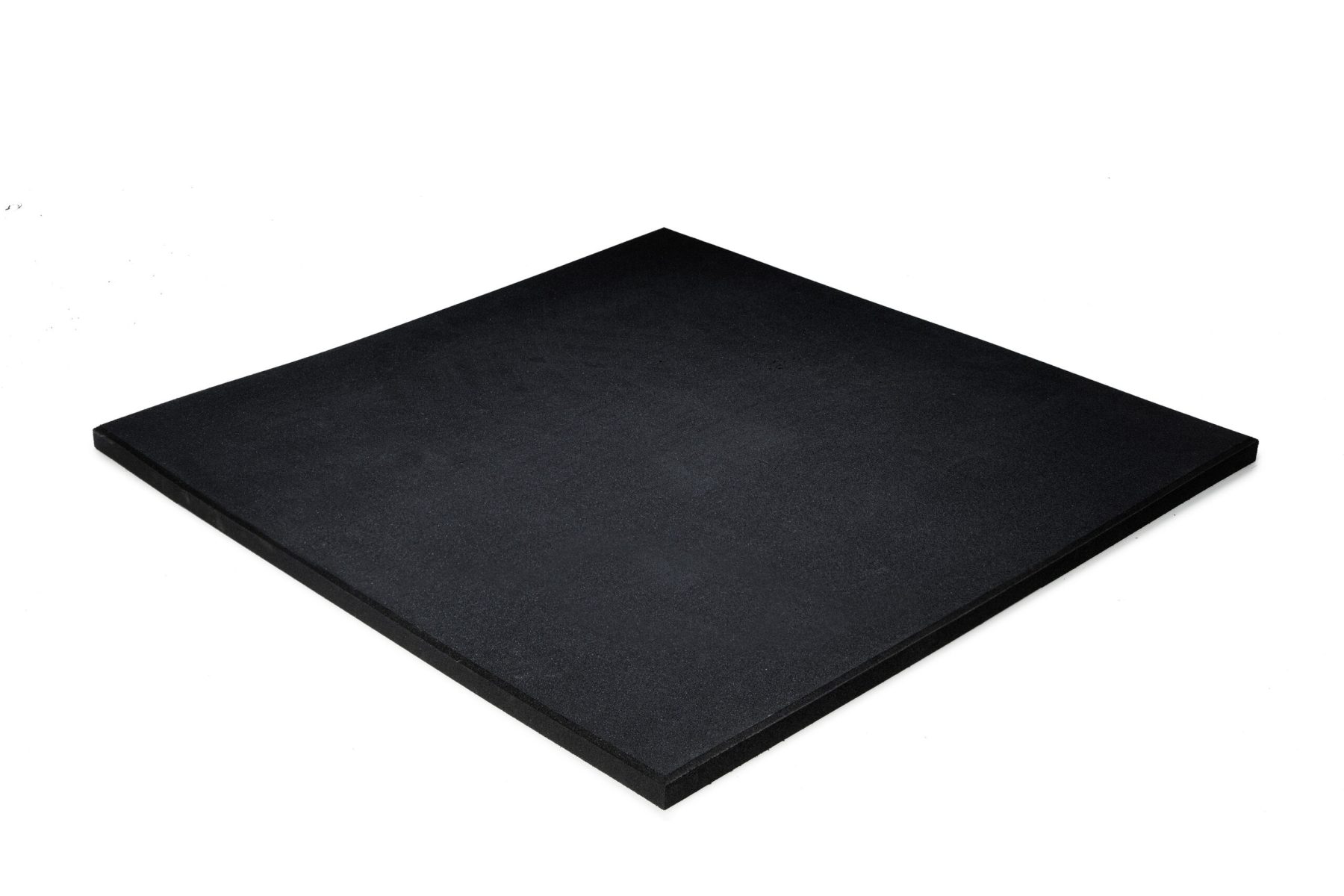
The smell noticed after rubber tiles are laid comes from volatile organic compounds released during the first weeks, and its intensity falls as the space is ventilated. The emission level depends on the binder used and on the product certification. Sustained ventilation during the commissioning period remains the single most effective measure.
Installing floor tiles, whether rubber, PVC, OSB or composite, raises questions that go well beyond wear resistance, and indoor air quality is at the top of the list. Two concerns come back constantly: a smell that will not go away, and the release of volatile organic compounds after laying. Both affect day-to-day comfort and, in enclosed or poorly ventilated spaces, they become a genuine operational problem. This guide explains where odours and VOCs come from, how long they persist, and what a specifier can do at each stage of a project.
Understanding odour and VOC emissions from floor tiles
What is a VOC?
Volatile organic compounds are chemical substances that evaporate readily at room temperature. They are present in a wide range of construction materials, adhesives, paints, varnishes and floor coverings. Some VOCs are harmless; others can affect health, from respiratory irritation through to carcinogenic risk, depending on the substance and the concentration.
Why do floor tiles smell?
- The nature of the material. Rubber, PVC, resins and certain timbers contain odorous molecules, either naturally or because of the additives used in manufacture.
- The manufacturing process. New tiles frequently give off a new-product smell as certain substances, particularly solvents and plasticisers, volatilise.
- Ventilation and environment. Indoors, poor air renewal amplifies the perception of odour, which can become very intrusive in the first weeks after laying.
Rubber tiles: specific odours and risks
Rubber smell is close to unavoidable
Rubber tiles, widely used in gyms, playgrounds and garages, naturally release a characteristic smell that is sometimes judged strong and persistent. Its intensity depends on several factors:
- Rubber quality. Higher-grade products, made from purer and better-processed raw materials, generally smell less and lose the smell more quickly.
- Origin of the material. Recycled rubber, particularly from end-of-life tyres, is often more odorous than virgin rubber, because of manufacturing residues and substances such as polycyclic aromatic hydrocarbons.
- Ambient temperature. The warmer it is, the stronger the smell, but also the faster it dissipates.
Odour perception is always individual. In some cases it will be judged genuinely disturbing, and that judgement is legitimate even where the product carries no associated health risk.
VOCs in rubber: what the risk actually is
- Initial emissions. Rubber tiles release VOCs mainly in the days and weeks after laying. Emissions normally decline over time, but in some cases they persist for several months.
- Substances of concern. Beyond ordinary VOCs, some recycled rubber granulates can contain substances classified as carcinogenic above certain concentrations. European regulation limits their content, but a strong smell can persist even where the regulatory thresholds are met, because odour thresholds and toxicological thresholds are not the same thing.
- Health and regulation. Products sold in Europe must meet the regulation in force, which sets a floor of safety. Olfactory discomfort nonetheless remains possible, particularly for sensitive users.
PVC, OSB, cork and other materials
PVC and vinyl: watch the adhesives
PVC and vinyl tiles also emit VOCs, mainly from plasticisers and from the adhesives used during laying. Emission performance is not visible on the product, so it has to be read from documentation: ask for the manufacturer’s emission test report, and where the market offers a recognised low-emission certification scheme, make it a requirement in the specification. Wherever the substrate allows it, loose-lay or interlocking systems that need no adhesive remove one entire emission source.
OSB and wood panels: a question of composition
OSB, widely used for decks and sub-floors, naturally contains VOCs from softwood, and also carries the resins and glues added in manufacture. Hardwoods emit considerably less. Precise emission data is not always published, so request the product data sheet, and prefer OSB/2 or OSB/3 boards, which are the grades intended for structural interior use.
Cork: a low-emission alternative, if the adhesive follows
Natural cork emits very little in the way of VOCs. The adhesives used to lay it, however, can emit a great deal. Choose low-emission adhesives, or specify a floating installation.
How long odours persist, and what to do
The timeline after installation
- Acute phase. Odour and VOC emissions are at their most intense in the first days to weeks after laying, especially where adhesives or synthetic materials have been used.
- Progressive decline. Most volatile substances evaporate over time. Dissipation is faster in premises that are well ventilated and heated.
- Difficult cases. Some odours persist for several months or longer, depending on the material, the indoor air quality and the sensitivity of the occupants.
What makes it worse
- Lack of ventilation. Stagnant air holds odours and VOCs. Closed or barely aired rooms are the most exposed.
- High temperatures. Heat increases volatilisation, so the smell is more noticeable, but it also speeds up long-term dissipation.
- Humidity. Some odours are amplified by damp, particularly where mould or material degradation is present.
Impact on indoor air quality and health
- Olfactory discomfort. A rubber or solvent smell can be genuinely unpleasant and can trigger headaches, irritation or nausea in sensitive people, without in most cases representing an objective danger to health.
- VOCs and health. Certain VOCs, among them formaldehyde, benzene and toluene, are classified as irritants or carcinogens at high concentrations or under prolonged exposure. Current regulation aims to limit that risk, but vigilance remains appropriate, particularly for young children, older people and sensitive users.
- Specific cases. Mould or material degradation, typically after water ingress, can generate persistent odours and harmful emissions and calls for a specific intervention rather than more ventilation.
How to limit odours and emissions
Before laying
- Specify certified low-emission products. Ask for the emission classification and the test report, and give preference to manufacturers with a documented environmental commitment rather than a marketing claim.
- Consider naturally low-emission materials. Linoleum, natural cork and hardwood are less emissive than PVC or recycled rubber, though each has its own performance trade-offs on a sports floor.
- Avoid adhesives, or choose solvent-free ones. Floating and interlocking systems reduce emissions considerably, and they also make future replacement far simpler.
During laying
- Ventilate heavily. Open the openings and use fans where possible to accelerate dissipation.
- Follow the manufacturer’s instructions. Some coverings require a drying or off-gassing period before they can be used normally, and that period belongs in the works programme, not in the handover week.
After laying
- Keep ventilating. Maintain good air circulation for several days to weeks. A dehumidifier or an activated carbon air purifier can accelerate the process.
- Clean the surfaces. A gentle clean with bicarbonate of soda or household vinegar can help attenuate residual surface odours on rubber tiles. It does not reduce off-gassing from within the material.
- Monitor. If odours persist well beyond a few weeks, or unusual symptoms appear, an indoor air quality analysis is the sensible next step.
What operators actually report
Recycled rubber tiles in a gym
Operators regularly report a strong smell that is still present several weeks after laying, above all in poorly ventilated rooms, and it is more noticeable during hot spells. In most cases the smell eventually fades, but it can remain perceptible to sensitive users. Our rubber gym flooring tiles and rubber flooring rolls are supplied with the technical documentation needed to answer this question before the order is placed.
Playground surfacing
Reports of aggressive odours and headaches have been recorded after rubber impact-absorbing surfacing was laid, above all outdoors during heat. Analyses show the presence of regulated substances, but the products are generally compliant with European standards. In a playground, that surfacing also has to meet EN 1177 for impact attenuation, while the play equipment itself falls under EN 1176-1: the two are separate requirements and both belong in the specification. See our range of playground surfacing.
OSB and alternative materials
OSB panels emit little odour but can release VOCs, particularly where they are bonded with synthetic resins. Cork and hardwood are valued for their low olfactory and health impact, provided solvent-rich adhesives are avoided.
Frequently asked questions
How long does rubber smell last after laying?
The smell is strongest in the first days and weeks and then declines progressively. In extreme cases it can persist for several months, particularly in a poorly ventilated interior.
Are the VOCs from floor tiles dangerous?
Most products sold in Europe comply with strict regulatory thresholds. Prolonged exposure to VOCs even at low doses is nonetheless undesirable, particularly for sensitive users, which is why ventilation during commissioning matters.
How can the odour be cleared faster?
Ventilate heavily, clean the surfaces, and keep a moderate ambient temperature to encourage the odorous substances to volatilise and be carried away by the air flow.
Should recycled rubber tiles be avoided indoors?
As a precaution it is sensible to limit their use in enclosed, poorly ventilated interiors. Where the room cannot be ventilated properly, natural alternatives or certified low-emission products are the better specification.
Summary and recommendations
- Floor tiles, rubber and PVC in particular, naturally emit odours and VOCs after installation, most strongly in the first days to weeks.
- Olfactory discomfort is subjective but can be pronounced; it generally declines with time and good ventilation.
- Health risk is limited where products meet European standards, but vigilance is warranted for sensitive users and where symptoms persist.
- To limit the problem: specify certified low-emission products, prefer adhesive-free systems, and ventilate heavily after laying.
- Where doubt remains, consult the product data sheet or bring in an indoor air quality specialist.
Specifying a floor you can hand over on time
Odours and VOC emissions after laying are common, and they are manageable. Informed material selection, careful installation and proper ventilation are what separate a handover that goes smoothly from one that does not. Tell us the room, its ventilation and the intended use, and our team will propose a floor build-up and a costed quotation: request a quote.
Réalisations documentées
- Dalles et sols sportifs : livraisons documentées – plusieurs chantiers
- Sol sportif extérieur, square Georges-Vallerey – Taverny (95)
Sources et références
- Arrêté du 19 avril 2011 – étiquetage des produits de construction ou de revêtement de mur ou de sol sur leurs émissions de polluants volatils (Légifrance)
- Ministère de la Transition écologique – étiquetage des produits de construction : classes d’émission A+ à C
À lire aussi sur le même thème
- Coastal outdoor gym equipment: specifying for marine and corrosive environments
- Quelles sont les caractéristiques essentielles à vérifier avant d acheter une plaque anti-vibration en caoutchouc ?
- Rubber flooring for shops, hotels and restaurants: comfort, safety, design and compliance
- Padel Court for a Club or a Council: What to Buy