Gym Equipment A to Z: Types, Functions and Innovations
L'équipement d'une salle se répartit en quatre familles : cardio, charges guidées, charges libres et petit matériel fonctionnel. Chacune répond à un besoin distinct et ne remplace pas les autres. Les innovations récentes portent surtout sur la connectivité et sur les matériaux, pas sur la biomécanique des mouvements.
Fitness clubs, hotel gyms, corporate wellness rooms, municipal sports halls and rehabilitation centres all start from the same question: which machines actually belong on the floor? Professional gym equipment divides into four families – cardio, selectorised (guided-load) strength machines, free weights and functional accessories. Each answers a different training need, and none of them replaces the others. This guide runs through the categories, what each one does, and where genuine innovation is happening.
What are the main types of gym equipment, and what do they do?
Gym equipment is deliberately varied, because the same muscle group can be trained in several ways and because members arrive with different goals. General conditioning and fat loss are served best by cardio work; shaping and building a specific muscle group calls for resistance machines. In practice most members combine the two, which is why a balanced floor plan matters more than any single machine.
For a commercial installation one filter comes before all the others: the equipment has to survive continuous use by people who have never been shown how to use it. Indoor machines specified for clubs, hotels and public facilities are built and tested to EN ISO 20957-1 class S. Anything below that standard belongs in a private living room, not on a paying gym floor.
The most common cardio equipment
Cardio machines drive whole-body work at moderate to high intensity. They serve as a warm-up before resistance training or as a session in their own right: they build general condition, support fat loss and, on the low-impact models, spare the joints.
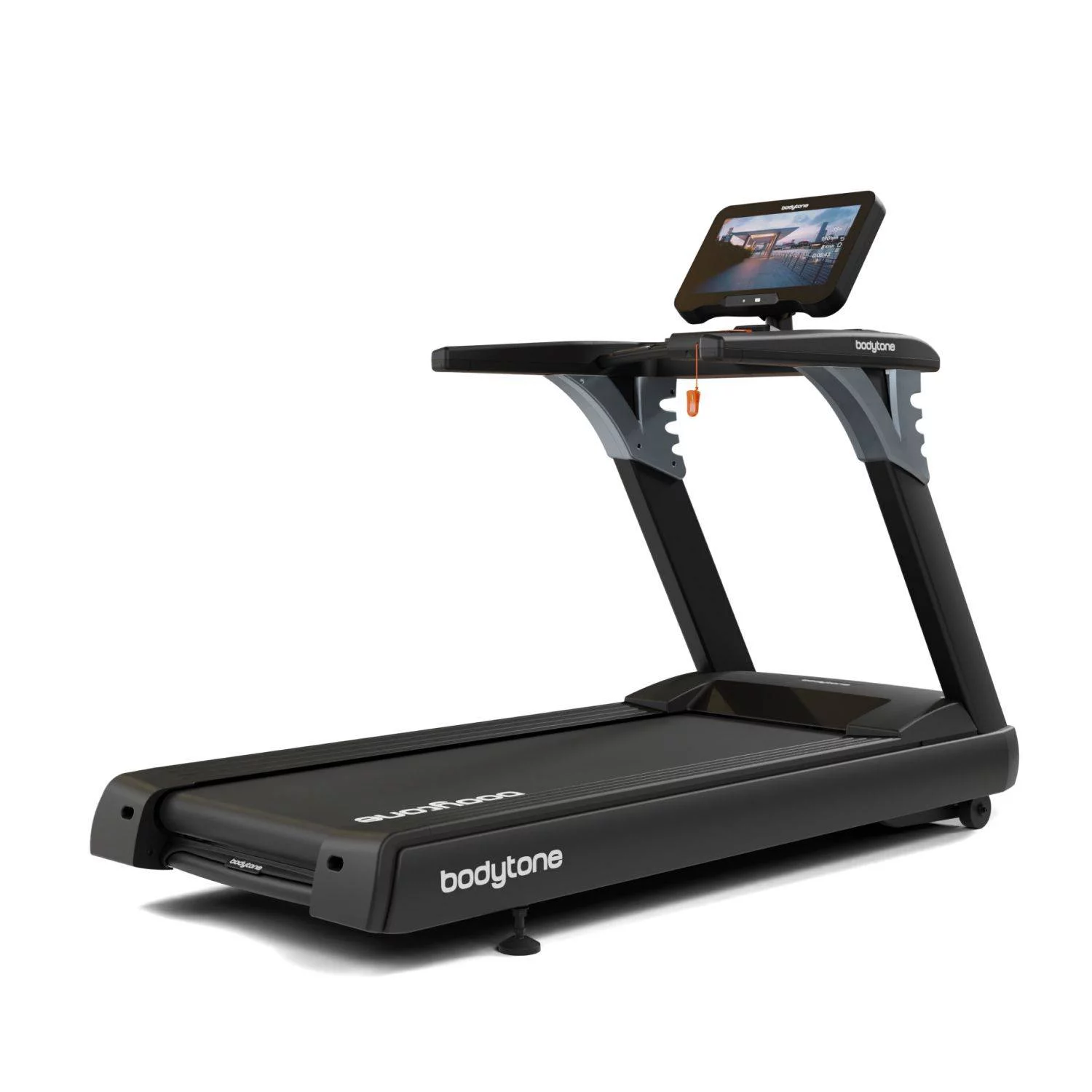
- Treadmills – the classic first purchase; no professional floor is complete without them, and they carry the highest usage hours of any machine in the room.
- Exercise bikes – upright and recumbent models keep members training when the weather outside rules out cycling, and they are the easiest entry point for deconditioned or older users.
- Cross trainers – a full-body movement that keeps the arms working instead of letting them idle, with no impact through the ankles and knees. See our range of professional cross trainers.
- Rowing machines – the rowing stroke recruits legs, trunk and back in one movement without loading the joints.
The full picture of what a cardio zone needs is easiest to grasp by browsing a manufacturer’s own catalogue of professional cardio equipment rather than a generic list.
Types of strength training equipment
Strength equipment is used to develop a selected muscle group. The work is done against a load and the exercise itself is built on repetitions of one controlled movement. On a commercial floor, guided-load machines take the beginners and the busy hours; free weights take the experienced members.
- Multi-station gyms – complete units that let one member run a demanding full-body session across arms, legs, back and chest without moving around the room.
- Smith machines – the classic guided barbell, allowing squats and presses under load with the bar held on a fixed path.
- Weight benches – flat, incline and decline, with leg supports, they give the body a safe position under load and underpin most free-weight work.
- Barbells and dumbbells – the loading itself, used across a very wide range of exercises and the most space-efficient investment per member.
Clubs that want progression to be readable for every member usually build the core of the strength zone around selectorised strength machines, then add free weights around them.
Innovative sports equipment
The market carries a large number of equipment manufacturers, differing in specialisation, breadth of range and build quality. Innovation, however, is concentrated in fewer places than the marketing suggests – and it is worth saying plainly that recent progress has been about connectivity and materials, not about the biomechanics of the movements themselves. A squat is still a squat.
One line worth singling out is the Light In Fitness eco range, built to capture the energy generated by the user and feed it back into the machine’s own power supply. Surplus energy can be routed to other appliances in the club – refrigerators, screens or the sound system – which lowers the energy bill and makes part of the floor self-sufficient.
The range covers electric treadmills, exercise bikes, cross trainers and multi-function trainers that combine cross trainer, bike and stepper in a single frame. This type of equipment is currently found mainly in premium clubs, but the direction of travel for the industry as a whole is clear enough.
Frequently asked questions
What is the difference between class S and class H equipment?
EN ISO 20957-1 class S covers equipment designed for studio and commercial use – unsupervised users, long daily running hours, higher structural requirements. Class H covers home use. Everything supplied for a club, hotel, gym or public facility should be class S; class H equipment placed on a commercial floor is a liability question, not a saving.
Which machines should a small club buy first?
The usual sequence is a small cardio bank, one multi-station or a compact set of selectorised machines, a pair of benches and a dumbbell rack. That covers every member profile in the least floor area. The exact mix depends on your surface, your ceiling height and your membership, which is what a layout study is for.
Do cross trainers replace treadmills?
No. They cover overlapping goals but not the same population. Treadmills remain the highest-demand machine in most clubs; cross trainers absorb the members who cannot or should not take repeated impact. A floor that offers only one of the two loses part of its membership.
Is energy-generating cardio equipment worth it?
It depends on your usage hours. The energy recovered is proportional to the time the machines actually run, so the case is strongest in clubs with dense, long opening hours and weakest in a hotel gym used a few hours a day.
Planning your equipment list
Choosing gym equipment is less about picking favourite machines than about matching four families to the members you actually have, in the floor area you actually have. Send us your surface, your ceiling height and your membership profile and we will come back with a layout and an itemised quote for class S equipment.
Request a free quote and our team will build the equipment list with you.