Best Brands for Equipping a Professional Gym for Heavy Use
For a commercial gym, the best brand is not a name but a set of provable properties: conformity with EN ISO 20957-1 class S, a frame engineered for continuous multi-user duty, mechanical components that survive high cycle counts, written warranties matched to that intensity, and an after-sales organisation that can put a machine back in service quickly. Every one of those can be verified before you sign. This guide sets out what to check, and in what order.
Brand rankings age badly. Manufacturers change suppliers, ranges get repositioned, and a model that was excellent five years ago may now sit on a different frame. What does not age is the method: judge the equipment against criteria that apply whatever the badge on the upright says. A buyer who works through the five criteria below will end up with a durable fleet regardless of which manufacturers the shortlist contains.
Criterion 1: conformity with the standard
For a commercial facility, the EN ISO 20957 series is the reference framework. It sets out safety requirements and test methods for stationary training equipment. The part that matters at purchase is the class: class S designates equipment intended for use in supervised commercial environments, which is exactly what a gym, a club, a hotel or a corporate facility operates.
Class S is the filter that separates equipment engineered for continuous multi-user duty from equipment designed for light, unsupervised, low-frequency use. Ask for the conformity documentation rather than accepting a marketing description, and write the class into your specification so that comparison between offers is meaningful. Be careful not to confuse class S with class I: class I is a professional class covering inclusive access, not a step above class S in intensity, and specifications that mix the two produce offers that cannot be compared.
Criterion 2: frame, stability, steel
Under heavy use, durability is decided first by the structure. Three things determine whether a frame is still rigid after five years of continuous service:
- Stability and rigidity: frame geometry, the position of the bearing points, and the anchoring arrangement where the machine is fixed down
- Quality of the assemblies: weld quality and continuity, the thickness of the base plates, and the grade of the bolting
- Durability of the finishes: resistance to impact, to sweat and to corrosion, particularly at contact points and cut edges
Steel section and wall thickness are worth asking about explicitly, because two machines with an identical silhouette can be built from very different tube. A frame that flexes visibly under load will keep flexing, and no maintenance contract fixes that.
Criterion 3: cables, pulleys and guide systems
A machine can look professional and still age badly if the mechanical components do not keep up. On the floor, the member experience depends on smoothness, noise, precision and consistency over time, and all four come from the parts nobody photographs.
- Cable construction and expected replacement interval
- Pulley and bearing quality, which governs both smoothness and endurance
- Guide systems: how much play develops, how easily they are serviced, and how consistent the movement path stays
These are also the components that fail first, which makes their availability as spare parts a purchasing criterion in its own right rather than an afterthought.
Criterion 4: warranties that are written and appropriate
A manufacturer aimed at the professional market offers warranties that are clear, written, and consistent with the intensity of use they are sold for. Read what is actually covered: frames, moving parts, upholstery and electronics are almost always covered for different periods, and the difference between those periods tells you where the manufacturer expects wear.
Equally important are the conditions attached. A warranty conditional on servicing intervals is entirely reasonable, but you need to know about it before you build the maintenance budget, not when you make the first claim.
Criterion 5: after-sales, maintenance and spare parts
The number one operational criterion for a commercial gym is fleet availability. A machine out of service is a machine your members notice every day. What to verify before ordering: the fault diagnosis procedure, the availability of wear parts, the stated response and repair times, and whether maintenance support is offered as a structured service or improvised call by call.
Ask how long parts remain available for a given model. A gym fleet is a ten-year asset at minimum, and the question that matters is not whether a part exists today but whether it will exist in year eight.
Building a coherent facility
Once the criteria are set, the specification is built zone by zone. The objective is coverage without duplication: a fleet that is robust, legible to members, and simple to maintain.
| Zone | Objective | What to specify |
|---|---|---|
| Strength | Cover the essentials without duplicating stations | Selectorised machines, plate-loaded machines, benches, cable stations |
| Racks and cages | Structure a free-weight area that absorbs peak-hour intensity | Power racks, squat racks, functional rigs |
| Accessories | Training density and high rotation, simple to replace | Dumbbells, bumper plates, kettlebells, functional accessories |
| Flooring | Safety, noise reduction, protection of equipment and building | Rubber tiles, weightlifting tiles, acoustic underlay |
| Cardio | Consistency of use, maintenance and long-term availability | Treadmills, bikes, cross trainers, rowers |
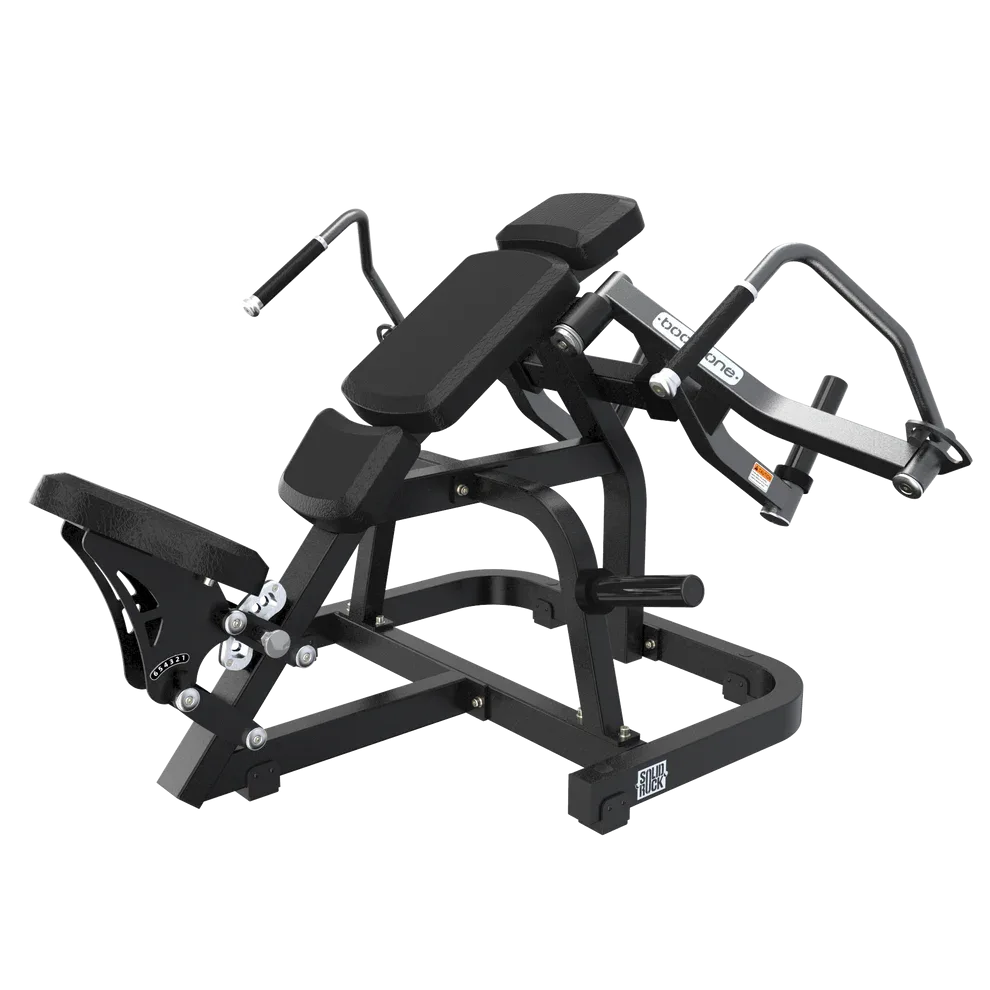
Start with the strength zone, since it defines the circulation of the whole floor: our professional strength training machines cover the guided and cable side, and our racks and power cages structure the free-weight area. Do not leave the floor to the end of the budget: rubber gym flooring protects both the equipment and the building, and retrofitting it around installed machines costs considerably more than laying it first.
Quick checklist for heavy commercial use
- Documented conformity with EN ISO 20957-1, class S
- Stable frame: rigidity, weld and assembly quality, finish durability
- Mechanical components: cable specification, pulleys, bearings, guide systems
- Written warranties appropriate to a commercial fleet, with conditions read in advance
- After-sales: diagnosis, parts availability, response times, return to service
Frequently asked questions
Which standard should I check for professional fitness equipment?
The EN ISO 20957 series covers safety requirements and test methods for stationary training equipment. For a commercial facility, specify class S, the class for equipment used in supervised commercial environments, and ask for the conformity documentation. Writing the class into the specification is what makes competing offers genuinely comparable.
Is durability only a question of the frame?
No. The frame is essential, but the mechanical components — cables, pulleys, bearings, guide systems — together with the quality of maintenance and the availability of parts usually determine real service life under heavy use. A rigid frame with unobtainable cables is still an unavailable machine.
Why do after-sales and spare parts matter so much?
Because the operational issue in a commercial gym is availability. A long immobilisation degrades the member experience and raises total cost of ownership far beyond the price of the part. Response time and parts availability deserve as much weight in the decision as the purchase price.
Does the best brand exist?
Not as a single answer. Different manufacturers are strong in different zones, and a well-specified facility often combines ranges rather than buying one badge throughout. What matters is that every machine on the floor meets the same five criteria.
How do I request a configuration for my space and budget?
Prepare the floor area, the expected membership and peak-hour attendance, the type of offer (premium club, cross-training box, personal training studio, hotel, public facility), any constraints of the building such as ceiling height and floor loading, and your budget envelope. With those five inputs a supplier can propose a genuine layout rather than a catalogue extract.
Specifying your fleet
The facilities that stay reliable are the ones where the specification was written around class S conformity, frame quality, mechanical components, warranties and parts availability — before any brand was shortlisted. Send us your floor area, your target attendance and the type of offer you run, and we will come back with a layout and an equipment specification you can compare like for like. Request a quote and our team will build the configuration with you.
Sources et références
- NF EN ISO 20957-1 – équipement d’entraînement fixe, partie 1 : exigences générales de sécurité et méthodes d’essai (AFNOR)
- AFNOR Normalisation – dossier thématique sur les appareils d’entraînement fixes et leurs classes d’usage