Rubber Gym Tiles 100x100: How to Choose and Buy
La dalle caoutchouc 100 x 100 cm est le format standard des salles de sport : pose rapide, sol stable sous machines, protection du béton et réduction du bruit. Le rapport qualité-prix se juge sur la densité et la tolérance dimensionnelle, pas sur le prix au m² seul. Une dalle mal calibrée ouvre ses joints en quelques mois.
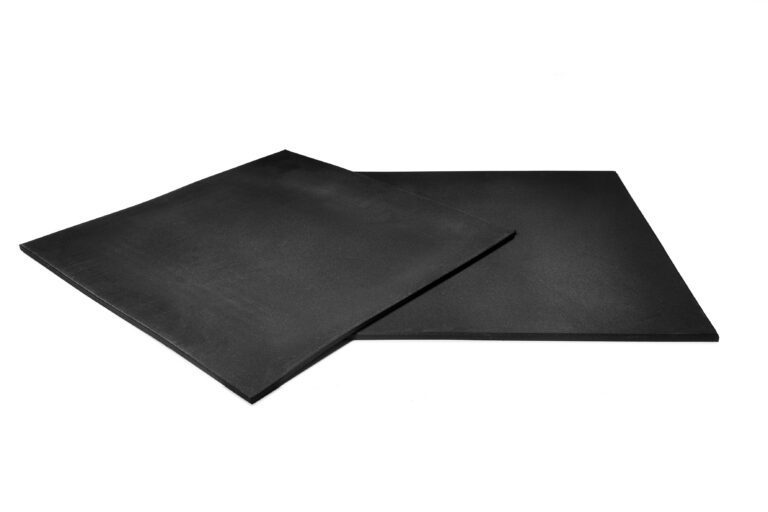
Rubber tiles measuring 100×100 cm, one square metre each, are the default sports flooring for gyms and training facilities: fast to lay, stable under machines, protective for the concrete slab underneath, and effective against noise and vibration. Buying well is not a matter of finding the lowest price per square metre. It means comparing thickness, density, finish, fire classification where the building requires one, and impact absorption against the way the floor will actually be used, from selectorised machines to dropped barbells.
1. Where to buy 100×100 rubber tiles
Tiles of this format are sold through several channels. For intensive use, the aim is to buy from a supplier who publishes comparable technical data and who can handle the logistics, because weight, pallet count and lead time drive the real cost of a flooring order.
Sports flooring specialists, recommended for intensive use
- Technical data available on request: density, weight per tile, finish, composition
- Thickness advice by zone: machines, free weights, drop areas
- Freight quoted as part of the order rather than added at checkout
Our rubber gym flooring tiles are listed by thickness and finish so two references can be compared line by line.
Builders merchants and general e-commerce
- Wide choice, but product sheets are often inconsistent between sellers
- Compare density, weight and supporting documents carefully
- Check freight terms: pallet handling, tail lift, delivery appointment
The rule that saves the most money is simple: always compare the delivered price per square metre, never the headline price alone.
2. Define the requirement before comparing prices
The best value depends entirely on how the floor is used. A tile that is too thin becomes expensive when it compresses, shifts or fails to protect the slab. A tile that is too thick is over-specified for a machine area and costs more to buy and to freight.
Your brief in 60 seconds:
- Zones: selectorised machines, cardio, free weights, drop areas for weightlifting and cross-training
- Constraints: noise and vibration transmission to neighbouring units, comfort, cleaning
- Requirements: fire classification if the building is open to the public, accessibility, indoor or outdoor use
- Budget target: delivered price per square metre set against expected service life
3. The criteria that decide real value for money
Density and weight, which govern stability
A dense, heavy tile generally stays where it is put and protects better. On a 20 mm 100×100 tile, a stated density of around 900 kg/m3 and a weight of about 17 kg per tile is a useful reference point when comparing two offers.
Composition and finish, which govern durability
The most common construction is recycled SBR granulate bound with polyurethane, in a fine-grain finish. Where UV stability, colour retention or a more premium appearance matter, look at references that add EPDM to the surface layer.
The checklist to send to any supplier:
- Exact dimensions, tolerances and flatness
- Actual thickness in millimetres and weight per tile
- Density in kg/m3
- Composition: SBR, EPDM, polyurethane binder
- Fire classification, where the building requires one
- Test reports and certificates relevant to the intended use
- Lead time, preparation and delivery terms: pallets, appointment, vehicle type
Dimensional tolerance deserves particular attention. A poorly calibrated tile opens at the joints within months, and no price advantage survives that.
4. Which thickness: 15, 20, 25, 30 or 40 mm
There is no single best thickness, only the thickness that suits a given zone and a given building.
15 to 20 mm
- Machine areas, moderate loads, circulation routes
- The best compromise between price and protection
- Suitable where no heavy drops take place
25 mm
- More comfort and more protection underfoot
- A sound choice where noise and vibration have to be managed
- Stable under racks and machines, subject to density and weight
30 to 40 mm and above
- High-intensity zones, frequent drops, weightlifting platforms
- Stronger reduction of impact and noise
- Higher budget, and more weight to move and handle
The most cost-effective specification is usually a mix: a standard thickness across most of the surface, and extra thickness only where impact is real, around barbells, kettlebells and dumbbells. Our weightlifting rubber tiles are designed for exactly those zones.
5. Buildings open to the public: fire classification and documents
If your facility is a building open to the public, the fire performance of the floor covering is part of the specification, and the requirement is set by the national building regulations that apply where you are installing. Check the classification stated on the product sheet before ordering: some tiles are declared Efl, and others meet stricter requirements depending on the configuration.
Ask for the classification in writing, in full, including the smoke index where one is declared, and keep it with the handover file. Our fire-rated rubber tiles carry their declared classification on the product sheet.
6. Installation and the mistakes to avoid
100×100 tiles are usually loose-laid, held in place by their own weight. To get the most out of that:
- Prepare a clean, dry, flat substrate with no high spots, otherwise the tile pumps and wears prematurely
- Let the tiles acclimatise to the room temperature where needed, and lay them with tight joints
- Cut cleanly at the perimeter and keep a margin, so edges do not lift
- Add storage and protection in impact zones, which extends the life of the whole floor
7. Quick calculation: quantity, budget, waste allowance
A 100×100 cm tile covers exactly 1 m2, so the tile count equals the area in square metres.
- Usable area = length x width, minus any area not being covered
- Quantity = usable area x (1 + waste allowance)
- Recommended allowance: 3 to 7 per cent for a simple room, 7 to 10 per cent where there are many cuts around columns and corners
- Compare budgets on the total: price per square metre, freight, and any accessories
Frequently asked questions
Where should I buy 100×100 rubber tiles?
From a sports flooring specialist for intensive use, or from general distributors and e-commerce for lighter requirements. Whichever channel you use, compare the technical data and, above all, the delivered price.
Which thickness gives the best value for money?
15 to 20 mm for machine and cardio zones with moderate loads, 25 mm where more comfort and protection are wanted, 30 to 40 mm and above for impact zones and frequent drops. Mixing thicknesses by zone is usually the most economical answer.
What evidence should I ask for to compare quality?
Density in kg/m3, weight per tile, composition (SBR or EPDM with a polyurethane binder), the declared fire classification where the building requires one, and any impact attenuation data relevant to the intended use.
How many tiles should I order?
One tile covers 1 m2. Take the area and add a waste allowance of 3 to 7 per cent, or 7 to 10 per cent where there are many cuts.
Get a delivered price for your floor
On a volume order, freight is the variable that most often changes the ranking of two quotes. Send us the area, the zoning and the building constraints and we will price the tiles, the pallets and the delivery together. Request a quote for your sports flooring.
Réalisations documentées
- Dalles et sols sportifs : livraisons documentées – plusieurs chantiers
- Sol sportif extérieur, square Georges-Vallerey – Taverny (95)
Sources et références
- Arrêté du 19 avril 2011 – étiquetage des produits de construction ou de revêtement de mur ou de sol sur leurs émissions de polluants volatils (Légifrance)
- Ministère de la Transition écologique – étiquetage des produits de construction : classes d’émission A+ à C