Rubber Gym Flooring Tiles: The Complete Guide to Choosing Well
Pour choisir une dalle caoutchouc de salle de sport, partez de l’usage de chaque zone, des charges et du support existant. Comparez ensuite l’épaisseur, la densité, les dimensions et les justificatifs de performance de la référence, en distinguant intérieur et extérieur. Light In Fitness propose des dalles pour les salles professionnelles et accompagne le choix du revêtement et de sa pose. Pour préparer le devis, précisez la surface, les usages, les contraintes acoustiques et l’accès au chantier.
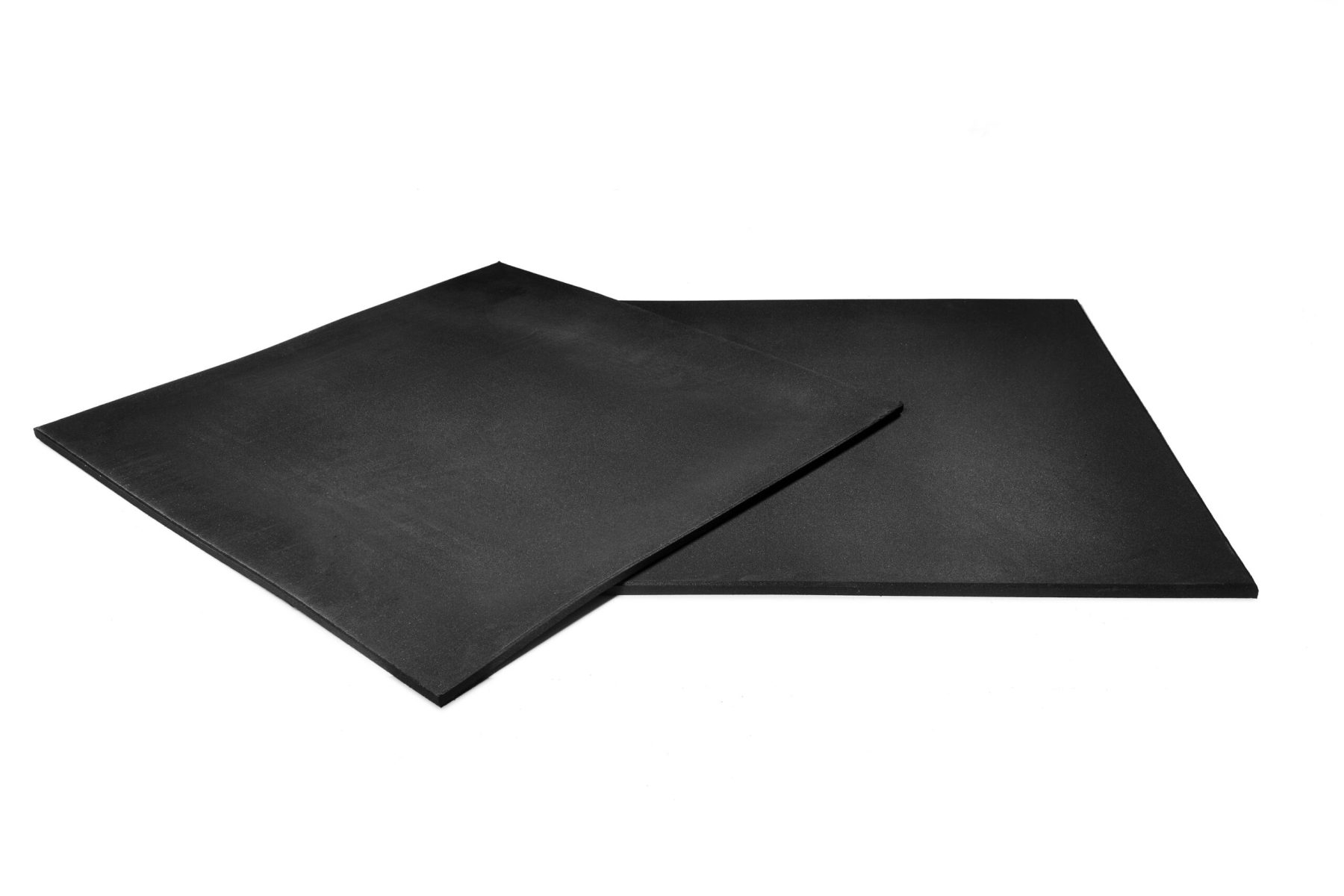
The floor of a gym is not a finish, it is the foundation of the safety, the comfort and the working life of everything placed on top of it. This guide covers the six decisions that shape a flooring project: the type of tile, the thickness zone by zone, the fire reaction classification where the public has access, the trade-off between tiles, rolls and tatami, the installation method, and the real budget at catalogue prices.
Short answer. For a multi-purpose gym, a 100 x 100 cm tile in 20 mm covers most of the floor, with 40 mm minimum in the drop zone and 15 mm in cardio. Where the public has access, the fire reaction classification drives the choice and moves the price from 26.00 EUR excluding VAT to 45.00 EUR excluding VAT per square metre at the same thickness. Bond the tiles under load, leave them loose everywhere else. Expect around a decade of service with pH-neutral detergent maintenance.
1. Why rubber tiles became the standard
Rubber tiling is the default professional sports floor for five reasons that compound:
- Impact absorption – it protects the concrete slab when loads are set down or dropped, and reduces vibration transmitted into the structure.
- Noise reduction – decisive in a shared building, a hotel, or any time there is an occupied space below.
- Grip – a textured surface that limits slipping, including when damp.
- Equipment stability – machines do not migrate and their feet wear more slowly.
- Working comfort – less fatigue during prolonged standing exercises and floor work.
It suits strength and fitness rooms, cross-training boxes, weightlifting areas, cardio floors, hotels and residences, corporate gyms and rehabilitation centres. The full range is here: rubber gym flooring tiles.
2. The types of tile
SBR tiles – recycled rubber
Granules from recycled tyres, bound with polyurethane. This is the best absorption-to-price ratio on the market and the basis of most professional projects.
Strengths: controlled price, very good mechanical resistance, a circular-economy material. Plan for: a characteristic odour for a few weeks after installation, and black or speckled finishes as standard.
EPDM tiles – rubber coloured throughout
The premium option for visible areas and outdoor use.
Strengths: odourless, wide colour choice, excellent UV resistance, longer service life. Plan for: a markedly higher price at equal thickness.
Interlocking and clip-together tiles
An interlocking system for fast installation without adhesive.
Strengths: very quick to install, removable, transportable. Plan for: visible joints and limited performance under heavy concentrated loads.
Wood-effect tiles
The same absorbing behaviour with a warmer appearance. This is the option that lets you install a yoga studio, a physiotherapy space or a coaching room in a building open to the public without the industrial look of black rubber.
Strengths: considered design, studded structure, a fire classification compatible with public-access premises, clip-together installation. Plan for: premium positioning.
Tiles with a studded underside
An often overlooked variant: studs on the underside create an air layer that amplifies absorption and mechanically decouples the tile from the substrate. At equal acoustic performance they often allow you to step down one thickness.
3. Choosing the thickness
This is the structuring criterion. A zone is sized on the most severe impact that occurs in it, never on the average use of the room.
| Zone | Thickness | Why |
|---|---|---|
| Cardio (treadmills, bikes, cross trainers) | 15 mm | Almost no impact noise: over-specifying brings no technical benefit |
| Selectorised machines and circulation | 20 mm | Static loads, weight stack return, foot traffic |
| Free weights, dumbbells, rowing | 25 to 30 mm | Repeated load setting-down, protecting the plates as much as the floor |
| Cross-training and weightlifting | 40 mm minimum | Olympic bar released from the overhead position |
| Weightlifting platforms | 50 to 60 mm | Snatches and clean and jerks, heavy and repeated loads |
| Outdoor with a height of fall | Per the critical fall height | Comfort no longer governs, EN 1177 does: 60 mm covers 2.00 m, 80 mm covers 2.50 m, 100 mm covers 3.00 m |
Check the weight before ordering. Published weights vary widely with density and underside structure: 19 kg for the 20 mm wood-effect tile, 27.5 kg for the 42 mm Premium with a studded underside, 32 kg for a solid 40 mm Training tile. On a timber floor or above ground level, add the weight of the floor to the weight of the heaviest equipment before confirming the order.
Our recommendation: for a multi-purpose gym, 20 mm covers the majority of the floor. Reserve 40 mm and above for the drop zone only. That is where the concrete is protected, and nowhere else.
4. Fire classification where the public has access
In premises open to the public, the floor covering has to justify a reaction-to-fire classification established to EN 13501-1. The classification reads in two parts: a letter followed by fl for behaviour in the presence of flame, and an s index for smoke production.
| Class | What it means | Reference and price per square metre |
|---|---|---|
| Bfl-s1 | The highest level in the catalogue for a resilient floor, with minimal smoke production | 20 mm Bfl-s1 tile – 45.00 EUR excluding VAT |
| Cfl-s1 | The class most commonly specified for gym floors in public-access premises | 20 mm Cfl-s1 tile – 42.00 EUR excluding VAT |
| Dfl-s1 | An intermediate level, accepted in some cases depending on the room concerned | 40 mm Dfl-s1 tile – 58.00 EUR excluding VAT |
| Efl | The base classification, with no smoke requirement | 40 mm Training tile Efl – 38.50 EUR excluding VAT |
A clarification that prevents a common misreading: there is no single class that is universally mandatory. The requirement depends on the type of building, its category and the specific room. Circulation routes and stairways are treated differently from activity rooms, and the exact requirement comes from the building regulations applying in your country. Validate it with your inspection body before ordering, never after installation. In every case, ask for the classification test report: a supplier who cannot produce one is exposing you.
Our fire-rated rubber tiles are supplied with a classification report issued by a notified testing body, a document you can put straight into a compliance file or a tender submission.
Other useful reference standards
- EN ISO 5470-1 – abrasion resistance, a good indicator of durability in high-traffic zones.
- ISO 16000 series – measurement of volatile organic compound emissions, relevant to indoor air quality in enclosed rooms.
- EN 1177 – impact attenuation under equipment presenting a height of fall, required as soon as outdoor equipment is involved.
5. Tiles, rolls or tatami
| Criterion | 100 x 100 tiles | Rolls | Puzzle tatami |
|---|---|---|---|
| Installation | Simple, tile by tile, no machinery | Fast over large areas, but heavy handling | Very fast, direct interlocking |
| Replacing a damaged area | One unit at a time, without closing the room | Cutting, bonding and a visible join | One unit at a time |
| Large uniform areas | Regular joints remain visible | Near-continuous surface, few joints | Not suited beyond a dedicated zone |
| Heavy loads and drops | Suitable from 40 mm | Available thicknesses too thin | No: a tatami is not a load floor |
| Martial arts and ground work | Too firm for falls | Not suitable | Its reference application |
| Available thicknesses | 10 to 100 mm | 6 to 15 mm | 20 to 40 mm |
In practice: tiles for a strength or fitness room, rolls for a large uniform cardio floor, tatami for martial arts and ground work, thick tiles for cross-training and weightlifting. A multi-activity facility generally combines two families rather than looking for a single compromise.
6. How to install the tiles
Preparing the substrate
Before anything is laid, the substrate must be clean, dry, flat – a tolerance of around 3 mm under a 2 m straightedge – and sound. Concrete poured less than two months ago should be treated as damp whatever the surface looks like. It is the leading cause of debonding on a glued installation.
Loose lay
Suited to small areas, cardio zones and temporary installations. Start from a corner, lay edge to edge, cut the perimeter tiles last. The tiles are held by their own weight. Advantage: fully reversible. Limitation: tiles migrate under repeated impact, which rules this method out in a drop zone.
Bonded installation
Recommended as soon as use is intensive, and mandatory in a weightlifting area. Polyurethane adhesive applied with a notched trowel, laying and rolling, then curing before the floor is loaded. Advantage: a monolithic surface with no movement. Limitation: irreversible. Removal destroys the tiles and requires stripping the substrate.
Cutting
A knife with a fresh blade and a steel rule for thin tiles, a jigsaw beyond 25 mm. Work in several passes rather than forcing a single cut: corners are the weak point, and that is where low-grade tiles tear. Mark in light-coloured pen on the back face, and allow around 5 % wastage when ordering.
7. Maintenance and service life
- Daily – vacuuming or damp sweeping: dust, chalk, loose granules.
- Weekly – damp washing with a pH-neutral detergent.
- Monthly – deep clean with a scrubber-drier suitable for rubber, or with steam and no detergent.
- Annually – inspection of perimeter joints, edges and compression zones under machines.
Four things never to do: solvent-based products, bleach which attacks the polyurethane binder, pressure washing which tears granules from the surface, and wire brushes which scratch permanently.
A professional-grade tile correctly laid and maintained gives ten to twenty years of service depending on the material and the installation method. The causes of premature wear are always the same: aggressive products, pressure washing, UV exposure without a suitable formulation, and permanent compression under a very concentrated load. And the operational advantage of the 100 x 100 cm format remains decisive: a damaged tile is replaced individually, without redoing the floor or closing the zone.
8. Price and budget
The prices below are the published catalogue prices, excluding VAT and excluding installation. They replace the indicative ranges in circulation, which are often a long way from real professional market prices.
| Reference | Thickness | Fire class | Price per m² |
|---|---|---|---|
| Training tile | 10 mm | – | 17.00 EUR excluding VAT |
| Fine-grain black tile | 15 mm | – | 22.00 EUR excluding VAT |
| High-density tile, 1 000 kg/m³ | 20 mm | – | 26.00 EUR excluding VAT |
| Bodytone Pro Flow Mat | 20 mm | – | 30.00 EUR excluding VAT |
| Premium Lock | 20 mm | – | 35.00 EUR excluding VAT |
| Cfl-s1 tile for public-access premises | 20 mm | Cfl-s1 | 42.00 EUR excluding VAT |
| Bfl-s1 tile for public-access premises | 20 mm | Bfl-s1 | 45.00 EUR excluding VAT |
| Wood-effect tile | 20 mm | Cfl-s1 | 49.00 EUR excluding VAT |
| Lock Tiles premium | 25 mm | – | 37.50 EUR excluding VAT |
| Training / CrossFit fitness tile | 40 mm | Efl | 38.50 EUR excluding VAT |
| Fire-rated tile | 40 mm | Dfl-s1 | 58.00 EUR excluding VAT |
| Bodytone Pro Flow Mat | 40 mm | – | 60.00 EUR excluding VAT |
| Premium tile | 42 mm | Cfl-s1 | 64.00 EUR excluding VAT |
| Fine-grain SBR tile | 50 mm | Efl | 65.00 EUR excluding VAT |
| Fine-grain SBR tile | 60 mm | Efl | 78.00 EUR excluding VAT |
Three budgets for 100 m²
- Standard floor, no public-access constraint – 100 m² in 20 mm high density at 26.00 EUR excluding VAT: 2,600.00 EUR excluding VAT.
- Floor in premises open to the public – 100 m² in 20 mm Cfl-s1 at 42.00 EUR excluding VAT: 4,200.00 EUR excluding VAT. It is the fire classification, not the thickness, that makes the difference.
- Mixed room with a drop zone – 50 m² in 20 mm at 26.00 EUR excluding VAT, that is 1,300.00 EUR, plus 50 m² in 40 mm at 38.50 EUR excluding VAT, that is 1,925.00 EUR: 3,225.00 EUR excluding VAT.
Add installation, around 5 % wastage and one or two spare tiles per thickness to reach the project budget.
The floor is generally a modest share of the equipment budget for a gym, against a machine inventory running into tens of thousands of euros. Yet it is the floor that determines how long everything else lasts, which makes it the line item where a short-term saving is repaid fastest.
9. Frequently asked questions
What thickness of rubber tile for a strength training room?
Thickness is chosen zone by zone: 15 mm in the cardio area, 20 mm under selectorised machines and in circulation, 25 to 30 mm for free weights, and 40 mm minimum in weightlifting and cross-training areas where bars are dropped. A single thickness applied to a whole room wastes budget in one place and under-protects in another.
How are rubber tiles installed in a gym?
The substrate must be clean, dry and flat. Loose lay suits small areas, cardio zones and temporary installations: start from a corner, lay edge to edge and cut the perimeter with a knife. Bonded installation with polyurethane adhesive is recommended for intensive use and mandatory in a drop zone, where unbonded tiles eventually shift under impact.
What is the price per square metre of professional rubber tiles?
At catalogue prices, allow 22.00 EUR excluding VAT for 15 mm, 26.00 to 30.00 EUR excluding VAT for standard 20 mm, 37.50 EUR excluding VAT for 25 mm premium, 38.50 EUR excluding VAT for 40 mm Efl, and 65.00 to 78.00 EUR excluding VAT for 50 to 60 mm. The reaction-to-fire classification weighs as much as the thickness: the same 20 mm tile moves from 26.00 EUR excluding VAT to 45.00 EUR excluding VAT per square metre depending on the level required.
What certification is needed for floors in premises open to the public?
The reaction-to-fire classification is established to EN 13501-1, with the fl suffix for floorings and a smoke index of s1 or s2. There is no single mandatory class: the requirement depends on the type of building, its category and the room concerned, under the building regulations applying in your country. In practice Cfl-s1 and Bfl-s1 are the levels expected on gym floors. Always ask the supplier for the classification test report.
Tiles or rolls: which should we choose?
100 x 100 cm tiles can be handled, cut and above all replaced individually if damaged, without closing the zone. Rolls suit large uniform areas better and show fewer joints, but a local repair means cutting, bonding and a visible join. For a standard gym, tiles are generally preferable.
Do rubber tiles smell?
SBR tiles made from recycled rubber give off a new-rubber odour that fades over a few weeks. Lay them at least ten days before opening and ventilate continuously. EPDM tiles in virgin rubber are practically odourless from day one, which makes them the option to prefer in a small enclosed volume or a premium space.
A quote, a zoning plan and a tile layout
Send us your floor area, your usage zones and whether the premises are open to the public. We will set out the thickness distribution, the appropriate fire classification and a detailed costing, with one point of contact for both the floor and the equipment. Request a quote and we will work from your floor plan.
About the author – Michael Galy runs Light In Fitness from Tours, France, a B2B manufacturer and distributor of professional fitness equipment since 2013, with more than 2,500 customers equipped: clubs, CrossFit boxes, hotels, care homes, rehabilitation centres and public authorities.
Réalisations documentées
- Dalles et sols sportifs : livraisons documentées – plusieurs chantiers
- Sol sportif extérieur, square Georges-Vallerey – Taverny (95)
Sources et références
- Arrêté du 19 avril 2011 – étiquetage des produits de construction ou de revêtement de mur ou de sol sur leurs émissions de polluants volatils (Légifrance)
- Ministère de la Transition écologique – étiquetage des produits de construction : classes d’émission A+ à C
- Décret n° 96-1136 du 18 décembre 1996 – prescriptions de sécurité relatives aux aires collectives de jeux (Légifrance)
- NF EN 1176-1 – Équipements et sols d’aires de jeux, partie 1 : exigences de sécurité et méthodes d’essai générales (AFNOR)
À lire aussi sur le même thème
- Gym Acoustic Insulation: Anti-Noise Solutions for Shared Buildings
- What Thickness of Rubber Gym Tile Should You Choose? Complete 2026 Guide
- 25 mm vs 30 mm Rubber Tiles: A Complete Comparison
- Hotel gym equipment: the complete guide to an attractive fitness room
- Gym Equipment Quotation: Prices and Full Budget Guide 2026