What Thickness of Rubber Gym Tile Should You Choose? Complete 2026 Guide
Choosing the right rubber tile thickness is what decides whether your floor is protected and whether training is comfortable. Too thin and the tile will not absorb the impact. Too thick and you are paying for performance nobody needs. This guide helps you select the right thickness for your use: fitness studio, commercial strength gym, cross-training box or multi-purpose sports room.
Rubber tile thicknesses compared
Here is a thickness-by-thickness comparison of the rubber tiles available on the market, with their characteristics and recommended uses.
| Thickness | Typical weight | Recommended for |
|---|---|---|
| 15 mm | around 15 kg per square metre | Yoga, stretching, light fitness and mobility zones |
| 20 mm | around 20 kg per square metre | Cardio areas, circulation, light machines |
| 25 mm | around 25 kg per square metre | The versatile choice: strength training with moderate loads, commercial gyms |
| 30 mm | around 30 kg per square metre | Weightlifting, intensive cross-training, heavy loads dropped |
| 40 mm | around 40 kg per square metre | Intensive professional use, barbell drop zones, extreme impact |
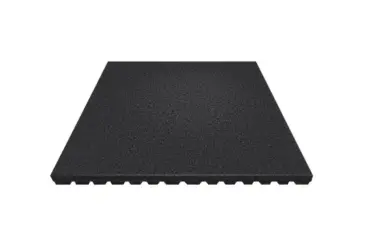
Our rubber gym flooring tile range is organised along exactly this scale, so a facility can specify one thickness for the general floor and a heavier one for the platforms.
Choosing by discipline
Thickness follows the practice and the intensity of the sessions, not the budget line.
Yoga and Pilates: 15 to 20 mm. These activities need very little attenuation, but they do need a stable, comfortable surface that does not deform under a hand or a knee.
Standard strength training: 20 to 25 mm is enough in most cases. Where members use guided machines and dumbbells without dropping them, this range is the right compromise between cost and protection.
Cross-training and weightlifting: 25 to 30 mm minimum. Explosive movements and barbell drops need higher absorption, both to protect the substrate and to keep the noise down for the rest of the building.
Intensive professional use: 30 to 40 mm in commercial facilities with heavy traffic and loads dropped regularly. Our weightlifting rubber tiles are built for that specific job, and the 40 mm cross-training tile is the usual reference for a drop platform.
Density matters as much as thickness
Beyond thickness, density is the criterion most often overlooked. A high-density tile in the region of 950 to 980 kg per cubic metre gives better shock absorption and a longer service life than a low-end tile at 600 to 700 kg per cubic metre – at the same nominal thickness.
Signs of a quality tile:
- High density: at least 900 kg per cubic metre for sports use.
- European manufacturing: a guarantee of quality control and of compliance with the applicable standards.
- A quality binding resin: resistance to wear and to humidity.
- A stated fire classification: check which Euroclass your building requires under EN 13501-1 and never accept a class quoted without its smoke index (Cfl-s1, Bfl-s1, Dfl-s1).
- Manufacturing tolerance: a maximum of 0.5 per cent on dimensions, so the joints stay tight across a large area.
Be wary of entry-level tiles using poor-quality resins: they crumble quickly and lose their attenuating properties within months.
Frequently asked questions
Which thickness for a fitness room inside a residential building?
Choose 20 to 25 mm. That range gives useful impact-noise reduction so the training room does not disturb the floors below, while protecting the substrate from the equipment.
Are 15 mm tiles enough for strength training?
15 mm tiles are suitable only for light work such as stretching and yoga. Under loaded strength training they are insufficient and will wear quickly. Specify 20 mm as the minimum.
Which thickness for a cross-training platform?
25 to 30 mm minimum. Explosive movements and barbell drops need higher absorption to protect the floor and to keep noise under control.
Can tiles be stacked to increase thickness?
It is possible but not advisable. Stacked tiles can slide against each other and create an unstable surface. It is better to invest directly in the right thickness.
How long does a rubber tile last?
A quality tile at 900 kg per cubic metre or above lasts 10 to 15 years under intensive use. Low-end tiles can deteriorate in 2 to 3 years, losing their attenuating properties as they go.
Do thicker tiles cost significantly more?
Thicker tiles do cost more per square metre, mainly because there is more material in them. The additional investment is usually recovered through the longer service life, and it is generally cheaper to specify the correct thickness once than to relay a worn-out floor.
Which thickness for a professional gym?
For intensive professional use, specify 30 to 40 mm. Those thicknesses cope with heavy traffic and with the equipment weights found in commercial facilities.
Do rubber tiles need special maintenance?
Maintenance is minimal: regular vacuuming and damp cleaning with a neutral product. Avoid aggressive solvents, which damage the rubber.
Can rubber tiles be laid over underfloor heating?
Yes, rubber tiles are compatible with underfloor heating. Check that the surface temperature does not exceed 28 degrees Celsius to avoid any deformation.
What is the difference between interlocking and solid tiles?
Interlocking tiles, with connectors, are easier to install and allow partial replacement. Solid tiles give better stability under very heavy loads but often need to be bonded.
Conclusion: invest in the right thickness
The thickness of your rubber tile is not a decision to take lightly. As this guide shows, every discipline has its own requirements in terms of substrate protection, shock absorption and impact-noise reduction.
The essentials to remember:
- 15 to 20 mm for light fitness and stretching
- 20 to 25 mm for standard strength training and general fitness areas
- 25 to 30 mm for cross-training and weightlifting
- 30 to 40 mm for intensive professional use
And remember that density matters as much as thickness. Always specify tiles at a minimum of 900 kg per cubic metre and European manufacturing, to protect the quality and the durability of the investment.
Light In Fitness supplies the full range, from 15 to 40 mm, manufactured in Europe from high-quality materials. Send us your surface area, your disciplines and the location of your drop zone and our team will specify the thickness map for your floor: request a quote.
Réalisations documentées
- Dalles et sols sportifs : livraisons documentées – plusieurs chantiers
- Sol sportif extérieur, square Georges-Vallerey – Taverny (95)