Polypropylene Interlocking Sports Tiles: the Buying Guide
Interlocking polypropylene (PP) tiles are the fastest sports floor to install and the easiest to take up again: no adhesive, no specialist fitter, and a two-person team can lay 100 m2 in four to eight hours. Light, modular, waterproof and available in more than 20 colours, PP is the alternative to rubber wherever the installation must be temporary, reversible or colourful — school gymnasiums, multi-purpose halls, outdoor sports terraces and event spaces. It is not, however, a free-weights floor. This guide sets out exactly where PP tiles excel, where they fail, and how to specify them.
Polypropylene vs rubber tiles: the comparison
| Criterion | Polypropylene tile | SBR rubber tile |
|---|---|---|
| Installation | Clips together — no glue, DIY-friendly | Bonded or loose-laid — more technical |
| Removal | Fully reversible and reusable | Difficult if bonded; partial if loose-laid |
| Weight | Very light — 1.5–2 kg/m2 | Heavy — 5–12 kg/m2 depending on thickness |
| Shock absorption | Low — a rigid tile | Good to excellent by thickness |
| Water resistance | Excellent — waterproof material | Good, but joints absorb moisture |
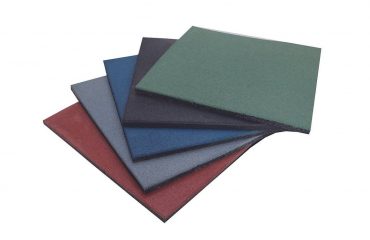
| Colours | 20+ colours, pattern and court-marking options | Limited — black, grey, red, green |
| Outdoor use | Yes, with integrated drainage | Yes, with UV-rated outdoor products |
| Heavy loads | Limited — cracking above ~500 kg point load | Excellent at any load |
| Indicative price | 8–20 EUR/m2 excluding VAT | 9–35 EUR/m2 excluding VAT by thickness |
| Ideal for | Gymnasiums, multi-sport, terraces, events | CrossFit, weightlifting, intensive clubs |
When NOT to choose polypropylene
PP tiles are the wrong answer in three situations — no exceptions:
- Bar drop zones: the tile’s rigidity transmits impact to joints and cracks the concrete beneath — dropped-weight areas need thick rubber.
- Concentrated heavy loads above ~200 kg: racks, loaded machines and heavy dumbbell trees will crack PP over time.
- Permanently wet areas without drainage: standing water trapped under the tiles breeds mould — specify drainage-profile tiles or a different floor.
For any serious strength zone, rubber remains non-negotiable — see the rubber gym flooring guide for that side of the decision.
Where PP tiles are the right choice
| Application | Recommended PP thickness | Why PP wins |
|---|---|---|
| School gymnasium | 15–20 mm | Multi-sport versatility, fast installation, school colour schemes |
| Outdoor sports terrace | 15–20 mm with drainage | Waterproof, UV-resistant, integrated drainage |
| Wellness / yoga space | 15 mm | Clean look, easy cleaning, moderate comfort |
| Light cardio zone | 15 mm | Stable under light machines, easy to clean |
| Multi-purpose event hall | 15 mm | Rapid assembly and dismantling, compact storage |
| Changing rooms / wet corridors | 15 mm with drainage | Waterproof, slip-resistant when wet |
| Stretching / mobility zone | 20 mm | Reasonable comfort plus thermal insulation from cold slabs |
Specification points to check before ordering
- Tile format: standard formats are 50 × 50 cm (0.25 m2 per tile) and 100 × 100 cm (1 m2). Smaller formats follow uneven substrates better; larger formats lay faster.
- Clip system: look for full-perimeter interlocks with multiple clips per edge — corner-only clips work loose under lateral sports movements.
- Surface profile: closed surface for indoor courts and wellness areas; open drainage grid for outdoor and wet zones.
- UV stabilisation: mandatory for outdoor use — non-stabilised PP fades and turns brittle within two or three summers.
- Rolling loads: professional PP tiles support 500–1,000 kg on castors, but only with wheel diameters above 50 mm — small castors under 30 mm can mark or fracture the tile.
- Expansion gap: PP expands with heat; leave the manufacturer’s specified perimeter gap (typically 10–15 mm, more outdoors) or the floor will buckle in summer.
Installation: genuinely a two-person job
- Substrate: hard and flat — concrete, asphalt, tiling or close-boarded timber. Never on grass or bare earth: soft ground lets the floor sag and deform. On timber decking, board gaps must not exceed 5 mm or clips catch in the joints.
- Quantity: for 100 m2, order 400 tiles of 50 × 50 cm or 100 tiles of 100 × 100 cm, plus 5% for edge cuts.
- Laying: start from a corner, clip row by row, cut edge tiles with a jigsaw or heavy-duty knife. 100 m2 takes 4–8 hours for two people — no technician required.
- Finishing: add ramp edges at doorways and transitions to prevent trip lips, especially where PP meets rubber zones of a different height.
Frequently asked questions
Can polypropylene tiles be laid on grass or earth?
No. On soft ground the floor sags and deforms under load. PP needs a hard, flat substrate — concrete, asphalt, tiling or tight timber decking.
How many tiles do I need for 100 m2?
400 tiles at 50 × 50 cm or 100 tiles at 100 × 100 cm, plus around 5% extra for perimeter cuts. Two people can lay the area in half a day to a day.
Do PP tiles survive equipment trolleys?
Yes — professional tiles take 500–1,000 kg rolling loads, provided castor diameters exceed 50 mm. Small hard castors concentrate the load enough to mark or crack the surface.
PP tiles, rubber or tatami — how do I decide between floor systems?
Match the floor to the dominant activity: rubber for strength and impact, tatami for grappling, PP for multi-sport, colour and reversibility. Our comparison of tiles, rolls and tatami walks through the full decision.
Get a modular flooring quote
Colour advice, price per square metre and delivery across Europe — with an installation method simple enough to skip the fitter entirely. Browse the polypropylene interlocking tile range or request a flooring quote.
Réalisations documentées
- Dalles et sols sportifs : livraisons documentées – plusieurs chantiers
- Sol sportif extérieur, square Georges-Vallerey – Taverny (95)
- Functional Rig inox – installations sur trois continents
- iGreenMill, tapis de course extérieur – installations sur trois continents