Which sports flooring should you choose? A three-question decision tree
The right sports flooring is decided by three questions, in this order: what is the dominant activity in each zone, which material family matches that activity, and what thickness protects both the slab and the user. Answer them zone by zone and the specification almost writes itself — whether you are fitting out a fitness club, a cross-training box, a hotel gym, a care home activity room or a municipal sports hall. This decision tree is based on more than a decade of B2B installations across Europe.
Why flooring is the most strategic line in your fit-out budget
Flooring is the most underestimated decision in a gym project, yet it conditions almost everything else:
- An unsuitable floor degrades heavy machines through vibration, often within 18 months of operation.
- A floor that is too thin under free weights creates genuine injury risk — dropped dumbbells, unstable footing, damaged screed.
- A non-compliant surface exposes the operator’s liability in publicly accessible premises if an accident occurs.
- Replacing a badly chosen floor costs two to three times more than specifying it correctly the first time.
Question 1: what is the dominant use of each zone?
One zone equals one dominant use. Trying to make a single surface do everything always ends in an unsatisfactory compromise. Map your floor plan against these six use cases:
- Free weights and weightlifting (racks, deadlift, Olympic lifts): high-density rubber tiles of 30 to 40 mm, doubled under drop zones if needed.
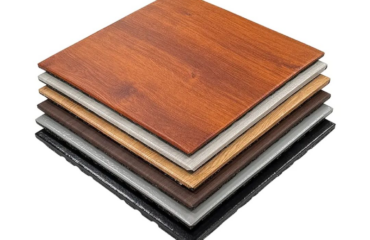
- Cardio and pin-loaded strength (treadmills, bikes, ellipticals, selectorised machines): rubber rolls or thin tiles of 6 to 10 mm to absorb motor vibration, or wood-effect rubber tiles for a premium finish.
- Cross-training and functional zones (sprints, sled pushes, plyometrics): artificial turf tracks for sled lanes, combined with 30-40 mm rubber tiles for plyometric areas.
- Martial arts, Pilates and soft gym: modular tatami mats with a density of 180-230 kg/m³ — around 20 mm for yoga and Pilates, 40 mm for judo and MMA where free falls occur.
- Outdoor fitness trails and calisthenics parks: draining impact-attenuating tiles or certified wood chips, specified against the free fall height of each station (EN 1177 test methods) and UV- and frost-resistant.
- Indoor multisport halls (badminton, pickleball, school sport): rigid interlocking polypropylene tiles or a dedicated multisport surface compliant with EN 14904 — high rigidity, limited cushioning.
Question 2: which material family?
Five material families cover practically every professional requirement. Each has a service life and a job it does best:
- Recycled rubber (SBR) — the reference for weights and cardio zones: shock absorption, slip resistance, 10-15 year service life.
- Interlocking polypropylene — rigid modular tiles for indoor multisport, glue-free installation, 8-12 years, little cushioning.
- Sports artificial turf — sprint and sled tracks for cross-training and HYROX-style formats, high traction resistance, 8-12 years, almost always combined with other surfaces.
- EVA tatami (jigsaw) — martial arts, rehabilitation, yoga: modular, cushioned, easy to store, 5-10 years, not suitable under heavy loads.
- Wood chips — outdoor trails and play areas: natural cushioning and drainage, but they need regular re-profiling and topping up every 3-5 years.
Question 3: which thickness for which activity?
Thickness is the most critical variable after the material itself. Too thin and it protects neither the slab nor the user; too thick and it adds cost and creates instability under machines.
| Use | Recommended thickness | Reference material |
|---|---|---|
| Cardio zone (treadmills, bikes, ellipticals) | 6-10 mm | Rubber roll or thin tile |
| Pin-loaded and light plate-loaded strength | 10-20 mm | High-density rubber tile |
| Standard free-weights zone | 20-30 mm | High-density rubber tile |
| Deadlift / Olympic lifting platform | 30-50 mm or double layer | Reinforced rubber tile or wood-rubber platform |
| Functional / plyometric zone | 20-40 mm | Rubber tile or turf on underlay |
| Martial arts (judo, MMA) | 40 mm tatami + cushioning underlay | Tatami, 230 kg/m³ density |
| Yoga / Pilates / soft gym | 15-20 mm | Soft tatami or PVC mat |
| Outdoor trail, fall height up to 1 m | 40 mm, EN 1177 tested | Draining impact-attenuating tiles |
| Outdoor trail, fall height above 2 m | 70-100 mm | Certified impact tiles or wood chips |
For a detailed method of matching tile thickness to the loads actually dropped in each zone, see our guide to rubber tile thickness by dropped load.
The eight-point checklist before you order
- Dominant use identified for every zone — heavy loads, cardio, functional, martial arts, outdoor or multisport.
- Surface measured precisely, with a dimensioned plan including circulation routes and clearances around heavy machines.
- Condition of the substrate: smoothed concrete? Levelling compound needed? A sports floor laid on a defective substrate degrades roughly three times faster.
- Ceiling height and door thresholds checked against the added floor height — a 40 mm build-up changes access levels.
- Applicable standards for your public: EN ISO 20957-1:2024 for the equipment itself, EN 1177 test methods where there is a fall height, EN 16630 for fixed outdoor fitness equipment, EN 14904 for indoor multisport surfaces.
- Finish: smooth, studded, wood-effect or coloured — the visual choice shapes the member experience and should be settled early.
- Installation method: interlocking (fast, relocatable), fully bonded (permanent, most stable) or loose-laid (flexible but less durable).
- Maintenance plan: cleaning protocol, compatible products, joint inspections and spot replacements.
Three classic mistakes to avoid
- Under-specifying thickness to save 15 %. A 15 mm tile under a deadlift zone fails within 6 to 12 months and damages the screed; the initial saving is spent three times over on remedial work.
- Using one uniform floor everywhere. It looks tidy, but it over-specifies the cardio zone and under-specifies the weights zone. Two adapted surfaces cost less over their life than one compromise.
- Ignoring outdoor standards. Impact attenuation under fall height is not optional for a public outdoor fitness trail: it engages the liability of the municipality or operator in the event of an accident.
The safeguard is simple: map the uses before choosing the material, then have the layout plan validated by a sports flooring professional. In a turnkey project this validation costs nothing extra and eliminates all three errors. Budget benchmarks per square metre are covered in our sports flooring price guide.
Frequently asked questions
Can I use the same rubber tile across my whole gym?
Technically yes, but it is rarely the right call. A single 20 mm tile everywhere over-serves cardio areas and under-serves deadlift zones. Zoning two or three thicknesses usually costs less and lasts longer.
What flooring should a hotel or care home gym use?
For light cardio and pin-loaded equipment, 6-15 mm rubber with a wood-effect or coloured finish works well. Acoustic performance matters most: in hotels, pair the surface with an acoustic underlay to protect bedrooms below; in care homes, favour non-slip, easy-clean finishes.
Is artificial turf only for CrossFit-style boxes?
No. Turf sprint and sled lanes are increasingly specified in mainstream clubs, corporate gyms and physiotherapy facilities because they enable low-impact conditioning work in a compact footprint.
Which standards apply to sports flooring?
Indoor multisport halls fall under EN 14904. Outdoor areas with a fall height are assessed with EN 1177 test methods, and fixed outdoor fitness equipment is covered by EN 16630. Fire behaviour of floor coverings is classified under EN 13501-1. Your supplier should state which classifications each product achieves.
Get a zone-by-zone flooring plan for your project
Light In Fitness has equipped more than 2,500 customers since 2013 — clubs, boxes, hotels, care homes, physiotherapy practices and municipalities. Send us your floor plan and we will return a zone-by-zone material and thickness recommendation with a detailed quotation, free of charge, within 24 working hours. Browse the full sports flooring range or contact our team for a free quote.
Réalisations documentées
- Dalles et sols sportifs : livraisons documentées – plusieurs chantiers
- Sol sportif extérieur, square Georges-Vallerey – Taverny (95)
Sources et références
- Code du sport, articles R322-4 à R322-43 – garanties d’hygiène et de sécurité applicables aux établissements d’activités physiques et sportives (Légifrance)
- Décret n° 96-1136 du 18 décembre 1996 – prescriptions de sécurité relatives aux aires collectives de jeux (Légifrance)
- NF EN 1176-1 – Équipements et sols d’aires de jeux, partie 1 : exigences de sécurité et méthodes d’essai générales (AFNOR)
- NF EN 1177 – revêtements de surface amortissants : détermination de la hauteur de chute critique (AFNOR)