Rubber tiles, rolls, pavers, polypropylene or turf: the sports flooring decision matrix
Cinq familles de sols sportifs couvrent les usages professionnels : dalles caoutchouc, rouleaux, pavés, polypropylène et gazon synthétique. Chacune répond à une contrainte dominante : charges lâchées, continuité de surface, extérieur, drainage ou glisse. Cette matrice croise les usages et les familles pour orienter le choix zone par zone.
Sports flooring is not chosen by venue, it is chosen zone by zone. Rubber tiles in the strength area, rolls across large cardio floors, interlocking rubber pavers outdoors where drainage matters, polypropylene tiles for light multi-sport use, artificial turf on sled lanes, tatami in martial arts rooms, tumbling in gymnastics. This article sets out the seven families, what each one costs, and the decision matrix we apply on projects.
The seven families at a glance
| Family | Primary use | List price excluding VAT | Indicative service life |
|---|---|---|---|
| Rubber tiles | Strength areas, weightlifting, intensive cross training | 22 to 60 EUR per m2 depending on thickness and fire classification | 10 to 20 years |
| Rubber rolls | Cardio floors and large continuous surfaces | Quoted per project | 10 to 15 years |
| Interlocking rubber pavers | Free draining outdoor areas, fitness trails, play areas | Quoted per project | 15 to 25 years |
| Polypropylene tiles | Light multi-sport, schools, ball courts, multi-purpose areas | From 24 EUR per m2 | 8 to 15 years |
| Artificial turf | Sled tracks, drag lanes, outdoor leisure and wellness surrounds | Quoted per project, hybrid rubber and turf tiles from 49 EUR per m2 | 10 to 15 years |
| Tatami | Martial arts, combat sports, low impact and adapted activity | From about 17 EUR per m2 depending on thickness | 5 to 20 years by material |
| Tumbling | Artistic gymnastics, acrobatics, tumbling runs | Quoted per project | 10 to 15 years |
Rubber tiles: the reference for load bearing zones
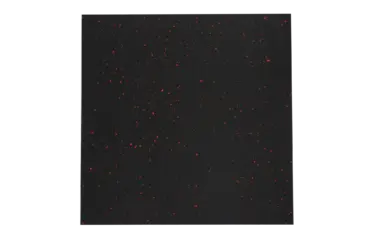
Rubber tiles are made from recycled SBR or from EPDM coloured through the mass. Thickness is specified by function rather than by room: 15 mm under cardio, 20 mm under guided machines and on circulation, 30 mm under free weights, 40 mm and above in drop zones and beneath weightlifting platforms. Current list prices include 22 EUR per square metre for a 15 mm black tile, 32 EUR for a 25 mm tile at 1,000 kg per cubic metre, 38.50 EUR for a 40 mm weightlifting tile, 42 EUR for a 20 mm tile classified CFL-s1, 49 EUR for a 20 mm light oak effect tile and 60 EUR for a 40 mm studded backing tile, all excluding VAT.
The strengths are calibrated shock absorption by thickness, modularity, and the ability to replace a single damaged tile. The constraints are weight, roughly 7 kg per square metre for each centimetre of thickness, a substrate that has to be genuinely flat, and a few weeks of new rubber odour on SBR products.
Rolls, pavers, polypropylene and turf
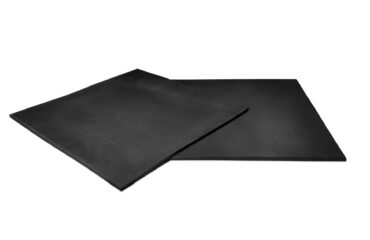
Rubber rolls give a continuous surface without visible joints, which is the right answer above about 100 m2 of cardio floor where modularity adds nothing and visual continuity counts. The trade off is that available thicknesses do not reach weightlifting requirements, localised repair means cutting and bonding with a visible joint, and installation is usually adhered.
Interlocking rubber pavers are the free draining outdoor reference for play areas, fitness trails, street workout zones and poolside surrounds. They are laid without adhesive, drain naturally through the joints, and can be dimensioned against the critical fall height required by EN 1177. They cost more than a standard tile and need a carefully prepared bedding layer, but being demountable is a genuine advantage for a public authority.
Polypropylene interlocking tiles suit light multi-sport use, basketball, handball and recreational volleyball, and outdoor multi-purpose areas. A standard interlocking sports tile lists at 24 EUR per square metre excluding VAT. They need no adhesive or sand bed, drain through the tile, and can be lifted and reused, but they are unsuitable for heavy loads and dropped weights.
Artificial turf is used indoors for sled tracks, drag zones and functional lanes, and outdoors for leisure and wellness areas. The determining specifications are pile height, density and infill type. Friction is high, which is exactly what a sled push or drag requires. Maintenance means brushing and vacuuming, and infill compacts over time.
Two families that plans routinely forget
Acoustic underlays sit beneath a primary floor to add impact absorption, sound insulation and structural protection. They are essential under a weightlifting platform in a multi-storey building and in workplace gyms above occupied floors. The methodological point matters more than the product: an underlay cannot be added later without lifting the entire floor, so the decision is taken before installation.
Wet area surfacing covers pool copings, decks and circulation. This is the one domain where slip classification becomes a regulatory criterion rather than a comfort preference, and it should be written into the specification alongside the material.
Decision matrix by project type
| Your project | Primary floor | Secondary floor |
|---|---|---|
| Fitness club, 500 m2 | Rolls or 15 mm tiles in the cardio zone | 20 to 30 mm tiles in the strength zone, puzzle tatami in the stretching area |
| Cross training box, 200 m2 | Rubber tiles 20 to 30 mm across the floor | 40 mm minimum in the drop zone, artificial turf on the sled lane |
| Municipal fitness trail | Interlocking pavers and turf by zone | Impact absorbing surface dimensioned to EN 1177 under equipment with a fall height |
| Competition martial arts dojo | Tatami approved for the discipline | Rubber or polypropylene tiles on circulation |
| Rehabilitation floor, 200 m2 | Rubber tiles 20 to 25 mm in effort zones | Softer surfacing in assessment and floor work areas |
| Hotel or workplace gym above occupied space | 20 mm tile with the required reaction to fire classification | Acoustic underlay across the whole area, specified before laying |
Three errors that cost money
- Under-specifying thickness in the drop zone. Tiles chosen for the general floor will not survive dropped barbells, and the substrate underneath takes the damage.
- Omitting the underlay on an upper floor. Impact noise is the leading cause of conflict with neighbours and, in the worst cases, of a gym being forced to close.
- Ignoring slip classification in wet zones. In a venue open to the public this is a compliance issue, not a comfort question.
Frequently asked questions
What thickness do I actually need?
Specify by zone, not by room: 15 mm under cardio, 20 mm under guided machines and circulation, 30 mm under free weights, 40 mm and above in drop zones and under platforms. Paying for thickness across an entire room where only a fifth of it is loaded is the most common budget leak in a flooring package.
Do I need a fire classified floor?
Where the venue receives members of the public, the floor covering has to meet a reaction to fire requirement. In practice that means specifying a classified tile such as CFL-s1, which changes the price per square metre and therefore has to be decided before the budget is built, not after. A strictly private or occupier-only room is not subject to the same requirement.
Can rubber tiles be laid loose or must they be bonded?
Both are used. Loose laid interlocking tiles suit modular strength zones and allow single tile replacement. Bonded installation is preferred on large continuous areas, in wheeled traffic zones and wherever lateral movement of the field would be a nuisance. The substrate has to be flat either way.
How heavy is a rubber floor?
Around 7 kg per square metre for each centimetre of thickness. A 40 mm drop zone of 40 m2 therefore adds roughly 1,100 kg of permanent load, which is worth checking against the floor loading of an upper storey before ordering.
Have your floor specified zone by zone
Light In Fitness supplies and installs professional sports flooring from Tours, France, and has equipped more than 2,500 customers since 2013. Quotations are issued within 24 working hours and stock items ship in five to ten working days across France, Belgium, Switzerland and Luxembourg. Relevant standards include EN 14904 for indoor sports surfaces, EN 1176 and EN 1177 for play areas and impact attenuation, and EN 16630 for outdoor fitness equipment.
See the rubber gym flooring tiles and outdoor sports flooring ranges, or request a quote with your zone areas and we will return a costed floor plan.
Réalisations documentées
- Dalles et sols sportifs : livraisons documentées – plusieurs chantiers
- Sol sportif extérieur, square Georges-Vallerey – Taverny (95)
Sources et références
- Décret n° 96-1136 du 18 décembre 1996 – prescriptions de sécurité relatives aux aires collectives de jeux (Légifrance)
- NF EN 1176-1 – Équipements et sols d’aires de jeux, partie 1 : exigences de sécurité et méthodes d’essai générales (AFNOR)
- NF EN 1177 – revêtements de surface amortissants : détermination de la hauteur de chute critique (AFNOR)
- Arrêté du 19 avril 2011 – étiquetage des produits de construction ou de revêtement de mur ou de sol sur leurs émissions de polluants volatils (Légifrance)