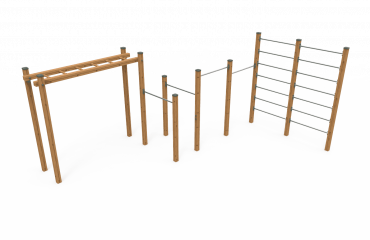
Buying Outdoor Fitness Trail Equipment: The Complete Buyer Guide
Un parcours santé associe agrès fixes et signalétique le long d'un itinéraire, pour une pratique libre et non encadrée. Les acheteurs sont les communes, parcs, campings, hôtels, résidences seniors et entreprises. Le choix porte sur le matériau des agrès, leur conformité EN 16630 et le sol de réception, avant le prix unitaire.
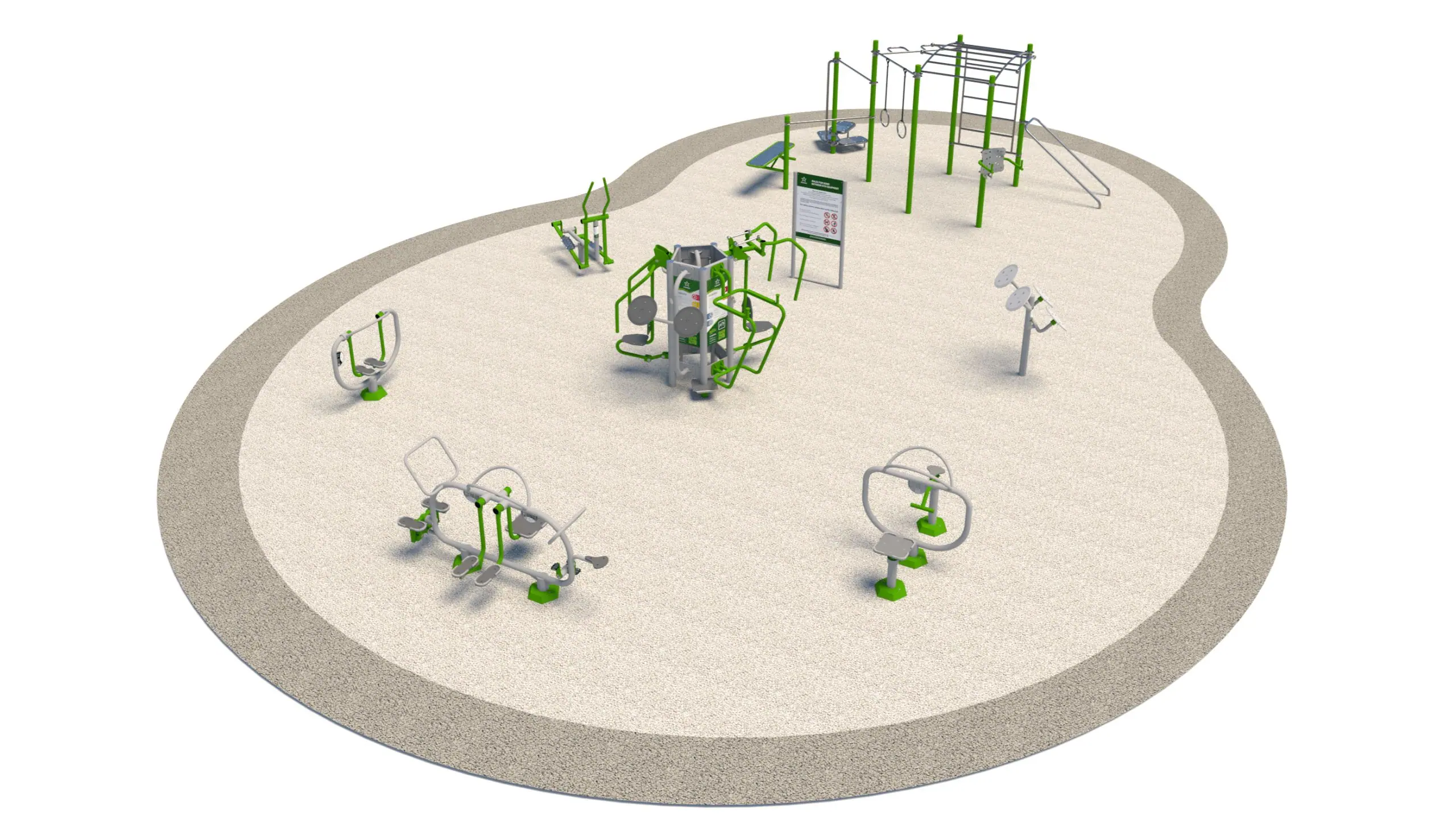
Outdoor fitness trails are appearing everywhere. Municipalities, parks, campsites, hotels, senior residences and employers all see the same appeal: an installation that is cheap to run, open without membership, and usable by every kind of visitor. Behind the apparent simplicity of a piece of outdoor apparatus, though, sit real constraints: safety standards, free fall height, impact-absorbing surfacing, how materials survive outdoors, the operator inspection duties, anchoring and landscape integration. This guide reviews the points that determine whether a trail lasts ten years or three.
The answer in 30 seconds
A freely accessible outdoor fitness trail falls under EN 16630, the standard for permanent outdoor fitness equipment. As soon as there is a significant free fall height, the surfacing beneath also falls under EN 1177. Neither is optional: without documented conformity, the operator carries direct liability in the event of an accident.
On materials there are three options according to exposure: hot-dip galvanised then powder-coated steel for most sites, stainless steel at the coast or in very humid environments, and class 4 treated timber for landscaped parks and woodland settings.
Finally, installation is not a detail to settle at the end of the job. Anchoring, foundations and ground preparation represent a real share of the budget and determine whether the finished installation is compliant at all.
1. Safety and standards: the non-negotiable point
The two reference standards
- EN 16630 is the European standard for permanently installed, freely accessible outdoor fitness equipment. It governs design, manufacture, installation and maintenance: mechanical strength, stability, absence of entrapment zones and sharp edges, corrosion resistance, and mandatory usage signage on every module.
- EN 1177 is the standard for impact-absorbing surfacing, applicable wherever there is a significant free fall height. It defines the shock absorption performance required for that height.
A frequent confusion to avoid: EN 16630 does not apply to childrens playgrounds, which fall under EN 1176. Outdoor fitness equipment is designed for users above roughly 1.40 m in height. A mixed project combining adult fitness and childrens play therefore falls under two distinct sets of requirements, in two separate zones.
What non-compliance exposes you to
- An accident not covered by the operator insurance.
- Civil, and potentially criminal, liability falling on the operator.
- Administrative closure of the area following an inspection.
- Rejection of a grant application, since these require the declarations of conformity.
With Light In Fitness: every item is supplied with its CE marking, its declaration of conformity and its user instructions in the language of the site. These documents come with the quotation rather than after the order, so they can be attached to a funding application from the moment it is submitted.
2. Impact-absorbing surfacing: the item most often forgotten
This is the classic first-project mistake: the budget covers the apparatus but not the ground. Yet the surfacing is an integral part of compliance, and it often represents a significant share of the works.
| Zone | Suitable surfacing | Points to watch |
|---|---|---|
| Beneath apparatus with a fall height | Free-draining impact-absorbing rubber tiles | Thickness follows the free fall height declared by the manufacturer, not an estimate |
| Trails in a natural or woodland setting | Wood chips | Performance depends on maintained depth: requires regular topping up, recorded in the maintenance log |
| Circulation routes and trail surrounds | Free-draining artificial turf | Usable in all weather but has no shock-absorbing function: it does not replace a tile beneath apparatus |
| Structure anchoring zone | Concrete or foundation blocks | To be completed with a soft surfacing around the perimeter; anticipate at the groundworks stage |
The full range is presented under outdoor sports flooring.
3. Materials and durability: what separates 3 years from 15
An outdoor trail is permanently exposed to rain, frost, UV and expansion cycles, and at the coast to salt spray. The material is not an aesthetic choice, it is a service life choice.
| Environment | Recommended material | Indicative service life |
|---|---|---|
| Urban park, school grounds, standard site | Hot-dip galvanised then UV-resistant powder-coated steel | 10 to 15 years with regular maintenance |
| Coastal, saline or very humid environment | Stainless steel | 15 to 20 years with no specific treatment |
| Landscaped park, woodland, campsite, natural site | Class 4 treated timber (Scandinavian pine, black locust) | 8 to 12 years depending on exposure |
Hot-dip galvanising deserves one technical point. The zinc protects the steel even where the coating is scratched, because it corrodes in place of the iron. That is precisely what simply painted steel lacks, where the smallest impact opens a rust point that then spreads underneath the paint. The relevant reference here is EN ISO 1461.
4. Ergonomics and accessibility: a trail for every user
A trail that is poorly matched to its users becomes a trail nobody uses, and therefore one that is hard to justify in a review. The points to check:
- Variety of demands — pulling, pushing, balance, mobility, cardio. A trail made up only of pull-up bars effectively excludes older users and beginners.
- Adapted-effort modules — pedal units, swing trainers, air walkers, shoulder wheels: gentle loading without joint overload, suited to older users and to those returning to activity.
- Accessible modules — reachable heights, support rails, ergonomic grips. See the accessible outdoor gym range.
- The approach route — an accessible piece of apparatus is worth nothing if it cannot be reached: path width, level changes, and the nature of the surrounding surface.
- Modules for younger children — to be handled in a separate zone under EN 1176, with dedicated childrens equipment.
The configuration that holds up best in use is the multigenerational cluster: a street workout station for younger and more experienced users, several intermediate functional modules, and two or three senior or accessible modules. That combination covers every age group and answers the inclusion criteria that public funding bodies tend to value.
5. Landscape integration: what gets the project accepted
A trail rejected by local residents is an under-used trail. The levers for integration are simple and inexpensive if they are decided early:
- Custom RAL colours, coordinated with the existing street furniture.
- Timber structures for parks, woodland and campsites; powder-coated steel with a clean design for urban spaces.
- Visual consistency across the whole trail. A module added three years later in a different colour is immediately obvious.
- Signage treated as a design element rather than a regulatory panel added as an afterthought.
Where the catalogue cannot deliver the integration required, whether because of a dimensional constraint, an imposed colour or a specific module, the structure can be produced to measure in our own workshop.
6. Maintenance and the operator duties
Compliance does not end when the works are handed over. EN 16630 places a continuing inspection regime on the operator:
- Routine visual inspection — at a frequency matched to how busy the site is.
- Operational inspection — checking fixings, surfaces, moving parts and signage.
- Annual main inspection — a full check by a qualified technician, to be documented.
- Maintenance log — every intervention recorded. This document is what protects the operator in a dispute.
Reducing the maintenance burden is decided at the point of purchase: anti-vandal fixings, stainless components on wearing parts, simple design without superfluous mechanisms, and genuine availability of spare parts. Light In Fitness offers an annual maintenance contract covering this regime, including on installations we did not supply.
7. Budget, funding and value for money
The budget depends on the number of pieces of apparatus, the material, the impact-absorbing surfacing, the groundworks and the installation. The ranges below are indicative and do not constitute a sale price.
| Type of project | Indicative budget | What it covers |
|---|---|---|
| Single item of apparatus (bar, stepper, outdoor bike) | 1,000.00 to 3,000.00 EUR excluding VAT | One module, excluding surfacing and installation |
| Multi-use station | 5,000.00 to 15,000.00 EUR excluding VAT | One structure grouping several exercise positions |
| Complete fitness area or trail | 15,000.00 to 80,000.00 EUR excluding VAT | Set of apparatus, surfacing, signage, installation |
| Senior fitness zone in a care home or residence | 8,000.00 to 30,000.00 EUR excluding VAT | Adapted-effort modules, non-slip surfacing, access route |
Public funding: in most countries a project of this kind can draw on national, regional or local support, whether through sports facility programmes, rural or municipal investment grants, or health-through-sport schemes. Which programmes exist, at what rate and on what timetable, varies entirely by country and territory. Confirm what applies with the competent authority for your area before fixing a funding plan, and do not budget on an assumption.
Plan ahead: grant applications follow strict submission calendars, often well before the year of construction. A project started in spring for an installation that summer rarely gets through the funding stage at all. Allow several months between the first sketch and a decision. We supply the technical documents for the file free of charge: dimensioned plan, product datasheets, declarations of conformity and a detailed quotation.
8. Logistics and installation: the most underestimated stage
This is where well-designed projects come apart. The recurring pitfalls:
- Poorly prepared ground — the nature of the terrain, whether concrete, soil, grass or fill, determines the type of anchoring. It should be surveyed before the order, not on the day of installation.
- Undersized anchoring — badly fixed apparatus is unstable and therefore non-compliant, however good the structure itself may be.
- Unmapped buried services — finding a pipe while excavating the foundation blocks can hold up a site for weeks.
- Split contracts — apparatus, surfacing and groundworks entrusted to three separate contractors almost always produce a liability dispute at the first defect.
The simplest answer is a single package: site survey, layout plan, supply, installation and conformity check by the same team.
On an outdoor fitness trail, the expensive part is never the apparatus. It is the surfacing that was forgotten, the foundation block discovered at the last minute, and the module that has to be replaced three years later because it was painted instead of galvanised.
Michael Galy, founder and director of Light In Fitness
What to remember before ordering
- Require documented EN 16630 conformity, CE marking and instructions in the local language, before the order rather than after.
- Budget the impact-absorbing surfacing from the outset. The thickness follows the declared fall height, not an estimate.
- Choose the material for the real exposure: galvanised and powder-coated on a standard site, stainless steel at the coast, class 4 timber in a landscaped park.
- Compose a multigenerational trail rather than a series of pieces at the same level.
- Treat accessibility through the approach route as much as through the modules.
- Set up the inspection regime and the log at handover. That is what protects the operator.
- Group apparatus, surfacing and installation into a single package to avoid liability disputes.
Frequently asked questions
Which standards must outdoor fitness trail equipment meet?
EN 16630 governs permanently installed, freely accessible outdoor fitness equipment: design, manufacture, installation and maintenance. EN 1177 applies in addition to impact-absorbing surfacing wherever there is a significant free fall height. Childrens playgrounds fall under a separate standard, EN 1176.
Which materials are best for an outdoor trail?
Hot-dip galvanised then powder-coated steel suits the large majority of sites. Stainless steel is the choice at the coast and in very humid environments, where salt corrosion attacks other finishes. Class 4 treated timber is the best aesthetic fit in a landscaped park, woodland or campsite. The deciding factor is the real exposure of the site, not the purchase price of the module.
Is impact-absorbing surfacing always required beneath the apparatus?
Yes, wherever there is a significant free fall height on the module concerned. The thickness and type of surfacing are determined from the fall height declared by the manufacturer, in accordance with EN 1177. Wood chips are a compliant solution in a natural setting, provided their depth is maintained over time by regular topping up.
What does a complete outdoor fitness trail cost?
A complete fitness area or trail generally falls between 15,000.00 and 80,000.00 EUR excluding VAT depending on the area, the number of modules, the range chosen and the surfacing. A single item of apparatus falls between 1,000.00 and 3,000.00 EUR excluding VAT, and a multi-use station between 5,000.00 and 15,000.00 EUR excluding VAT. These figures are indicative and do not include specific groundworks.
Are outdoor fitness trails accessible to people with reduced mobility?
Some modules are designed specifically for accessible use: reachable height, support rails, ergonomic grips and adapted effort. The overall accessibility of the area, however, depends as much on the approach route and the surrounding surface as on the apparatus itself. Accessibility requirements should therefore be stated at the quotation stage so they can be built into the layout plan.
How long does a good outdoor fitness trail last?
Galvanised and powder-coated steel equipment lasts 10 to 15 years with regular maintenance. A stainless steel structure reaches 15 to 20 years with no particular treatment. Class 4 treated timber structures generally last 8 to 12 years depending on exposure. These figures assume the inspection regime required by the standard is followed.
What maintenance duties fall on the operator after installation?
The standard requires routine visual inspection, an operational inspection of fixings, surfaces and moving parts, and an annual main inspection carried out by a qualified technician. Every intervention must be recorded in a maintenance log. Without documented maintenance, the operator carries liability in the event of an accident.
Does Light In Fitness handle delivery and installation?
Yes. Light In Fitness delivers and installs across Europe, including ground preparation, anchoring, assembly, conformity check and handover of the maintenance log. Delivery, installation and lead times are confirmed per project at the quotation stage, since they depend on the country and the site. A showroom is available by appointment at our base in Tours.
Planning an outdoor fitness trail
Site survey, dimensioned layout plan, module selection by user group, compliant impact-absorbing surfacing, installation and the technical documents for your funding application, all through one contact from sketch to handover. See also our outdoor fitness trail range, and request a quotation.
Standards referenced — EN 16630 (permanent outdoor fitness equipment, free access). EN 1177 (impact-absorbing surfacing, shock absorption). EN 1176 (childrens playgrounds). EN ISO 1461 (hot-dip galvanising). Budget ranges are indicative and do not constitute a sale price; public funding schemes change and must be confirmed with the competent authority in your country.
Réalisations documentées
- Cage street workout ultime, Carcassonne – armée française
- Cage street workout ultime, Tahiti – armée française, Polynésie
- Cage SP Max, centre EPIDE de Combrée – établissement public d’insertion
- Cage SP Max, lycée Saint-Bénigne de Dijon – établissement scolaire
Sources et références
- Décret n° 96-1136 du 18 décembre 1996 – prescriptions de sécurité relatives aux aires collectives de jeux (Légifrance)
- NF EN 1176-1 – Équipements et sols d’aires de jeux, partie 1 : exigences de sécurité et méthodes d’essai générales (AFNOR)
- NF EN 1177 – revêtements de surface amortissants : détermination de la hauteur de chute critique (AFNOR)
- NF EN 16630 – modules fixes d’entraînement physique de plein air : exigences de sécurité et méthodes d’essai (AFNOR)
À lire aussi sur le même thème
- EN 16899: safety requirements for parkour equipment
- Timber or steel for an outdoor fitness trail: a material comparison
- Case Study: Deploying a Fitness Trail Network Across 12 Municipalities
- Buying a Pickleball Court: The Complete Guide for Clubs and Operators
- Play and Sports Areas for Professionals: Choosing Well and Avoiding Costly Mistakes