Play and Sports Areas for Professionals: Choosing Well and Avoiding Costly Mistakes
Une aire de jeux ludique et sportive relève de la série EN 1176 pour les structures et de l'EN 1177 pour le sol amortissant. Pour un acheteur public ou privé, les erreurs les plus coûteuses portent sur le sous-dimensionnement du sol et sur l'absence de plan de maintenance. Ce guide traite le choix, le prix et les pièges de ce type de projet.
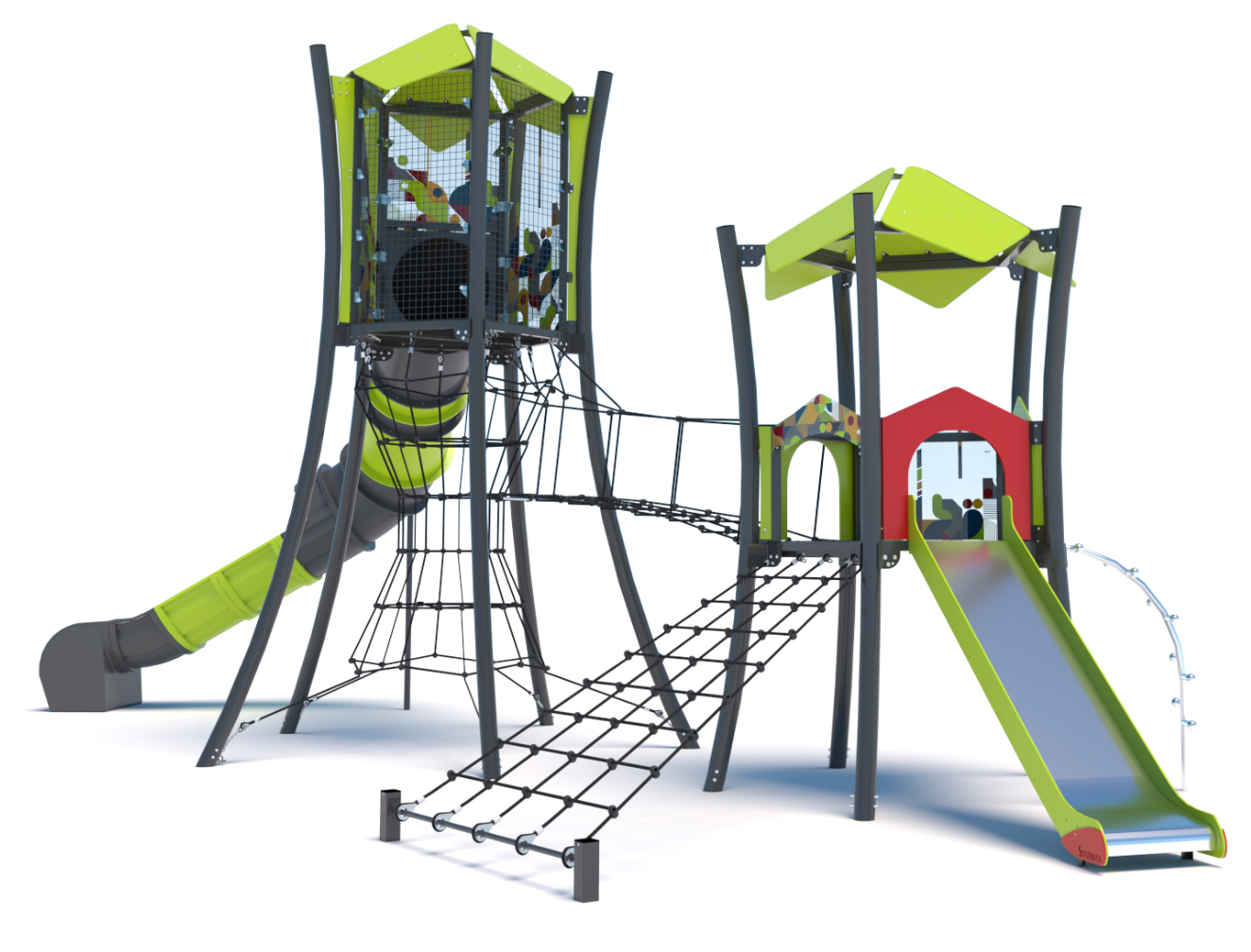
Play and sports areas have become structural equipment in public and private spaces. For a local authority, a school, a campsite, a hotel, a shopping centre or a property developer, it is a committing investment, and one where the safety framework is unusually strict compared with most sports equipment. This guide covers the standards that apply, the choice of materials, accessibility, impact-attenuating surfacing, real budgets and the maintenance obligations that begin at handover.
In brief
Two European standards govern the subject: EN 1176 for the equipment and EN 1177 for impact-attenuating surfacing. Impact surfacing becomes necessary as soon as the free height of fall exceeds 60 cm, and the operator has to keep a maintenance plan with a traceable record of inspections. On budget, the range runs from around 2,000.00 EUR excluding VAT for an entry-level module to well beyond 300,000.00 EUR excluding VAT for a large signature structure.
The mistake that comes up in almost every tender: CE marking
Playground equipment does not carry CE marking. It falls under neither the toy safety directive, nor the machinery directive, nor personal protective equipment: no European directive requires CE marking on a play structure.
What is required is conformity with EN 1176 and EN 1177, evidenced by a test report or a certificate from a testing body. A supplier who advertises CE marking on a playground has the wrong framework, and an experienced public buyer will notice.
1. The standards framework
The two standard series do different jobs and neither replaces the other.
EN 1176 covers play equipment: structural strength, absence of entrapment, impact areas, marking, and, in part 7, installation, inspection and maintenance.
EN 1177 covers impact-attenuating surfacing: test methods and the determination of critical fall height.
How these standards are made binding varies from one country to another. In some, they are referenced by national regulation and compliance is a legal obligation rather than a voluntary choice; in others they are the recognised state of the art. Check the national framework applicable to your site early, because it determines what evidence you have to hold on file.
One distinction to know: EN 1176 covers equipment intended for children. As soon as outdoor fitness apparatus for users of at least 1.40 m is installed, street workout or fitness trails, EN 16630 takes over. On a site serving both audiences the two frameworks coexist with different dimensioning rules, and they must not be mixed.
What non-conformity costs
- An accident engaging the operator liability, civil and potentially criminal.
- Closure of the area by the competent authority.
- An insurer disputing cover for lack of conformity and maintenance documentation.
In all three cases it is not the equipment that is judged, it is the file: test reports, layout plan, maintenance record. That is why conformity documentation is supplied with delivery as a matter of course.
2. Choosing materials
Galvanised steel and stainless steel. The reference for intensive public use. Hot-dip galvanising protects the steel even where it is scratched; stainless goes further, for coastal or saline exposure. Consistency matters: ordinary fasteners ruin the protection of a stainless structure.
Treated timber. Suited to parks and natural settings. Use class 4 qualifies suitability for permanent ground contact; it is not absolute rot-proofing. Timber remains a living material that has to be checked and maintained.
HPL panels and high-density plastics. UV stability, durable colour, simple upkeep and good resistance to damage. This is what carries the visual identity of a modern play area.
The wrong trade-off is paid for twice: a structure that degrades early, and an unbudgeted early replacement. Over a ten to fifteen year service life, the initial price gap between an appropriate material and a barely adequate one is almost always smaller than the cost of replacing it.
3. Accessibility and multi-generational design
A successful area serves several audiences at once: play modules for the youngest, ninja structures and children fitness trails for older children, street workout and outdoor fitness apparatus for teenagers and adults, and a multi-sport court for collective use.
On accessibility, national legislation generally addresses the built environment and the routes through it: level access, a trafficable surface, manoeuvring space. Inclusive design of the modules themselves, ground-level play reachable from a wheelchair, sensory panels, adapted seats, is usually a programming choice rather than a legal obligation. It is a choice that shows, and one that is easy to defend in front of a decision-making body.
4. Impact surfacing: the most committing requirement
As soon as equipment presents a free height of fall above 60 cm, the surface must attenuate the impact in accordance with EN 1177. The sizing rule is simple: the critical fall height of the surface must be at least equal to the free height of fall of the equipment, established by laboratory test.
| Solution | Characteristics |
|---|---|
| Rubber tiles | Critical fall height set by thickness: around 2.00 m at 60 mm, 2.50 m at 80 mm, 3.00 m from 100 mm. Simple upkeep, replaceable tile by tile. See playground surfacing. |
| Wet-pour, cast in place | Continuous coloured surface with no joints, suited to free forms and graphic patterns. Quoted per project. |
| Wood chips | Natural and economical, to be topped up periodically to compensate for compaction and displacement. See playground wood chips. |
| Interlocking rubber pavers | Free-draining, demountable, suited to circulation routes and the approaches to the area. |
A point to watch: a surface described as compliant in a catalogue is not enough. What counts is the test report corresponding to the thickness and the installation method actually chosen.
5. Budgets: the figures actually observed
The following ranges are catalogue figures, excluding impact surfacing, ground preparation and installation.
| Type of equipment | Price range excluding VAT | Typical context |
|---|---|---|
| Entry-level module, agility trail | 2,000.00 to 5,500.00 EUR | School, institution grounds, extension of an existing area |
| Multi-activity timber structure | 20,000.00 to 30,000.00 EUR | Natural park, campsite, residential scheme |
| Themed structure in steel and HPL | 36,000.00 to 80,000.00 EUR | Municipal area, school group |
| Large modular structure or cage | 80,000.00 to 240,000.00 EUR | Urban park, major public facility |
| XXL signature structure | Above 300,000.00 EUR | Identity project, destination park |
To these figures add the impact surfacing, whose cost depends directly on the fall heights of the modules chosen, plus ground preparation, drainage and installation. This is why a serious costing is done after the modules are selected and never before: they determine the area and the thickness of the surfacing, and therefore a significant part of the budget.
Public tenders increasingly carry environmental award criteria alongside price. For a play area that translates into verifiable requirements: documented recycled content, warranty duration, availability of individual spare parts and an end-of-life route. Check the procurement rules applicable in your country before drafting the specification.
6. Maintenance and inspections
The operator has to establish a maintenance plan and follow it. EN 1176-7 sets out three levels.
- Routine visual inspection at a frequency matched to usage, to catch obvious damage: glass, vandalism, a missing part.
- Operational inspection covering function and stability, tightening, wear of moving parts and the condition of the impact surfacing.
- Annual main inspection, a thorough examination of the structure, the foundations and conformity, with a written report.
The corresponding record is what you will be asked for after an accident. Equipment in perfect condition with no record is, in liability terms, weaker than equipment that is properly documented.
7. Siting and installation
- Ground preparation: levelling, bearing capacity and drainage. An area that holds water destroys its own impact surfacing within a season.
- Impact areas and free space between modules, defined by the standard according to equipment type and fall height.
- Anchoring, the most critical point for both safety and service life, documented in the project file.
- Signage: an information panel giving the age ranges, the rules of use and the contact details of the operator.
Frequently asked questions
Which standards apply to play areas?
EN 1176 for the equipment and EN 1177 for impact-attenuating surfacing. Whether they are binding or represent recognised good practice depends on the national regulation applicable to your site, which is worth checking at the start of the project.
Does a play area need CE marking?
No. Play equipment falls under none of the directives that require CE marking. What is required is conformity with EN 1176 and EN 1177, evidenced by a test report or a certificate.
How much does a professional play area cost?
From 2,000.00 to 5,500.00 EUR excluding VAT for an entry-level module or agility trail, 20,000.00 to 30,000.00 EUR for a multi-activity timber structure, 36,000.00 to 80,000.00 EUR for a themed steel and HPL structure, and 80,000.00 to 240,000.00 EUR for a large modular or caged structure. Impact surfacing, ground preparation and installation are additional.
Is impact surfacing compulsory?
Yes, as soon as equipment presents a free height of fall above 60 cm. The critical fall height of the surface, established by test to EN 1177, must then be at least equal to the free height of fall. The governing document is the test report for the thickness and installation method chosen, not the catalogue entry.
Which materials last longest?
Hot-dip galvanised steel for the structure, stainless steel for coastal or saline exposure, use class 4 timber for natural sites, and HPL or high-density plastics for decorative and coloured elements. Consistency counts as much as the main material: fasteners and fixings have to match the same level of protection.
How long does a play area last?
Ten to fifteen years in public use with regular maintenance, longer for galvanised or stainless steel structures. It is rarely the structure that limits service life but the wear parts, ropes, nets, bearings and swing seats, whose availability from the supplier is therefore worth verifying before purchase.
Can a play area be customised?
Yes: colours, materials, themes and the visual identity of the authority or the establishment. Bespoke structures also make it possible to fit a layout to a constrained plot or to work around a particular landscape constraint.
Framing your project
Send us your plan and the audiences you want to serve. We will produce a zone-by-zone recommendation, impact surfacing sized to the fall heights, a 3D layout plan and a detailed quotation including conformity documentation: request a quote.
Réalisations documentées
- Cage street workout ultime, Carcassonne – armée française
- Cage street workout ultime, Tahiti – armée française, Polynésie
- Cage SP Max, centre EPIDE de Combrée – établissement public d’insertion
- Cage SP Max, lycée Saint-Bénigne de Dijon – établissement scolaire
Sources et références
- Décret n° 96-1136 du 18 décembre 1996 – prescriptions de sécurité relatives aux aires collectives de jeux (Légifrance)
- NF EN 1176-1 – Équipements et sols d’aires de jeux, partie 1 : exigences de sécurité et méthodes d’essai générales (AFNOR)
- NF EN 1177 – revêtements de surface amortissants : détermination de la hauteur de chute critique (AFNOR)
- NF EN 16630 – modules fixes d’entraînement physique de plein air : exigences de sécurité et méthodes d’essai (AFNOR)