How to Choose Between a Rubber Flooring Roll and One Metre Square Tiles
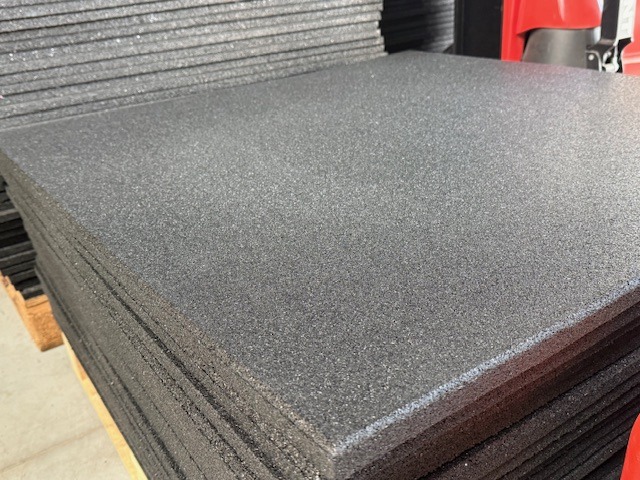
When you are specifying a new floor, whether for a wet area, a technical or industrial space or a high-traffic training zone, choosing the right covering matters more than most people expect. Two options dominate: rubber flooring in rolls, and square rubber tiles of one metre by one metre. Each has its own advantages and drawbacks, and the right answer usually comes down to the specifics of your project rather than to a general rule.
1. Ease of installation
Rolls are often preferred for how quickly they go down. A roll can be unrolled across a large area, which cuts the number of joints and speeds up installation, particularly in large rooms where getting the space back into service quickly is the priority.
Square tiles, by contrast, have to be aligned accurately, which lengthens installation time, above all over a large surface. On the other hand, a tiled floor can be laid in sections around equipment that cannot be moved, and it can be extended later without touching what is already down.
Whichever format you choose, the substrate decides the result. Check that the slab is sound, level and dry, and plan any levelling compound before delivery rather than after. Both formats can be bonded or loose-laid depending on the use, and a bonded installation is the norm anywhere carts, machines or heavy loads move across the floor.
2. Durability and wear resistance
Rubber flooring is recognised above all for its durability. It stands up well to impact and to wear, which makes it the natural choice for high-traffic zones and for rooms where impacts are frequent.
Between the two formats the material is the same, so the difference lies in thickness and in how damage is repaired. A thin roll covers a large area economically but offers less shock absorption than a thick tile. A damaged tile, on the other hand, is lifted and replaced individually, while a damaged roll usually means recovering a whole strip. On a floor that takes dropped weights, that difference alone can decide the specification: see our weightlifting rubber tiles for the heavy-impact case.
3. Appearance and finishes
Aesthetically, one metre tiles give you creative flexibility. They can be laid out to create patterns, zones and colour blocks, which is how a large room is broken into recognisable training areas without building anything.
Rolls give a more uniform, continuous appearance, although they too come in a range of colours and patterns. Where a room needs to read as one clean surface, a roll does it with far fewer visible lines.
Non-slip surface options exist in both formats, and the choice between a smooth and a textured surface should follow the activity rather than the look.
4. Maintenance
Rolls and square tiles are both easy to maintain.
- A continuous roll has fewer joints, which means fewer places for dirt and moisture to collect and a faster clean.
- Rubber floors in general may need specific products to avoid a build-up of dust or moisture, and aggressive cleaners should be avoided on both formats.
5. Cost and budget
Cost is often the deciding factor, and the only meaningful comparison is price per square metre at the thickness your use actually requires.
- Rolls are made in thin gauges and cover large open areas with very little waste, which is what keeps the installed cost down on a big floor.
- Tiles are where the thick, shock-absorbing formats live, and thickness is what you are paying for. Over a large surface the number of tiles required adds up quickly, but on an awkward or partial area a tiled floor wastes almost nothing and can be extended later.
Ask for both formats priced for your actual area and thickness before deciding. Our rubber flooring rolls and rubber gym flooring tiles ranges are quoted the same way, per square metre installed.
Frequently asked questions
Which format is better for a free weight area?
Thickness is what protects the slab under dropped weights, and the thick formats are tiles. A tiled floor also lets you replace the pieces that take the punishment without redoing the room.
Which format is better for a large cardio floor?
Usually a roll. The loads are lower, the area is open, and a continuous surface with few joints looks better and cleans faster.
Can the two be combined in one room?
Yes, and it is common. Rolls over the cardio and circulation zones, thick tiles under the free weights and platforms. The transition is detailed at the specification stage so the levels match.
Does the substrate need preparing?
It needs to be clean, dry and sound, and level enough for the format chosen. Levelling work, where needed, is planned before delivery.
Conclusion
In short, choosing between a rubber roll and one metre square tiles depends on a handful of criteria: the intended use of the space, your aesthetic preferences and your budget. Weigh ease of maintenance, appearance and durability carefully and specify the covering that best answers the needs of your facility.
Send us the area, the use of the room and the heaviest impact the floor has to take, and we will recommend the format and the thickness. Request a quote and our team will come back with both options costed.
Réalisations documentées
- Dalles et sols sportifs : livraisons documentées – plusieurs chantiers
- Sol sportif extérieur, square Georges-Vallerey – Taverny (95)