Mastering the Upright Row on a Guided Bar: Complete Guide
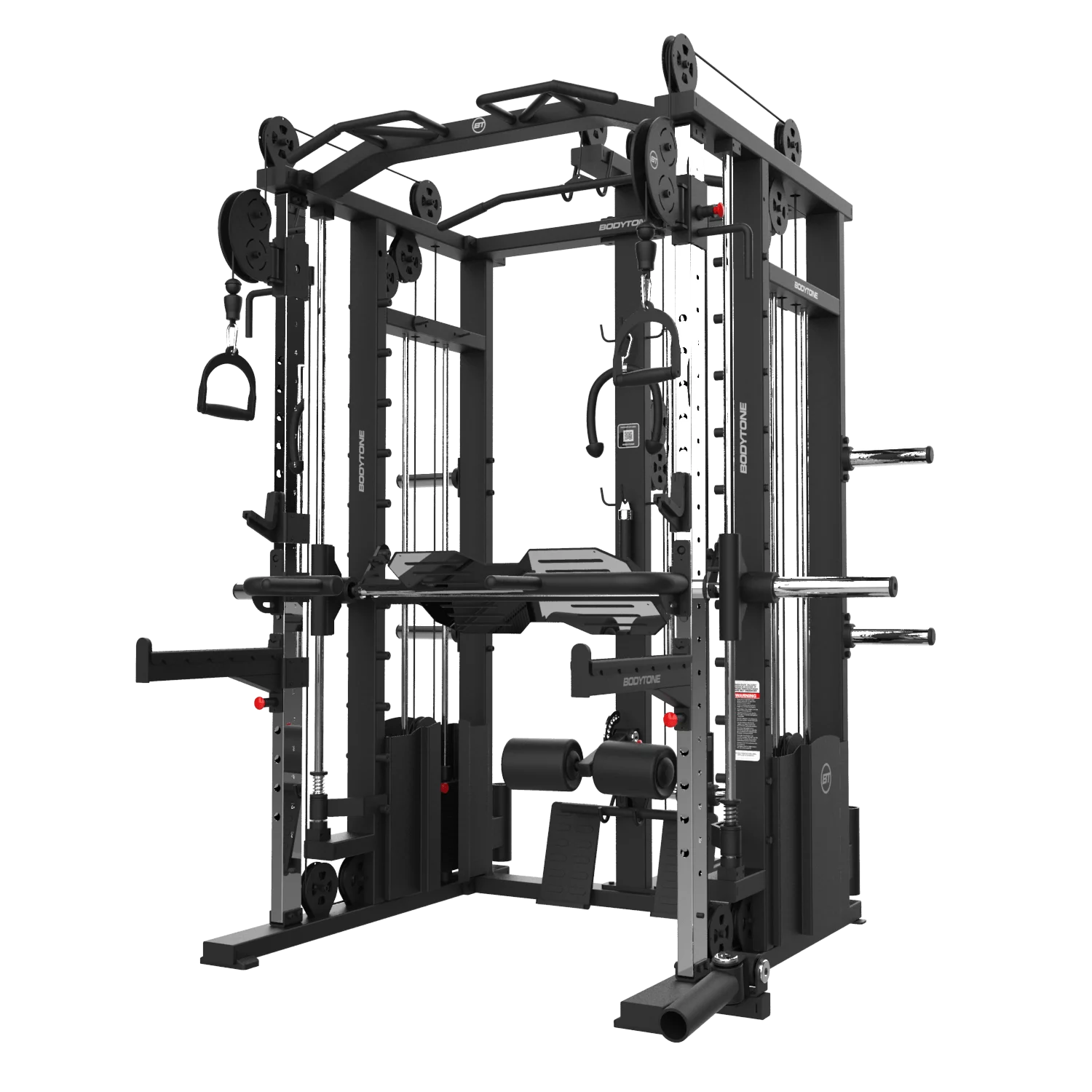
The upright row is one of the most frequently mis-coached exercises on a gym floor. Performed on a guided bar it becomes far easier to teach, far easier to supervise and far safer for members who have never held a barbell – which is exactly why it belongs in the argument for specifying a Smith machine rather than relying on free weights alone.
What the upright row is
The upright row is a compound pulling movement performed standing, in which the bar is drawn vertically along the front of the body towards the chin, elbows leading. On a guided bar the path is fixed, which removes the balance component and lets the user focus entirely on the pull.
Which muscles it works
The upright row is a shoulder and upper-back exercise, not a lat exercise. The primary movers are:
- Deltoids, particularly the lateral and anterior heads;
- Upper trapezius, which drives the shrug component at the top of the pull;
- Biceps and forearms, as secondary contributors through the elbow flexion.
Well programmed, it strengthens the shoulder girdle and the upper back, which supports scapular position and posture, and carries over into pull-ups and overhead pressing.
Correct technique on a guided bar
Grip and setup
- Take a pronated grip – palms facing the body, knuckles forward, thumbs towards each other.
- Hands slightly wider than shoulder width. A very narrow grip increases internal rotation at the shoulder and is the main reason this movement gets a bad reputation.
- Stand upright under the bar, feet hip-width apart, knees soft, ribs down, core braced.
Execution
- Breathe in and pull the bar upward along the body, leading with the elbows rather than the hands.
- Stop when the upper arms reach roughly shoulder height. Pulling higher forces the shoulder into internal rotation at end range and is where most discomfort comes from.
- Lower under control, keeping tension in the deltoids and traps throughout.
Programming
Place the upright row within a shoulder or upper-back session, after the main compound work – overhead press, rows or pull-ups – rather than as the opening movement.
Start with a dynamic warm-up. Three to four sets of eight to twelve repetitions with an appropriate load suits most members, with full rest between sets. Load is secondary here: quality of the pull matters more than the number on the bar.
Variations
| Variation | Effect |
|---|---|
| Wider grip | Less internal rotation at the shoulder, more lateral deltoid emphasis |
| Dumbbells instead of a bar | Each arm finds its own path, usually more comfortable for tight shoulders |
| Cable or low pulley | Constant tension through the full range |
| Reduced range to shoulder height | The default for anyone with a history of shoulder discomfort |
Common mistakes
- Arching or rounding the back – the torso stays upright and braced throughout.
- Pulling too high – stopping at shoulder height keeps the shoulder out of its most compromised position.
- Too narrow a grip – the single most common cause of complaints about this exercise.
- Using momentum – the movement is controlled in both directions, with constant tension in the target muscles.
Why this matters when specifying equipment
A guided bar removes the balance requirement, which is what makes an exercise like this teachable to a beginner in one induction session and supervisable across a busy floor. That is the practical case for a professional Smith machine in a facility with mixed ability levels, alongside the wider strength training machines and a set of adjustable weight benches.
All of it should be specified to EN ISO 20957-1 class S, the class for professional and institutional use.
FAQ
Is the upright row dangerous?
Not inherently. Discomfort is almost always down to a grip that is too narrow or a pull that goes above shoulder height. Widen the grip, cap the range, and most members train it without issue.
Should it replace rows or pull-ups?
No. It is a shoulder and upper-trap movement and complements horizontal rowing and vertical pulling rather than substituting for either.
Free bar or guided bar?
Guided for beginners and unsupervised floors, free for experienced members. Most facilities need both.
Specify your strength area
Light In Fitness has equipped professional facilities since 2013. Send us your floor plan, your member profile and your budget, and we will come back with a specified strength area. Request a quote.