Which Obstacle Course Is Best? Formats and Equipment Compared
Obstacle course racing has stopped being a weekend novelty and has become a permanent training format that gyms, resorts and local authorities are now asked to build for. There is no single best obstacle course. There is the format that matches your users, the surface area you have and the way you intend to operate the site. This guide compares the main formats and sets out what each one demands from professional equipment.
Why the question has no single answer
Ask ten operators what the best obstacle course is and you will get ten answers, because they are not running the same activity. A competitive race needs obstacles that separate a field of trained athletes. A holiday resort needs obstacles that a mixed group can clear on a first attempt and repeat all week. A rehabilitation centre or an armed forces site needs progression and repeatability rather than spectacle. The equipment specification follows from that decision, not the other way round.
Endurance obstacle races
Endurance formats are the ones most people picture first. They combine running with heavy carries, walls, rope climbs and grip obstacles, and they are staged over a wide range of distances, from short sprint courses through to long events aimed at experienced athletes. What they share on the equipment side is load: walls, rigs and carry stations are hit thousands of times in a single day, often in mud and rain. Galvanised or stainless steel structures and generously sized foundations are not a luxury here, they are what keeps the course open for a second season.
Mud runs and participation formats
Participation formats put enjoyment and team spirit ahead of ranking. The obstacles are less technical but no less demanding physically: ramps, hurdles, cargo nets, tunnels and water or mud sections. These are the events that fill a start list with first timers, which changes the design brief completely. Clearances, landing zones and escape routes matter more than difficulty, and every obstacle needs an alternative line so that a participant who cannot clear it stays in the event instead of leaving it.
Ninja Warrior and grip formats
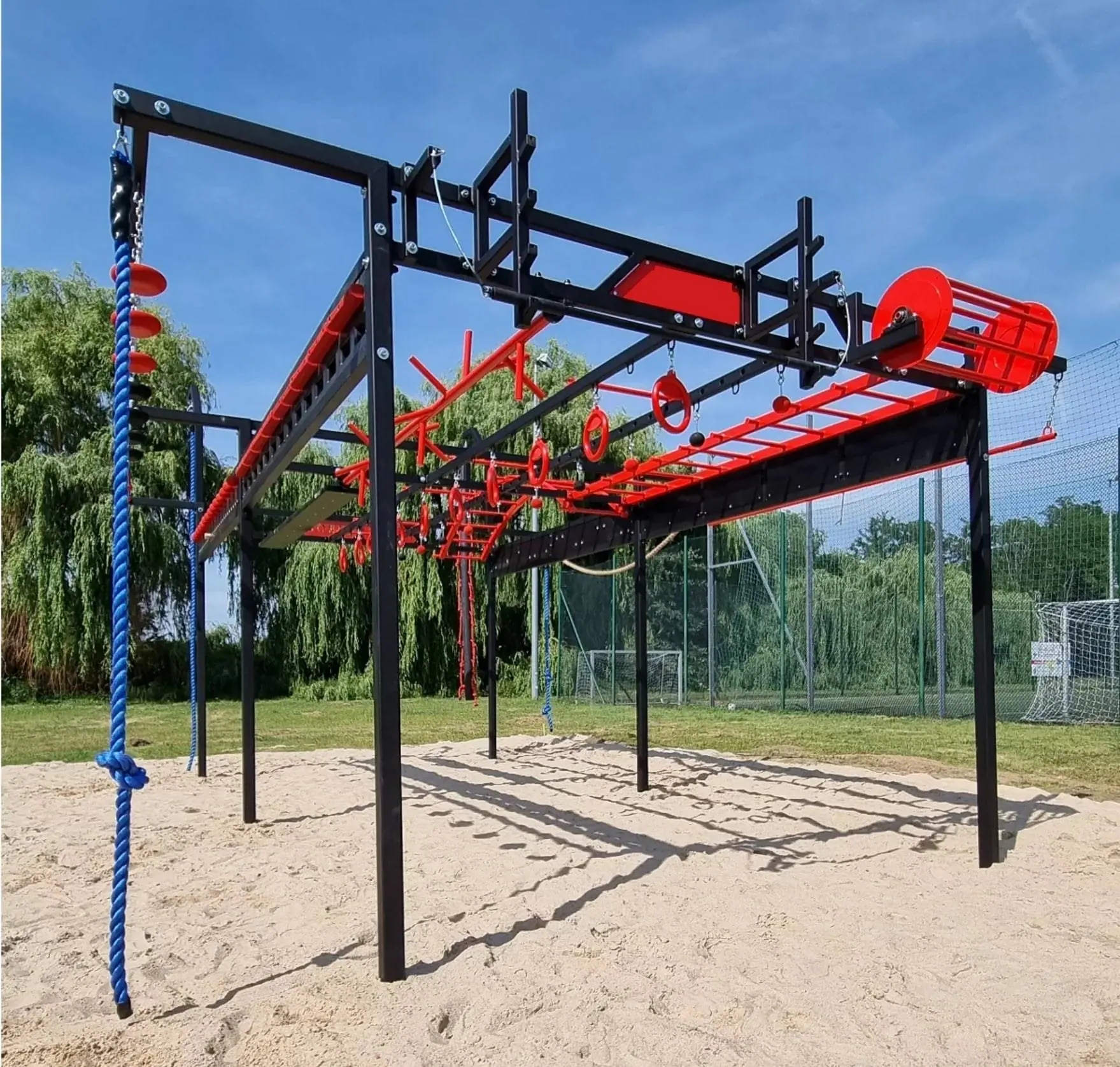
Ninja Warrior style courses have pulled obstacle training indoors and into permanent installations. They are built around grip, suspension and coordination: monkey bars, hanging rings, cliffhanger ledges, a warped wall and a sliding pole for the descent. Because the athlete is off the ground for most of the run, the structure and the impact surfacing underneath it carry the whole safety case. This is also the format that converts best into a fixed installation, since one rig serves coached sessions, private bookings and competitions from the same footprint. Compare the permanent structures on the Ninja Warrior rigs page before you fix a layout.
Natural terrain courses
Trail based courses replace manufactured obstacles with what the site already offers: streams, rocky steps, banks and steep gradients. They cost far less to install and they suit campsites, forest sites and rural municipalities that have land rather than budget. The trade off is control. Natural features change with the weather and cannot be inspected the way a manufactured obstacle can, so most operators end up combining a natural route with a handful of fixed stations at the points where they want a measurable, repeatable effort. That is exactly what the outdoor obstacle modules are designed for.
Indoor obstacle courses
An indoor course takes the weather out of the business plan. It runs all year, it can be sold by the hour and it lets beginners build the grip strength and technique they need before they enter an outdoor event. Indoor equipment sits under a different framework from outdoor structures: fixed training equipment used in a supervised commercial facility is specified to EN ISO 20957-1 class S, the professional class. Class I is a professional class designed for inclusive access, not a step above class S, and anything offered as semi-professional has no place in a facility open to the public.
Getting the standards right
Outdoor obstacle and fitness equipment for adults falls under EN 16630. Equipment intended for children is a different family altogether: EN 1176-1 for the structures and EN 1177 for the impact attenuating surfacing beneath them. The two are never interchangeable, and EN 16630 must never be applied to a children’s obstacle course. Getting this wrong is one of the most common reasons an installation fails its inspection, and it is far cheaper to settle at specification stage than after the foundations have been poured. The full family of courses is grouped on the OCR obstacle courses page.
Frequently asked questions
How much space does a permanent obstacle course need?
It depends on the format and on the free height of fall of each obstacle, which sets the safety zone around it. Send us the plan of the plot and we will return a layout that respects those zones, rather than quoting a surface area that may not apply to your site.
Can one course serve both adults and children?
Only as separate zones. Adult equipment sits under EN 16630 while children’s equipment sits under EN 1176-1 with EN 1177 surfacing, with different dimensions, different gaps and different surfacing requirements. A shared course that tries to satisfy both usually satisfies neither.
Is an indoor rig a substitute for an outdoor course?
It is a complement. An indoor rig delivers grip and upper body work all year and is the right place for progression, while an outdoor course adds running, terrain and volume. Operators who run both tend to use the indoor rig as the training product and the outdoor course as the event product.
Have your course specified
Tell us who will use the course, what surface area you have and whether it is intended for training, for events or for both, and we will come back with a layout, an equipment specification and a budget. Use the request a quote form to get started.